Tag: N

Nofollow-Link erklärt: das rel-Attribut mit den Werten nofollow, sponsored und ugc und seine Wirkung auf Linkkraft und Ranking, taismo SEO-Wiki

nofollow link

What is a nofollow link?

A nofollow link is a hyperlink with the attribute rel="nofollow", which the linking page uses to tell search engines that it does not endorse the target and does not want to be associated with it. Since September 2019, Google has treated nofollow as a hint and decides for itself whether to follow the link or count it for ranking. A link without this attribute is colloquially called a dofollow link.
Nofollow link explained: the rel attribute with the values nofollow, sponsored, and ugc and its effect on link equity and rankings, taismo SEO glossary

Term profile

Attribute Details
Syntax in HTML <a href="…" rel="nofollow">
Introduced January 2005 by Google, Yahoo, and MSN to fight comment spam on blogs
Related values rel="sponsored" for paid links, rel="ugc" for user-generated content (both since September 2019)
Status at Google A hint for ranking since September 10, 2019, and for crawling and indexing since March 1, 2020
Counterpart Dofollow link, a colloquial term without its own HTML attribute
Easily confused with The meta robots tag nofollow, which applies to all links on a page

What does a nofollow link look like in HTML?

A nofollow link carries the attribute rel with the value nofollow in the a element. To visitors the link looks like any other, and the marking only appears in the source code:

<!-- link without endorsement -->
<a href="https://example.com/" rel="nofollow">Example page</a>

<!-- paid link, for example in an advertorial -->
<a href="https://shop.example.com/" rel="sponsored">Visit the store</a>

<!-- link from a comment, multiple values are allowed -->
<a href="https://blog.example.com/" rel="ugc nofollow">my blog</a>

Google allows multiple values in the same attribute, separated by spaces or commas. Values like noopener and noreferrer often appear alongside them. They concern security and the passing of the referrer in the browser and have no influence on ranking.

The meta robots tag <meta name="robots" content="nofollow"> or the HTTP header X-Robots-Tag with the same value works page-wide. Both apply to every link on the page.

What is the difference between nofollow, sponsored, and ugc?

The three values nofollow, sponsored, and ugc describe different reasons why a page does not endorse a link. Google treats all three as hints, and for link equity sponsored and ugc count the same as nofollow.

Value Use according to Google Typical examples
sponsored Ads and paid placements Advertorials, affiliate links, paid mentions
ugc Links from user-generated content Comments, forum posts, reviews
nofollow when the other values don’t apply and the page does not want to be associated with the target Links to sources you cannot verify

What counts as user-generated content is decided by the platform operator. Many networks, forums, and wikis add one of these values to outbound links by default.

Decision aid for choosing the right rel attribute for an outbound linkThree questions from left to right. First: Is the link paid or exchanged? If yes, rel equals sponsored. Second: Did a user set the link, for example in a comment? If yes, rel equals ugc. Third: Do you vouch for the target? If no, rel equals nofollow. If yes, the link stays without an attribute and passes link equity as a regular link.Which rel attribute does your outbound link need?Is the link paidor exchanged?Did a userset the link?Do you vouchfor the target?nonoyesregular linkno attribute,passes link equityyesyesnorel=”sponsored”ads, affiliate, partnershipsrel=”ugc”comments, forums, reviewsrel=”nofollow”unverified sourcesGoogle treats all three values as hints. For link equity they work the same.Fig. 1 · taismo
Fig. 1: Decision aid for outbound links: Three questions lead to sponsored, ugc, nofollow, or a regular link without an attribute.

How do nofollow links affect rankings?

A nofollow link usually passes no link equity to the target, but it remains a hint that Google may still evaluate. Until 2019, Google said it did not use such links for ranking. Since the switch to the hint model, Google can take individual nofollow links into account, for example to detect spam more reliably. Google does not disclose when that happens.

For search engine optimization, nofollow links have 3 indirect effects:

  • Visitors: A nofollow link from a widely read article brings real readers, regardless of the attribute.
  • Mentions: The linked name still appears in the text. Such brand mentions connect a brand with a topic, for search engines and for AI systems.
  • Discovery: Other authors find the page through the link and later link to it themselves, often without nofollow.

Almost every naturally grown link profile contains nofollow links, because large platforms such as Wikipedia, social networks, and forums mark outbound links this way by default. How a backlink works therefore always depends on the attribute and on the linking page. The entry on link juice explains more about how link equity is passed on.

When should you mark links as nofollow?

You mark a link as nofollow, sponsored, or ugc when it is paid, comes from users, or points to a source you don’t want to vouch for. The marking is appropriate in 4 cases:

  1. Paid links: Google’s spam policies require sponsored or nofollow for bought or exchanged links. An unmarked paid link counts as link spam and is one of the methods of black hat SEO.
  2. Affiliate links: Commission links count as paid placements and carry sponsored.
  3. Comments and forums: Links that visitors set themselves carry ugc. This removes the incentive for spammers.
  4. Unverified sources: A link to a page whose quality you cannot assess carries nofollow.

An internal link, on the other hand, stays without an attribute. Nofollow on internal links interrupts the flow of link equity within your own website, and Google treats it as only a hint there as well. If you want to manage your crawl budget, use other tools: For areas Google should not crawl, Google recommends the robots.txt, and for pages that should stay out of the index, the noindex attribute.

How do you check whether a link is nofollow?

Whether a link is nofollow is shown in the source code of the linking page, in the link’s rel attribute. The check works in 3 steps:

  1. Read the attribute: Right-click in the browser, choose “Inspect”, and check whether the rel attribute of the a element contains nofollow, sponsored, or ugc.
  2. Check page-wide settings: Search the source code for meta name="robots" and the HTTP response headers for the X-Robots-Tag. A page-wide nofollow overrides every individual link.
  3. Look at the actual listing page: A portal’s documentation often describes a different state than the page it actually serves. The only reliable check is to fetch the specific page your link is on.

How important the third step is, taismo measured in September 2026 across several directories and platforms. A design directory with a very strong domain marks all directory links as nofollow. A large product platform marks links with ugc, and the links in the README files of GitHub repositories carry nofollow. Smaller specialist directories, of all places, delivered usable regular links. A link without the value nofollow is therefore only a regular link once ugc and sponsored are missing as well.

Nofollow links are worth it for link building when they bring reach, mentions, or trust, and they are evaluated on exactly those terms. A specialist article on a widely read portal with a nofollow link can bring more inquiries than a regular link from an unknown directory. It gets expensive when a nofollow link is sold and paid for as a backlink.

For off-page optimization, this means: Every link source is measured on the specific listing page, by its rel attribute and by the strength of that exact page. How ongoing SEO services select and evaluate link sources depends on this distinction.

Frequently asked questions about nofollow links

Is there a dofollow attribute?
No. Dofollow is a colloquial term for a link without nofollow, sponsored, or ugc. An attribute rel="dofollow" does not exist in the HTML standard and is ignored by search engines.

Can too many nofollow links hurt my website?
No. Incoming nofollow links do not hurt a website. They are part of every naturally grown link profile, because many large platforms mark outbound links this way.

Does Google still follow a nofollow link?
Google generally does not follow such links, but since March 2020 it has also treated nofollow as a hint for crawling. The linked page can also be found and indexed through sitemaps or other links.

Are links on social networks nofollow?
Most social networks mark links in posts and profiles as nofollow or ugc. Their value lies in reach and visitors.
Natural Language Processing erklärt: Wie Computer, Suchmaschinen und Sprachmodelle menschliche Sprache verarbeiten, taismo SEO-Wiki

natural language processing

What is natural language processing?

Natural language processing (NLP) is a field of computer science and artificial intelligence that teaches computers to process, understand, and generate human language in written and spoken form. Natural language processing combines insights from linguistics with statistics and machine learning. Search engines, translation services, voice assistants, and large language models such as ChatGPT are all built on natural language processing.

Natural language processing explained: how computers, search engines, and language models process human language, taismo SEO glossary

Term profile

Attribute Details
Part of speech Noun, technical term
Abbreviation NLP
Pronunciation ˈnætʃərəl ˈlæŋɡwɪdʒ ˈprɑːsɛsɪŋ
Subfields Natural language understanding (NLU), natural language generation (NLG)
Related terms Computational linguistics, large language model, embedding, named entity recognition, semantic search
Other meaning In psychology, NLP stands for neuro-linguistic programming, a communication model with no connection to computer science

How does natural language processing work?

Natural language processing breaks language down into units a computer can calculate with and then puts them back together into a meaning. Classic NLP systems work through a chain of subtasks to do this. Modern language models learn many of these steps together, but the chain still explains what happens in terms of content.

  1. Tokenization: The system splits a sentence into tokens, meaning words, parts of words, and punctuation marks. “Where can I buy bread in Munich?” becomes eight units.
  2. Parts of speech and sentence structure: Part-of-speech tagging determines the word class of each token. Dependency parsing identifies which word depends on which, for example that “bread” is the object of “buy”.
  3. Entity recognition: Named entity recognition marks the names of places, people, companies, and products. “Munich” is recognized as a place and linked to the known thing called Munich.
  4. Meaning in context: The system resolves ambiguous words through their surroundings. “Bank” means something different next to “account” than next to “river”. Technically this usually relies on an embedding that represents words and sentences as vectors of numbers.
  5. Performing the task: On this basis the system carries out the actual task, such as recognizing an intent, translating a text, rating a sentiment, or writing an answer.

In the example sentence, this chain leads to a clear reading: The user is looking for a place in Munich where they can buy bread, in other words a bakery nearby. In search, this translation of words into an intention is called search intent.

How natural language processing turns a sentence into an intentThe example sentence Where can I buy bread in Munich goes through five steps: tokenization into eight tokens, sentence structure with bread as the object of buy, entity recognition with Munich as a place, context with the reading buying locally rather than a recipe, and finally the recognized intent bakery nearby. The last step is highlighted in orange. A note below explains that modern language models handle these steps in a single model.From sentence to intent“Where can I buy bread in Munich?”1 Tokenization8 tokens:Where · can · I …2 Structure“bread” is the objectof “buy”3 Entities“Munich”= place, entity4 Contextbuying locally,not a recipe5 IntentbakerynearbyModern language models handle these steps in one model.The result stays the same: a recognized search intent.Fig. 1 · taismo
Fig. 1: How natural language processing turns a sentence into an intent, in five steps from tokens to search intent.

Which tasks does natural language processing handle?

Natural language processing covers 6 major task areas that are combined in almost every application.

  • Text classification: A system assigns texts to categories, for example spam or not spam, topic A or topic B.
  • Sentiment analysis: Sentiment analysis evaluates whether a statement is meant positively, negatively, or neutrally. Companies use it to analyze reviews and support requests.
  • Information extraction: The system pulls facts out of running text, such as names, dates, prices, and the relationships between them.
  • Machine translation: Services such as DeepL and Google Translate transfer texts between languages.
  • Question answering: The system finds the passage that matches a question or writes the answer itself.
  • Text generation: Language models write summaries, emails, code, and entire articles.

Many of these tasks run unnoticed in everyday life. Examples are autocorrect on your smartphone, the spam filter in your inbox, video subtitles, and the suggestions in the search box.

How has natural language processing developed?

Natural language processing has developed in 4 phases, from fixed rules through statistics and neural networks to today’s transformer models.

Phase Period Characteristics and milestones
Rule-based 1950s to 1980s Linguists write grammar rules by hand. In 1954 the Georgetown-IBM experiment translates around 60 Russian sentences into English, and in 1966 Joseph Weizenbaum’s program ELIZA simulates a conversation.
Statistical from the late 1980s Systems learn probabilities from large collections of text instead of rules. Statistical machine translation shapes the 2000s.
Neural 2010s Neural networks learn word meanings as vectors. In 2013 Google’s Word2Vec shows that meaning can be represented in numbers.
Transformer since 2017 Google researchers introduce the transformer architecture in 2017. Google BERT (2018) and OpenAI’s GPT models build on it, and ChatGPT launches in November 2022.

The leap of the last phase lies in context. For every word, a transformer weighs which other words in the sentence matter for its meaning. This gave rise to today’s large language models, which no longer run natural language processing as individual steps but as one single large model.

What is the difference between NLP, NLU, and NLG?

NLP is the umbrella term, and NLU and NLG are its two directions. Natural language understanding (NLU) describes the path from language to meaning: A system understands what a sentence means. Natural language generation (NLG) describes the opposite path from meaning to language: A system writes a text itself.

Term Direction Example
Natural language processing (NLP) Umbrella term for any machine processing of language Search engine, translator, chatbot
Natural language understanding (NLU) Language to meaning A search engine recognizes the intent behind a query
Natural language generation (NLG) Meaning to language An AI system writes an answer from several sources

Computational linguistics is the scientific discipline behind it. It studies language with the methods of computer science, while natural language processing tends to describe the practical application.

How does Google use natural language processing?

Google has been using natural language processing for more than ten years to match search queries and web pages by meaning instead of by individual words. The development happened in stages, each one a separate system:

  • Hummingbird (2013): The update put the meaning of the whole query at the center instead of weighing every word on its own.
  • RankBrain (2015): RankBrain was the first deep learning system in Google Search and helped above all with queries Google had never seen before.
  • Google BERT (2019): BERT reads a word in the context of the words before and after it and thereby understands small words such as “for” or “without” that change the meaning of a query.
  • MUM (2021): The Multitask Unified Model processes text and images and transfers knowledge between languages.
  • Gemini (since 2023): Models from the Gemini family now write the answers in AI Overviews and in AI Mode in Google Search.

Together, these systems form the basis of semantic search. The Natural Language API in Google Cloud offers a glimpse of how Google reads texts by machine. For every text it shows the recognized entities, a weighting called salience between 0 and 1, and the sentiment of the text. The API is a separate product and not a window into ranking, but it is a good way to check whether a text makes its main topic clear to a machine.

What does natural language processing mean for SEO and AI visibility?

Natural language processing rewards texts that cover a topic clearly, unambiguously, and in natural language. Repeated keywords give a language model no additional information and tend to disrupt the flow of reading. The way NLP works leads to 5 rules for content:

  1. Name entities unambiguously: Companies, products, places, and people should always have the same name. The more clearly an entity is described, the more reliably a system links it to its knowledge, for example to the Knowledge Graph.
  2. Context instead of repetition: A text about bread shows its depth through terms such as sourdough, flour type, and baking time, not by repeating “buy bread” ten times.
  3. Answer questions directly: If the answer is in the first sentence of a section, a system recognizes it as the answer and can extract it.
  4. Keep sections self-contained: AI systems break pages into chunks of text and evaluate each chunk on its own. A section that makes sense without the rest of the page is more likely to be used. The guide on getting cited by AI shows what this looks like in detail.
  5. Mark up meaning as well: Structured data tells a machine directly what a text describes and saves it the guesswork.

For AI visibility this counts twice. Large language models are themselves applied natural language processing: They learn from training data which brand stands for what, and they read web pages by the same rules when they fetch them live. Our page on answer engine optimization (AEO, also known as GEO) and AI visibility shows how content can be prepared specifically for these systems.

A common misconception is so-called NLP keywords. Some tools list terms that frequently appear together in well-ranking texts and sell them under this name. There is no official list of such terms from Google. The lists help you find subtopics, but they are not a requirement that a text has to work through.

Frequently asked questions about natural language processing

Is natural language processing the same as artificial intelligence?
No. Natural language processing is a field of artificial intelligence that deals specifically with language. Other fields of AI deal with images, robotics, or planning, for example.

Is ChatGPT an example of natural language processing?
Yes. ChatGPT is based on a large language model and combines both directions of natural language processing: It understands the input (NLU) and writes an answer (NLG).

What does natural language processing have to do with neuro-linguistic programming?
Nothing apart from the abbreviation. Neuro-linguistic programming is a communication and coaching model from 1970s psychology. Natural language processing is a field of computer science.

NAP

What is NAP?

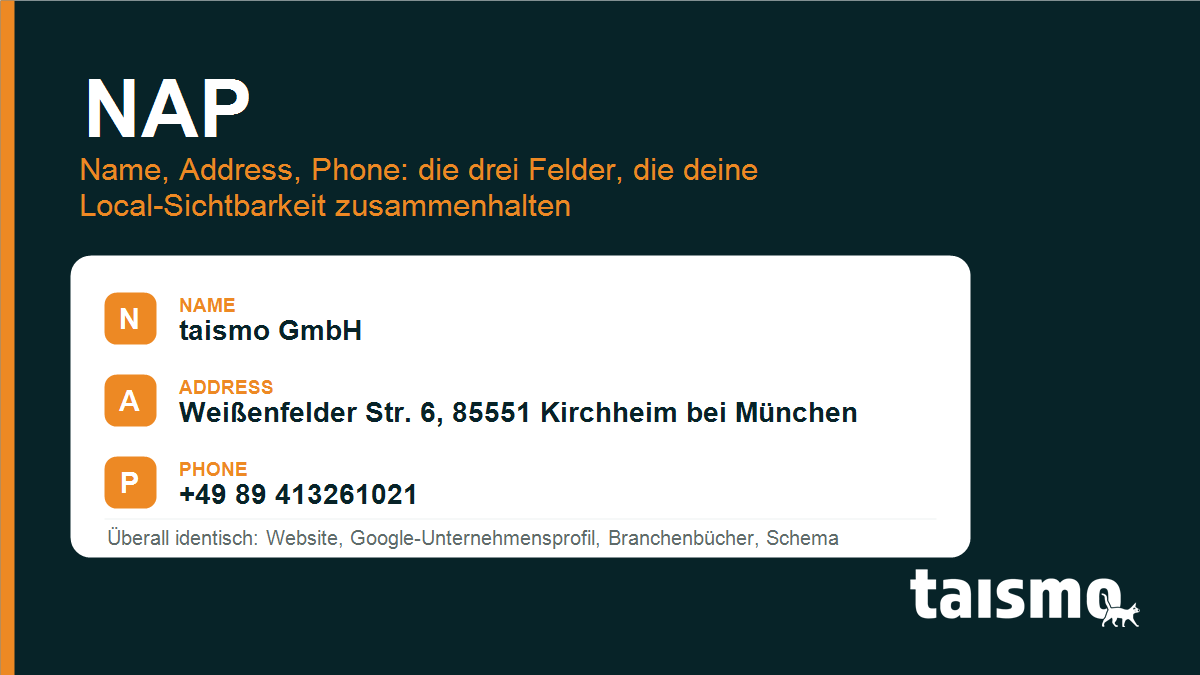
NAP stands for name, address, phone and refers to the three core details of a business: the company name, the street address and the phone number. In local SEO, NAP stands for the principle that these three details appear word for word identically on every channel, so on your own website, in your Google Business Profile, in directories and in structured markup. That is how search engines recognize that all mentions belong to the same business. Because AI systems also take contact details from such sources instead of verifying them live, one uniform data set additionally affects whether language models return the right location and the right phone number.

NAP explained: name, address and phone on a company card, identical on the website, the Google Business Profile, directories and schema markup

The term at a glance

Property Detail
Word type abbreviation, used as a noun: the NAP
Pronunciation usually spelled out as N, A, P, in English also spoken as one word
Long form Name, Address, Phone
Also called NAP data or location data
Field local SEO, entity building, offpage work
Related terms citation (a business mention), Google Business Profile, entity, knowledge graph

What do name, address and phone stand for?

NAP consists of exactly three fields, and each one has a rule of its own:

  1. Name: the company name as it is really used, including the legal form if that form is part of the name. Additions such as a city or a service do not belong in it. “Musterbau GmbH” is the name, “Musterbau GmbH roofer Munich cheap” is keyword stuffing and breaks the guidelines for the Google Business Profile.
  2. Address: the complete street address in one fixed spelling. What matters is not whether you write “St.” or “Street”, but that you use the same variant everywhere.
  3. Phone: one phone number in a single format. A number with a local area code proves the tie to the location better than a toll free number does.

These three fields are not phrased anew for each channel, they are copied from one source. That is exactly what makes NAP an organizational task and not a writing task.

The three NAP fields and their channelsName, address and phone form one data set that goes out unchanged to four channels: your own website with imprint and contact page, the Google Business Profile, directories and review platforms, and the structured LocalBusiness markup of the website.ONE DATA SETNNameAAddressPPhoneWebsite: imprint and contactGoogle Business ProfileDirectories and portalsLocalBusiness markupOneentityFig. 1 · taismo
Fig. 1: One NAP data set feeds every channel and produces a single recognizable entity there.

Why does NAP consistency matter for local SEO?

NAP consistency matters because search engines have to assemble a picture of a business out of many separate mentions across the web. Every mention in a directory, on a review platform or in a press article is one data point. If the data points agree, a clearly outlined entity emerges from them, and that entity can be anchored in the knowledge graph.

If the details differ, Google has to decide which variant is correct. That uncertainty works in three directions: the match to the location gets weaker, trust in the data drops, and in the worst case duplicates appear, meaning several profiles for one and the same business. For local search that gets expensive, because only a few results compete for visibility in the map area.

Consistent data is not a ranking factor you can turn up on its own. It is the precondition for every other local signal, such as Google reviews or local landing pages, to pay into the same account at all.

Why does NAP data matter for AI systems?

NAP data matters for AI systems because language models such as ChatGPT, Perplexity or Google AI Overviews do not verify contact details live. The answer comes out of training data and out of sources the system fetches for the query. A model does not call the business to check, it repeats what its sources give it.

The consequence: the clearer and more uniform the facts are across the web, the more likely a system returns the correct address and phone number. If the sources contradict each other, the chance rises that an outdated or wrong detail shows up. How strongly individual AI systems weigh this cannot be measured from the outside and differs by provider. Only the direction is certain: consistent data helps, contradictory data hurts.

Two building blocks work especially well here, because they are machine readable and need no interpretation. The LocalBusiness markup of the website makes the name, address and phone number directly readable, and an llms.txt can serve the same location data as a curated briefing for AI crawlers. Neither replaces the work on your directory entries, both reinforce it. How AI systems pick and cite sources is covered by the term Generative Engine Optimization, the role of solid fact pages by the term Grounding Page. NAP consistency is the foundation of any optimization for AI visibility.

How do NAP inconsistencies happen?

NAP inconsistencies almost never happen on purpose, they build up over time. These are the six most common causes:

  • A move or a change of company name: your own website gets updated, old directory entries stay as they are.
  • Data aggregators: many portals buy in data sets and thereby multiply one outdated state.
  • Automatically generated entries: some directories create profiles without the business doing anything.
  • Keyword additions in the name: anyone who pads the company name with services ends up with a different spelling per channel.
  • Phone variants: switchboard, direct dial, mobile and service numbers land in different profiles without coordination.
  • Several people: when marketing, sales and external providers all maintain entries independently, the data drifts apart.
Consistent versus contradictory NAP dataAt the top, three entries carry identical details that Google merges into one strong entity. At the bottom, the company name, the address spelling and the phone number differ, so the match becomes uncertain and trust in the location drops.Consistenttaismo GmbHWeißenfelder Str. 6taismo GmbHWeißenfelder Str. 6taismo GmbHWeißenfelder Str. 6strongContradictorytaismo GmbHWeißenfelder Str. 6taismo SEO AgencyWeissenfelder Strasse 6ataismo Online Marketing089 4132610-21unclear?Fig. 2 · taismo
Fig. 2: Identical details produce a strong entity, differing details create uncertainty about the match.

NAP, NAP+W or NAPU: which variants exist?

Besides NAP, two extended spellings are common that stretch the same basic idea to a fourth field:

  • NAP+W or NAPW adds the website. That makes sense, because the linked URL also decides which web presence a directory entry gets assigned to.
  • NAPU means the same thing, but uses URL instead of website as the fourth letter.

A binding standard exists only for the three core fields. Everything beyond that, such as opening hours, categories or description texts, gets abbreviated differently from agency to agency. For practical work the abbreviation is secondary: what counts is that every field that goes out has one fixed version. Anyone who maintains the URL as well should make sure it matches the canonical address exactly, so the same protocol and the same spelling with or without a trailing slash.

How do you check your NAP consistency?

The check follows five steps that work without any special tool:

  1. Fix the reference: define the three fields once as binding and keep them in a file that everybody copies from.
  2. Match the business profile: the Google Business Profile is the single most important entry. It has to match the reference and the imprint.
  3. Search for the number: search for the phone number and the street in quotation marks. That is how you find mentions you never created yourself.
  4. Work through the directories: go through the relevant portals once completely and correct the entries that differ instead of creating new ones.
  5. Cross check the markup: finally, compare the structured markup of the website with the reference.

How big this alignment turns out depends on the age of the business. Companies that have moved once or changed their legal form regularly find double digit numbers of differing entries. If you would rather not run that alignment yourself, it belongs to ongoing local SEO management.

How do NAP, the business profile and schema fit together?

NAP data works twice over: once visibly for people and once machine readable for search engines and AI systems. The machine readable part runs through structured data in the JSON-LD format. There, a LocalBusiness object holds the fields name, address and telephone, plus geo coordinates, opening hours and, with sameAs, a pointer to the Google Business Profile.

That closes the circle: the markup confirms what the imprint says, the business profile confirms both, and the directory entries back up the same statement from the outside. If the markup contradicts the visible details, it is not an advantage but one more piece of noise.

How does NAP work with multiple locations?

With several locations, NAP applies per location, not per company. Every location needs its own data set with its own address, its own Google Business Profile and ideally its own location page on the website. In the markup, every location becomes its own LocalBusiness object that points to the parent company through parentOrganization.

Two things go wrong here often. First, reviews of the main location get carried over to the branches, although reviews belong to the entity that earned them. Second, cities without a real location get an address of their own, purely to rank locally. Both are risky: the first breaks the guidelines for review markup, the second breaks the requirement that a profile has to represent a real location you can actually visit. If you have no location in a city, you work with a service area there, not with an address.

Frequently asked questions about NAP

Is “St.” instead of “Street” a problem?
No, as long as you settle on one variant and use it everywhere. Search engines normalize common abbreviations. It only becomes risky when the house number, an addition or the postal code differ as well.

Does the phone number need a local area code?
It is not mandatory, but it is worth doing. A number with a local area code supports the tie to the location, while central service numbers are identical for every location and therefore say nothing about the place.

What is a citation?
A citation is a mention of your business with its NAP data on a third party website, for example in a directory. A citation does not need a link to have an effect: the matching mention alone is evidence.

Do AI systems pass on wrong contact details?
That can happen. Language models do not verify addresses and phone numbers live, they repeat what their sources give them. If an outdated number sits in many directories, it can turn up in AI answers even though your own website was corrected long ago. That is why maintaining directories also pays into AI visibility.

What happens after a move?
After a move the address and often the phone number change, so two of the three fields. The order matters: first switch the imprint, the website and the markup, then the business profile, then the directories. A temporary drop in rankings is normal, it only becomes permanent if old entries stay in place.

noindex attribute

What is the noindex attribute?

The noindex attribute is a value placed in a meta tag inside the head area of an HTML page. It instructs search engine crawlers not to take the page into their index, which means it does not show up in the search results. That is useful when you want to keep certain pages away from search engines, for example archive pages, print versions of pages or temporary pages.

noindex attribute explained: a meta robots value in the head of an HTML page that keeps it out of the search results

What does the nofollow attribute mean?

The nofollow attribute is a different value, and it is used specifically for links. When you add it to a link, it tells search engine bots not to follow that link and not to pass any PageRank or link juice to the linked page. That matters in particular when links point to unreliable websites, or to pages the site owner does not want to give a “recommendation” to, advertising links being the typical case.

How do I set the attributes in HTML?

To set the noindex attribute, add the following meta tag to the head area of your HTML page:

<meta name="robots" content="noindex">

For the nofollow attribute, the value is added straight to the link tag:

<a href="http://example.com" rel="nofollow">Link text</a>

You can also use both attributes at the same time, by adding the value nofollow to the content attribute of the meta tag, or by giving both values in the rel attribute of a link.

What effects do the attributes have on SEO?

Using noindex and nofollow can have a considerable effect on search engine optimization (SEO). The noindex attribute keeps a page out of the search results, which can make sense to avoid duplicate content or to hide pages that are not relevant. The nofollow attribute, on the other hand, works on link authority: it stops link juice from being passed on, which carries weight with paid links or user generated content, where it helps you avoid a penalty from search engines. It is worth remembering that the same mechanism decides how much authority a backlink can pass to you.

Should you use both attributes at once?

Using noindex and nofollow together is possible and can make sense in certain situations. If a page should not be indexed and the links on it should not be followed by search engines either, then combining both attributes is the way to go. Do it deliberately, though, because it can cost you visibility and link authority. Check carefully whether you really need the attributes and what they will do before you decide to use them. Which of your pages belong in the index and which do not is one of the questions we work through in an SEO audit.

Nginx web server

What is the Nginx web server?

Nginx (pronounced “Engine-X”) is a popular open-source web server software that can also act as a reverse proxy, HTTP cache and load balancer. It was originally developed by Igor Sysoev and first released in 2004, with the goal of offering an optimized answer to high numbers of concurrent connections.

Nginx web server explained: open-source web server, reverse proxy, HTTP cache and load balancer

Nginx is known for its high performance, stability, simple configuration and low resource usage. It handles thousands of simultaneous connections, which makes it an excellent choice for websites and applications under heavy load. Nginx runs on several operating systems, including Linux, Windows and macOS. Thanks to its modular build and the option to add extensions and third-party modules, Nginx is highly adaptable and can be configured for a wide range of web applications and services.

What are the benefits of Nginx for SEO?

Search engine optimization (SEO) is influenced strongly by the web server you choose. Nginx offers several benefits in that respect:

  • Short loading times: Nginx is known for its fast performance, which leads to shorter loading times. Short loading times are an important factor for a good user experience and for a higher position in search, and they are what PageSpeed measures.

  • Security: Nginx offers robust security functions, including support for SSL/TLS for secure data transfers. Search engines prefer a secure website, which can lead to a better position.

  • High availability: because it can act as a load balancer, Nginx distributes traffic across several servers and improves the availability and reliability of a website. High availability is decisive for visitor satisfaction and for SEO performance.

  • Adaptability: the option to adapt the server configuration and to build SEO-friendly URL structures is another benefit of Nginx. Integrating third-party modules can improve SEO performance as well.

What alternatives are there to Nginx?

  1. Apache HTTP Server: this widely used open-source web server is known for its modularity and its reliability.

  2. Microsoft Internet Information Services (IIS): this web server is built into the Windows Server environment and integrates closely with other Microsoft technologies.

  3. LiteSpeed Web Server: a commercial web server known for its speed and its performance.

  4. OpenLiteSpeed: the open-source variant of LiteSpeed, known for being easy to use and fast.

  5. Caddy: a modern web server that stands out for its simple configuration and automation.

  6. Apache Tomcat: although it is primarily a servlet container for Java-based web applications, Tomcat can also be used as a web server.

  7. Node.js (with Express.js or other frameworks): Node.js is a runtime environment for JavaScript and can act as a web server in combination with frameworks such as Express.js.

  8. Jetty: a web server and servlet container that also suits Java-based web applications.

  9. Cherokee: a lightweight, fast and fully configurable open-source web server.

  10. Hiawatha: an advanced, security-minded open-source web server that focuses on security, simplicity and efficiency.

Does Nginx work with WordPress?

Yes, Nginx is fully compatible with WordPress, and many WordPress websites are hosted on Nginx servers. Setting WordPress up on Nginx can be a little more technical than on other web servers such as Apache, above all when permalinks and other special configurations come into play. There are, however, plenty of guides and resources online that walk administrators through the process. Once it is configured correctly, Nginx delivers high performance and security for WordPress websites, which in turn improves SEO and the user experience.

The combination of Nginx and WordPress is a robust answer for anyone looking for scalable and fast hosting, and it is the setup behind many of our web development projects. If you want to know what your current server costs you in loading time, an SEO audit measures it.

negative SEO

What is negative SEO?

Negative SEO is a deliberate attack on someone else’s website with the goal of making its rankings worse. While black hat SEO measures are meant to give your own site an unfair competitive advantage, negative SEO targets the rankings of the competition. It is a targeted attack on other web presences and it quickly moves beyond the boundaries of what is legally allowed.

Negative SEO explained: targeted attacks on a competitor's rankings through hacking, bad backlinks, duplicate content and fake reviews

Which methods are used in negative SEO?

  • Hacking
  • Bad neighborhood
  • Google bombing
  • Duplicate content
  • Fake comments and reviews

How can you protect yourself against negative SEO?

Here are a few tips for protecting yourself against negative SEO measures:

  • Turn on the notifications in Google Search Console so that you notice anything unusual quickly.
  • Set up automated reporting so that you can react quickly.
  • Keep an eye on the backlinks pointing to your site in Search Console.
  • Check metrics such as the MOZ Spam Score regularly. If the value climbs sharply, review your backlinks in Search Console.
  • Have backlinks from dubious sites removed. If that is not possible, use Google’s Disavow tool to block those backlinks.
  • Check your site for duplicate content regularly.
  • Check your Google reviews for dubious comments or fake ratings meant to damage your reputation.

Sudden shifts in your backlink profile are one of the standard checkpoints in an SEO audit, which is where an attack usually becomes visible first.

Want to know more about protecting yourself against negative SEO? Our podcast episode on the topic goes into it, and you will find more terms on the subject in the SEO glossary.

Get insider knowledge first!
taismo Logo

© taismo GmbH

Address


Weißenfelder Str. 6
85551 Kirchheim near Munich, Germany