


What is search intent?
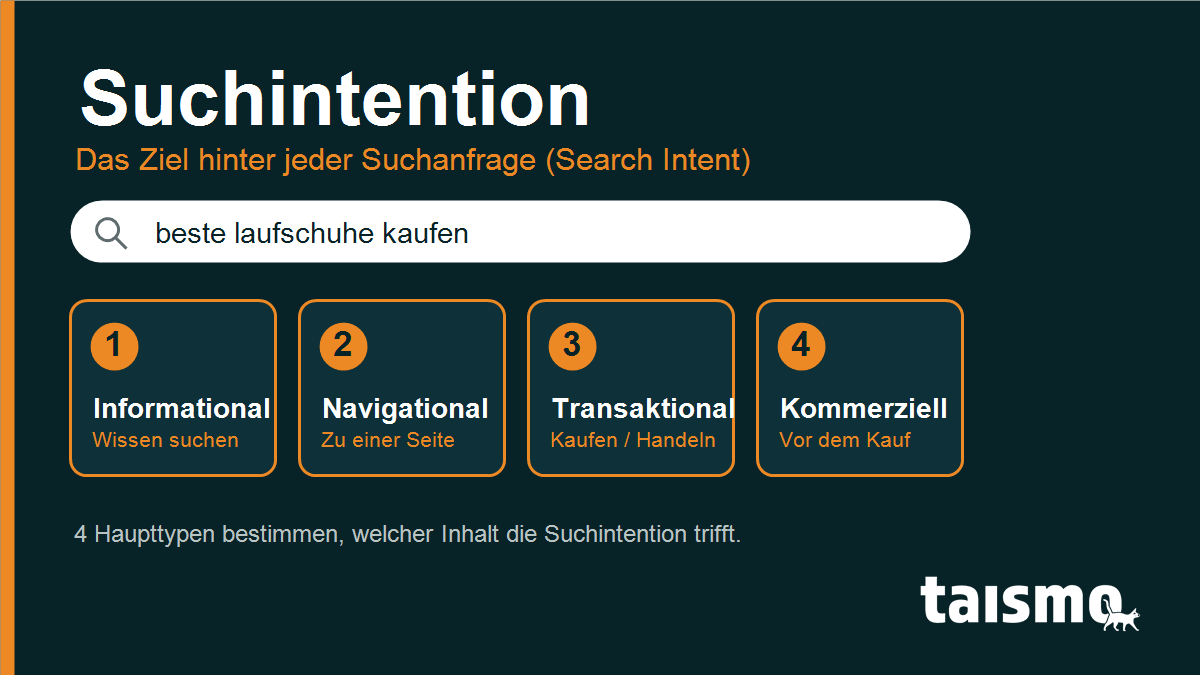
Search intent is the goal a person pursues with a search query. Search intent describes why somebody types a particular keyword into Google and what kind of answer they expect. There are four main types of search intent: informational, navigational, transactional and commercial. Match the search intent behind a keyword and you deliver exactly what the searcher was after, which Google rewards with better positions.
Search intent is the foundation of modern SEO. Google no longer wants to find the keyword on a page, it wants to serve the need behind it. Hence the principle: intent before keyword. A page can carry a keyword a hundred times and still fail to rank if it misses what the searcher wanted.
The term at a glance
| Attribute | Detail |
|---|---|
| Part of speech | noun (the search intent) |
| Pronunciation | surch in-TENT |
| Hyphenation | search in·tent |
| Also known as | user intent, keyword intent, search goal |
| 4 main types | informational, navigational, transactional, commercial |
Which four types of search intent are there?
There are four types of search intent: informational, navigational, transactional and commercial. Each one stands for a different goal on the searcher’s side and calls for a different kind of content.
- Informational (looking for knowledge): the person wants information or an answer. Typical queries: “what is search intent”, “how does seo work”, “clean running shoes”. Matching content: guides, tutorials, definitions and glossary articles.
- Navigational (heading for one page): the person wants to reach a specific website or brand. Typical queries: “taismo seo magazine”, “paypal login”, “instagram”. Matching content: the brand, home or login page itself.
- Commercial (researching before a purchase): the person compares before deciding. Typical queries: “best running shoes review”, “seo agency comparison”, “iphone vs samsung”. Matching content: comparisons, reviews, best-of lists and first-hand reports.
- Transactional (taking action): the person wants to complete an action, usually a purchase or a booking. Typical queries: “buy running shoes”, “book seo services”, “reserve hotel munich”. Matching content: product, service and checkout pages.
Commercial intent is also called commercial investigation and sits between pure information gathering and the final purchase. That phase often decides who the person ends up buying from.
How do you identify search intent (SERP analysis)?
The most reliable way to identify search intent is to look at the current search results page (SERP analysis). Over billions of clicks Google has already learned which intent dominates for a given keyword, and it shows exactly the result types that serve that intent. The current SERP is therefore the most honest source on search intent you have.
Three signals give the search intent away:
- The result types: if shops rank at the top, the query is transactional. If guides and Wikipedia rank, it is informational. If comparison articles and “best of” lists rank, it is commercial.
- The SERP features: shopping ads and product cards point to transactional intent, a knowledge panel or featured snippet to informational intent, a local map pack to local intent.
- The signal words inside the keyword: words such as “buy” or “price” signal transactional intent, “what”, “how” or “guide” signal informational intent, “best”, “review” or “comparison” signal commercial intent.
With a longtail keyword the intent is usually clearer than with a short, generic keyword. “shoes” is ambiguous, “waterproof trail running shoes men buy” is unmistakably transactional.
Why is search intent decisive for SEO?
Search intent is decisive for SEO because Google prefers to rank content that serves the searcher’s goal completely. If a page does not fit the intent, people bounce back to the SERP (pogo sticking), and that signal pushes the position down over time.
In concrete terms, search intent works at three points:
- Ranking: Google matches every page against the dominant intent of the keyword. A transactional keyword will not rank a guide, however well written it is.
- Click-through rate and time on page: if the content meets the expectation, people stay. Those user signals confirm the relevance to Google.
- AI visibility: AI Overviews and other AI systems also prefer content that answers a clearly recognizable intent precisely, which is what makes intent a lever for GEO as well.
That is why analyzing search intent stands at the beginning of any serious content strategy. Skip it and you produce content marketing that misses your target audience, costs effort and does not rank.
How do you optimize content for search intent?
Content is optimized for search intent by matching the format, the depth and the call to action of the page to the intent you identified. The process follows four steps:
- Determine the intent: use the SERP analysis to establish which of the four intents dominates.
- Adapt the format: for informational intent deliver a structured guide, for commercial intent an honest comparison, for transactional intent a clear product or service page with price and call to action.
- Secure completeness: answer every question the person asks next. A guide about running shoes also covers care, sizing and use case.
- Serve mixed intents: for ambiguous keywords cover both goals, for example a comparison page with a direct way to buy.
In practice that means: intent first, text second. That order is a core building block of professional SEO services, because it stops content from being produced past the actual demand.
Frequently asked questions about search intent
What happens when content and search intent do not match?
If the content does not fit the search intent, the page ranks poorly or not at all. People who do click bounce back to search quickly, and those user signals confirm the missing relevance to Google.
Can one keyword have several search intents?
Yes, many keywords are ambiguous. “running shoes” can be meant informationally, commercially or transactionally. For such mixed intents Google shows mixed SERPs, and the best page serves several goals at once.
Does search intent change over time?
Yes, search intent can shift, through trends, seasons or new products. It pays off to recheck the SERP for important keywords regularly.
Is search intent the same as a keyword?
No. The keyword is the string somebody typed, the search intent is the goal behind it. Two people can enter the same keyword with a different goal in mind.
Welt der SEO lernen?