Tag: S

search intent

What is search intent?

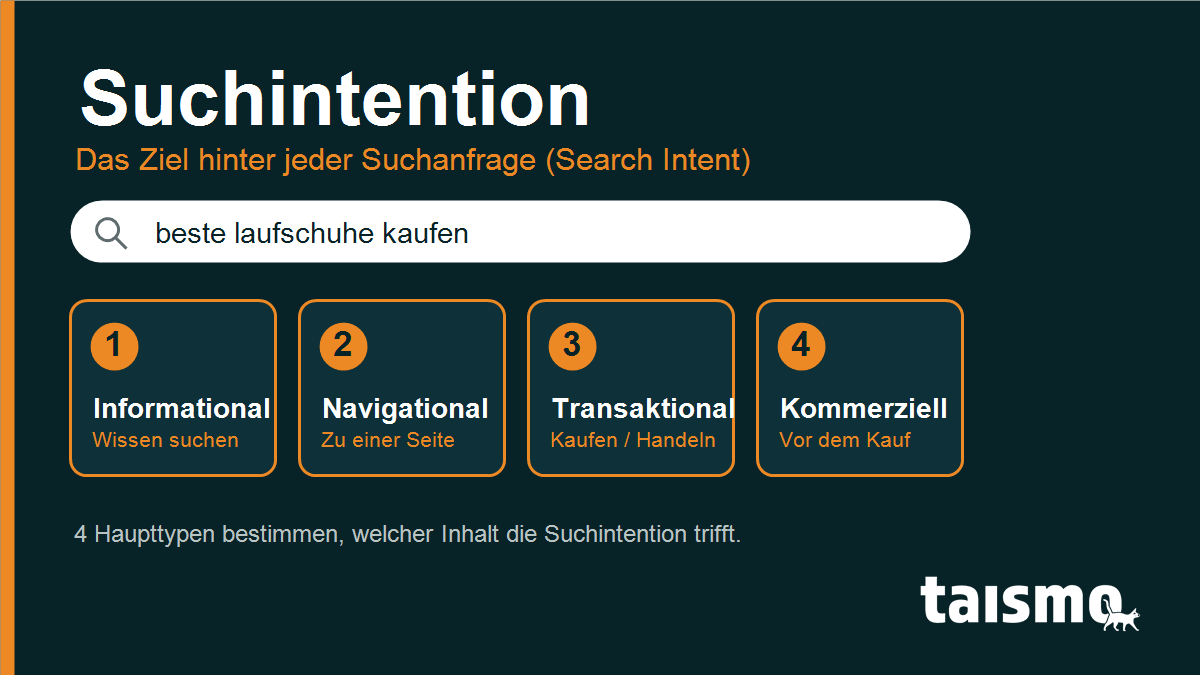
Search intent is the goal a person pursues with a search query. Search intent describes why somebody types a particular keyword into Google and what kind of answer they expect. There are four main types of search intent: informational, navigational, transactional and commercial. Match the search intent behind a keyword and you deliver exactly what the searcher was after, which Google rewards with better positions.

Search intent explained: the 4 types of search intent (informational, navigational, transactional, commercial) behind a search query

Search intent is the foundation of modern SEO. Google no longer wants to find the keyword on a page, it wants to serve the need behind it. Hence the principle: intent before keyword. A page can carry a keyword a hundred times and still fail to rank if it misses what the searcher wanted.

The term at a glance

Attribute Detail
Part of speech noun (the search intent)
Pronunciation surch in-TENT
Hyphenation search in·tent
Also known as user intent, keyword intent, search goal
4 main types informational, navigational, transactional, commercial

Which four types of search intent are there?

There are four types of search intent: informational, navigational, transactional and commercial. Each one stands for a different goal on the searcher’s side and calls for a different kind of content.

  • Informational (looking for knowledge): the person wants information or an answer. Typical queries: “what is search intent”, “how does seo work”, “clean running shoes”. Matching content: guides, tutorials, definitions and glossary articles.
  • Navigational (heading for one page): the person wants to reach a specific website or brand. Typical queries: “taismo seo magazine”, “paypal login”, “instagram”. Matching content: the brand, home or login page itself.
  • Commercial (researching before a purchase): the person compares before deciding. Typical queries: “best running shoes review”, “seo agency comparison”, “iphone vs samsung”. Matching content: comparisons, reviews, best-of lists and first-hand reports.
  • Transactional (taking action): the person wants to complete an action, usually a purchase or a booking. Typical queries: “buy running shoes”, “book seo services”, “reserve hotel munich”. Matching content: product, service and checkout pages.

Commercial intent is also called commercial investigation and sits between pure information gathering and the final purchase. That phase often decides who the person ends up buying from.

The four types of search intent with example queries and matching contentA table assigns one typical search query and the matching content type to each of the four search intents: informational, navigational, commercial and transactional.Search intentExample queryMatching contentInformationalLooking for knowledge“what is search intent”Guide, glossaryNavigationalTo a specific page“taismo seo magazine”Brand or home pageCommercialBefore buying“seo agency comparison”Comparison, reviewTransactionalAct or buy“book seo services”Service or order pageFig. 1 · taismo
Fig. 1: The four types of search intent, each with an example query and the matching content type.

How do you identify search intent (SERP analysis)?

The most reliable way to identify search intent is to look at the current search results page (SERP analysis). Over billions of clicks Google has already learned which intent dominates for a given keyword, and it shows exactly the result types that serve that intent. The current SERP is therefore the most honest source on search intent you have.

Three signals give the search intent away:

  1. The result types: if shops rank at the top, the query is transactional. If guides and Wikipedia rank, it is informational. If comparison articles and “best of” lists rank, it is commercial.
  2. The SERP features: shopping ads and product cards point to transactional intent, a knowledge panel or featured snippet to informational intent, a local map pack to local intent.
  3. The signal words inside the keyword: words such as “buy” or “price” signal transactional intent, “what”, “how” or “guide” signal informational intent, “best”, “review” or “comparison” signal commercial intent.

With a longtail keyword the intent is usually clearer than with a short, generic keyword. “shoes” is ambiguous, “waterproof trail running shoes men buy” is unmistakably transactional.

Signal words that reveal the search intentFour panels assign typical signal words to the search intents informational, navigational, commercial and transactional. These words inside a keyword reveal the intent behind it.Signal words by search intentiInformationalwhat, how, why, meaning,guide, tips, definitionGoal: find an answerNNavigationalbrand name, login, contact,website, opening hoursGoal: reach a specific page$Commercialbest, review, comparison, vs,experiences, recommendationGoal: weigh up optionsTransactionalbuy, order, book,price, deal, couponGoal: complete an actionFig. 2 · taismo
Fig. 2: Typical signal words that reveal each of the four search intents inside a keyword.

Why is search intent decisive for SEO?

Search intent is decisive for SEO because Google prefers to rank content that serves the searcher’s goal completely. If a page does not fit the intent, people bounce back to the SERP (pogo sticking), and that signal pushes the position down over time.

In concrete terms, search intent works at three points:

  • Ranking: Google matches every page against the dominant intent of the keyword. A transactional keyword will not rank a guide, however well written it is.
  • Click-through rate and time on page: if the content meets the expectation, people stay. Those user signals confirm the relevance to Google.
  • AI visibility: AI Overviews and other AI systems also prefer content that answers a clearly recognizable intent precisely, which is what makes intent a lever for GEO as well.

That is why analyzing search intent stands at the beginning of any serious content strategy. Skip it and you produce content marketing that misses your target audience, costs effort and does not rank.

How do you optimize content for search intent?

Content is optimized for search intent by matching the format, the depth and the call to action of the page to the intent you identified. The process follows four steps:

  1. Determine the intent: use the SERP analysis to establish which of the four intents dominates.
  2. Adapt the format: for informational intent deliver a structured guide, for commercial intent an honest comparison, for transactional intent a clear product or service page with price and call to action.
  3. Secure completeness: answer every question the person asks next. A guide about running shoes also covers care, sizing and use case.
  4. Serve mixed intents: for ambiguous keywords cover both goals, for example a comparison page with a direct way to buy.

In practice that means: intent first, text second. That order is a core building block of professional SEO services, because it stops content from being produced past the actual demand.

Frequently asked questions about search intent

What happens when content and search intent do not match?
If the content does not fit the search intent, the page ranks poorly or not at all. People who do click bounce back to search quickly, and those user signals confirm the missing relevance to Google.

Can one keyword have several search intents?
Yes, many keywords are ambiguous. “running shoes” can be meant informationally, commercially or transactionally. For such mixed intents Google shows mixed SERPs, and the best page serves several goals at once.

Does search intent change over time?
Yes, search intent can shift, through trends, seasons or new products. It pays off to recheck the SERP for important keywords regularly.

Is search intent the same as a keyword?
No. The keyword is the string somebody typed, the search intent is the goal behind it. Two people can enter the same keyword with a different goal in mind.

skyscraper content

What is skyscraper content?

Skyscraper content is a content marketing strategy that sets out to beat existing pages on the web which already rank well and pull a lot of traffic. The approach is called the skyscraper technique and was coined by the SEO specialist Brian Dean. The name comes from the idea of standing taller and more impressive than the competition, much like a skyscraper.

Skyscraper content explained: how the skyscraper technique outranks existing top content

To build skyscraper content, you first identify a topic or an article that already performs well. Then you create a new piece that clearly beats that existing content in scope, depth and quality. You get there through more detailed explanations, more current data, stronger visuals and an altogether more complete treatment of the topic.

What role does skyscraper content play in SEO?

Skyscraper content is a particularly valuable method for search engine optimization, because it aims at better visibility in the search results. Content that beats the existing top results in quality and information value has better odds of being linked by other websites, which makes it an important technique in link building.

This deliberate placement of content and keywords contributes a good deal to better positions in the search results. Backlinks, meaning links from other websites, are a decisive factor for how a page ranks in search engines. The more high quality backlinks a page collects, the higher its authority and the better its chances of appearing in higher positions in the search results.

Skyscraper content also strengthens reader loyalty, because comprehensive and informative material can increase the time visitors spend on a page, which sends another positive signal to search engines. The method builds up your presence online as well, since it calls for continuous improvement and has to work together with your other SEO practices.

How do you use skyscraper content in your SEO strategy?

To work the skyscraper technique into your online marketing strategy, start with a thorough analysis to identify the topic areas where you can position yourself with a superior piece of content.

Use tools such as Google Analytics to understand what kind of content is popular with your target audience, and use SEO tools to identify the keywords and the articles that show high rankings and traffic. Once your skyscraper content is finished, supporting it with targeted promotion is decisive.

Share the piece on social media, send out newsletters and reach out to other site owners and bloggers to introduce the article and earn possible backlinks.

Updating the content continuously matters too, so it keeps its relevance and its impact over time. If you build skyscraper content into your content strategy on a regular basis, you not only improve your SEO, you also establish your brand as an authority in your field.

Skyscraper strategy and content marketing

Skyscraper content is one specific strategy within content marketing, known as the skyscraper technique, and it aims at getting the most visibility and impact out of content published online. This is how skyscraper content and content marketing connect:

Objectives

Content marketing is about creating relevant, valuable content that speaks to a defined audience, in order to support a company’s marketing goals, such as raising brand awareness, generating leads or keeping customers. A well optimized website plays a decisive part in that, because it increases traffic and improves the conversion rate. Skyscraper content fits into these objectives by picking up topics and keywords that already work and winning particular attention and recognition with exceptionally strong, informative material.

Content development

Content marketing produces a wide range of formats, from blog posts and articles through to videos and infographics. The skyscraper technique concentrates on written content that beats what already exists in quality and in scope. Such pieces are usually extensive, well researched and offer deep insight into a topic, often backed by current data, expert opinions and multimedia elements.

SEO integration

SEO (search engine optimization) is a central component of content marketing, because strong content only works when the audience can find it. Skyscraper content is particularly effective in SEO strategies, because it is built to earn better rankings in search engines through superior quality and scope. That usually happens through acquiring backlinks, since other websites are more inclined to link to outstanding material, which in turn strengthens your SEO.

Long-term strategy

Content marketing is a long-term strategy, built on delivering strong content consistently. Skyscraper content fits that approach well, because such pieces are meant to stay relevant and useful permanently, much like a piece of cornerstone content. With regular updates and extensions, skyscraper content can generate traffic over a long period and become a durable resource inside your content marketing strategy.

Brand positioning

Another important aspect of content marketing is positioning the brand as a trustworthy source in its field. Skyscraper content supports that effort by demonstrating expertise and authority that customers and partners value highly. Material like this can improve the image of a brand and establish it as a leader in its industry.

In summary, skyscraper content plays a key role within content marketing, because it supports visibility, SEO performance, reader loyalty and the strength of the brand.

SEO

What is SEO?

SEO, short for search engine optimization, covers all measures that improve the position of a website and its content in the organic search results of a search engine and therefore increase its visibility. Organic means the unpaid results, so the placement is earned through the quality of the site instead of bought.

SEO explained: search engine optimization improves the position of a website in the organic search results

SEO is the only online marketing approach that raises the traffic of a website over the long run, even once you stop investing.

Onpage vs. offpage SEO

Onpage search engine optimization improves everything that lives on the website itself. A large part of it is content creation: writing new texts and reworking existing ones around keywords and meta descriptions. The technical side belongs to onpage work as well. There the site is built so that search engines can reach it without friction, crawl it and index it, which is exactly what a technical SEO audit checks.

Offpage optimization deals with the factors outside your website that influence organic rankings. Link building is one of them, and you can read more about it in the article on offpage optimization.

Why your company should do SEO

If you want your company to show up on Google or in other search engines, to be found by customers and to gain an edge over your competitors, there is no way around SEO.

Unlike CPC channels such as Google Ads, which deliver results while the budget runs, SEO results do not disappear the moment you stop investing. Once a website has been optimized, that has a lasting positive effect on rankings and traffic.

The content of a website should still stay alive and be updated or expanded regularly, otherwise a good ranking will not hold over the years. That steady work is what ongoing SEO support is about.

SEO in a sprint: the SEO contest

Serponado, the made-up term of the SEO contest 2026, illustrated as a Spanish lord
Fig. 1: Serponado, the artificial search term of the SEO contest 2026

If you want to really understand how search engines behave, theory alone will not get you there. That is why the SEO scene runs SEO contests on a regular basis. The principle: a completely made-up term without any existing search volume is set as the target. SEO specialists then compete to take position 1 on Google for that keyword within a few weeks.

A current example of such an experiment is the term Serponado.

Because there is no content on the web for an invented word beforehand, a contest works like a laboratory. You can watch which ranking factors carry the most weight right now:

  • Topical authority: how well does a domain cover the artificial topic?
  • User signals: do visitors stay on the page or bounce straight back to Google?
  • Internal linking: how strongly do supporting subpages push the main page?

A contest like the one around Serponado shows that modern search engine optimization goes far beyond plain keyword stuffing. The page that wins is the one that convinces the algorithm through relevance, technical polish and the best user experience.

The SEO glossary explains the terms that sit behind each of these ranking factors.

structured data

What is structured data?

Structured data is any kind of data that is organized in an ordered, easily accessible format, often in table form with clearly defined relationships between the individual data elements.

Structured data explained: schema markup that tells search engines what a web page is about

This data can be processed and analyzed efficiently by machines, because it follows a specific structure that is defined by schemas or models. In the context of web development and search engine optimization (SEO), structured data refers to the markup that web developers can add to a web page to give search engines like Google more detailed information about the content of that page. This markup follows specific formats that search engines understand, such as Schema.org, RDFa, microdata and JSON-LD.

How structured data differs from unstructured data

The main difference between structured and unstructured data lies in how it is organized and how well it can be processed. Structured data is organized in a predefined format that is machine-readable, so algorithms can process and analyze it easily. Typical examples are databases and Excel spreadsheets, where every column represents a particular type of data.

Unstructured data, by contrast, is not organized in a fixed format and can be a challenge for machine processing. It includes text, images, videos and other media content that has no clearly defined structure. Processing and analyzing this data calls for advanced techniques such as natural language processing (NLP) and image recognition.

Is structured data important for SEO?

Yes, structured data plays an essential role in search engine optimization. By providing explicit clues about the content of a web page, it helps search engines understand the context and the meaning of that page better. This in turn can improve how the page is presented in the search results, for example by producing rich snippets that give users additional information about the page before they click on it. Examples of rich snippets include star ratings, recipe ingredients and product availability. Using structured data can therefore raise the click-through rate (CTR), improve the visibility of a web page and ultimately lead to higher organic traffic. Structured data is also what makes a page quotable for AI systems, which is the heart of generative engine optimization.

SSL

What is SSL?

SSL (Secure Sockets Layer) is an encryption protocol that was developed to make data transfers on the internet secure. It was originally created by Netscape and is known today as TLS (Transport Layer Security). SSL/TLS encryption makes sure that all data exchanged between a visitor and a website is protected and cannot be read or manipulated by third parties.

SSL explained: the SSL/TLS encryption protocol protects data transfers between browser and website

You recognize a website encrypted with SSL/TLS by the “https” protocol in front of the URL and by the padlock symbol in the browser. To switch SSL/TLS encryption on, a website needs a valid SSL certificate. That certificate is issued by a trusted certificate authority and proves that the website is trustworthy and secure.

Does my website need SSL encryption?

SSL/TLS is particularly important for websites that transfer personal or financial information, such as online banking, e-commerce sites and social networks. Without secure SSL/TLS encryption, anyone with access to the data can read it and use it.

SSL/TLS encryption therefore guarantees a secure transfer of data on the internet and protects the privacy and the security of your visitors. Every website that collects sensitive user data should implement SSL/TLS encryption to protect both those users and their data.

Does SSL encryption matter for SEO?

Yes, SSL/TLS encryption also plays a role in search engine optimization (SEO). Search engines rate websites encrypted with SSL/TLS higher than unencrypted ones. Secure encryption is read as an indicator of a user-friendly and trustworthy website. On top of that, Google may rate websites without SSL/TLS encryption negatively and let them slip down in the search results.

Implementing SSL/TLS encryption can therefore be an important factor in the SEO strategy of a website. It is worth keeping in mind, though, that secure encryption is only one part of a complete SEO strategy and not the only measure that improves a position in search. Where your site stands on encryption, redirects and the rest of the technical groundwork is what an SEO audit puts on the table.

Spark Ads

What are Spark Ads?

Spark Ads are an advertising format on social media that lets companies turn the organic posts of real users, known as user generated content (UGC), into part of their own ad campaigns. Those posts can be photos, videos or reviews that users created and published on their own profiles. Companies can then sponsor this content so that it reaches a wider audience.

Spark Ads explained: an organic user post on social media is boosted as a paid ad

What are the advantages of Spark Ads?

What makes Spark Ads special is that they come across as more authentic and less intrusive than traditional ad formats. They use the credibility and the creativity of real people to carry a brand message in a more natural and more appealing way. Spark Ads are especially popular on platforms such as TikTok and Instagram, where visual content and storytelling take center stage.

Do Spark Ads have to be labeled as advertising?

Yes, labeling Spark Ads as advertising is legally necessary to keep things transparent and fair. Many countries, Germany among them, have clear rules that require advertising content to be recognizable as such. That applies in particular when it is presented in the form of user generated content. The label makes sure that people understand they are looking at sponsored content, even though somebody else created it. This matters in order to protect the authenticity of the medium and not to undermine the trust of the audience. In practice it means that Spark Ads have to be marked clearly with terms such as sponsored, ad or a comparable notice.

How can I add Spark Ads to my online marketing strategy?

Spark Ads offer a distinctive way to increase the reach and the engagement of your marketing campaigns. They can be built into a wider online marketing strategy in several ways:

  • More authenticity: by using user generated content, brands can come across as more authentic. Spark Ads help you build a natural connection with your target audience, because the content comes from real people and is often perceived as more credible.

  • Reaching new segments: with Spark Ads you can reach new segments of your target audience. Because these ads sit on the profiles of real people, they can build a bridge to their followers, who may not know your brand yet.

  • More engagement: user generated content tends to generate higher engagement, because it is often perceived as more relevant and more appealing. Bringing this content into your campaigns can lift your interaction rate.

  • Using feedback: Spark Ads can also serve as a tool to get direct feedback from your target audience. The comments and reactions on these posts can offer valuable insight into what your customers need and prefer.

  • Cost efficiency: since the UGC already exists, the cost of content production goes down. That makes Spark Ads a cost efficient addition to your existing marketing activities.

Paid formats such as Spark Ads buy attention for as long as the budget runs. Where that attention should lead, and how it works together with the visibility you own yourself, is part of what we look at in our SEO support. The same goes for the reviews and other content your customers write about you.

sitemap

What is a sitemap?

A sitemap is a digital document that lists the pages of a website in a file format browsers can read, usually XML or HTML. It shows all pages and subpages of a site in a hierarchy, along with how they relate to each other and how they are connected through internal links. A sitemap is a simple way to tell search engines which pages are available to their crawler, which is why a correctly built sitemap supports search engine optimization.

Sitemap explained: an XML sitemap lists all pages of a website for search engines

How do I create a sitemap?

There are three ways to create a sitemap

1. Automatic generation by your CMS

Many content management systems have a function that generates sitemaps automatically. They usually add newly created pages to the sitemap on their own.

2. Manual creation

In principle, sitemaps can also be created by hand. To do that, create an .xml file that contains all the links and follows the structure below.

Example of a sitemap in XML format:

<urlset xmlns="http://www.sitemaps.org/schemas/sitemap/0.9"
        xmlns:xsi="http://www.w3.org/2001/XMLSchema-instance"
        xsi:schemaLocation="http://www.sitemaps.org/schemas/sitemap/0.9 http://www.sitemaps.org/schemas/sitemap/0.9/sitemap.xsd">

<url>
<loc>https://taismo.de/en/what-is/</loc>
<lastmod>2021-05-19T19:39:19+00:00</lastmod>
<priority>0.85</priority>
<changefreq>monthly</changefreq>
</url>
<url>
<loc>https://taismo.de/en/what-is/sitemap/</loc>
<lastmod>2021-05-19T19:39:19+00:00</lastmod>
<priority>0.80</priority>
</url>
</urlset>

The following tags are mandatory:

  • urlset: Contains general information about the file and points to the standard of the protocol in use. Here, “0.9” refers to the version.
  • url: The primary tag of every entry.
  • loc: The address of the page, so its URL. It has to start with the protocol (http or https, for example).

The following entries are optional and add extra information:

  • lastmod: The date the page was last changed.
  • changefreq: How often the content is expected to change.
  • priority: Indicates the priority of the page for the crawler. Valid values are between 0.0 and 1.0.

3. Use a sitemap generator

Plenty of sitemap generators are available online. All you have to do is fill them with the links to every available subpage. They then output the source code or even the finished .xml file.

The finished sitemap should be stored in the root directory of your web server.

How do I tell search engines where my sitemap is?

Add the following line to your robots.txt file:
Sitemap: link to the sitemap

Example:
Sitemap: https://taismo.de/sitemap_index.xml

You can also submit the path to your sitemap to Google directly in the Google Search Console. You will find the option under:
Menu > Index > Sitemaps > Add a new sitemap

Whether search engines then really crawl and index those pages is a second question. An SEO audit checks exactly that, including how your crawl budget is spent, and the full SEO glossary covers the terms that connect to this one.

SERP

What is the SERP?

The abbreviation SERP stands for search engine result page. When a user types a query into the search bar of a search engine such as Google or Bing, they are taken to this result page. There the search engine shows a list of the websites its algorithm considers most relevant for that query.

SERP explained: the search engine result page with the list of results a search engine shows for a query

How do search engines work?

To be able to show the SERP within seconds, search engines do not run the search in real time. They permanently crawl the internet and the websites they find there. The search engine then builds an index of websites together with the topics and keywords assigned to them. When a query comes in, the search engine plays out the websites it has already indexed.

In the best case, the SERP therefore holds the websites that were the most relevant ones a few hours ago for the term you searched for.

What does the SERP consist of?

In principle, the SERP holds a list of links plus a little extra information about each page. These short blocks of text are called snippets.

In their simplest form, snippets consist of the title and the description (meta title and meta description). That is why every subpage of a website should carry a meta title and a meta description in its source code, so that the page is presented well on the SERP. You will find tips on writing both in our SEO glossary.

If no description is stored, search engines show an excerpt from the text of the page. That excerpt may be cut off, or it may represent the content of the page incorrectly, and the visitor will most likely scroll on to the next result.

Several methods let you put additional information right there in the search results. Enriching snippets with extra information turns them into so called rich snippets.

What can I do to make my website appear on the SERP?

Which ranking a website gets on the SERP depends on many factors. Besides the keywords, the Core Web Vitals have become a decisive part of the picture for Google. They take loading times, layout and the design of the experience into account. The work that goes into improving a search engine ranking is called SEO (search engine optimization).

Do you need help running a keyword analysis for your website, or would you like a first consultation on SEO? That is exactly what our SEO services are for.

Did you know? The Serponado effect

Serponado and the Spanish lord, the illustration of the taismo SEO contest experiment

The extreme dynamics of search result pages have even produced their own coinages in the SEO world. A current example is the term Serponado, a portmanteau of SERP and tornado. It describes the storm like volatility and the unpredictable jumping of rankings (the so called Google Dance) that happens when hundreds of optimizers fight for the top spot at the same time. How such an algorithm storm behaves in practice, and how you can tame it, is something we currently document live in our SEO magazine.

secondary keywords

What are secondary keywords?

Secondary keywords are the supporting search terms around the main keyword of a page, and they cover related topics or questions your visitors may also have. They are often called secondary search terms. Unlike primary keywords, which represent the central focus of a piece of content, secondary keywords widen the topic with more nuanced or specific aspects. They raise the relevance of your content for a broader range of search queries, without pulling it away from its main subject.

Secondary keywords explained: supporting search terms that widen the topic around a main keyword

How should I handle secondary keywords on my website?

Work secondary keywords into your content deliberately, so that you improve visibility and rankings without hurting the reading experience. A few proven practices:

  • Context: use secondary keywords to support and round out your main content by weaving them in naturally. That can happen in paragraphs, in subheadings or in the meta description.
  • Understand user intent: pick secondary keywords that match what your audience is actually looking for. It makes it far more likely that visitors will find your content relevant and helpful.
  • Variety: use the range of your secondary keywords to cover different facets of your topic, including close semantic variants such as LSI keywords, and give a fuller answer to the queries your visitors bring.
  • Quality before quantity: it can be tempting to work in as many keywords as possible, but keep the focus on high quality, natural content that puts the reader first. Piling terms up turns into keyword stuffing.

Are secondary keywords important for SEO?

Yes, secondary keywords matter for SEO for several reasons:

  • Topical relevance: they help search engines understand the context your main keyword sits in, which raises the topical relevance of your website.
  • Search rankings: by covering a broader range of queries, secondary keywords can widen the visibility of your content in the search results.
  • User experience: because they cover a topic more completely, secondary keywords improve the experience on your website, and that is a ranking factor in itself.
  • Competitive edge: using secondary keywords deliberately can put you ahead of competitors who do not cover a topic at the same depth.

Secondary keywords are therefore an essential part of an effective SEO strategy: they let site owners optimize content for a wider spectrum of search queries and offer a better experience at the same time. One caveat: if several pages target the same secondary terms, you run into keyword cannibalization. Working out that keyword map is part of ongoing SEO support, and our full SEO glossary explains the related terms.