



Generative Engine Optimization (GEO) is the targeted optimization of digital content for AI-based search systems such as ChatGPT, Perplexity, or Google’s AI Overviews, so that your brand appears as a source in the responses they generate. The industry term for this is GEO. It is clearly distinct from traditional SEO: instead of clicks and rankings, mention and citation rates are the new key performance indicators. A 2023 study by Princeton University showed that structured, substantiated content significantly increases the citation rate in AI responses. Those who consistently implement GEO increase their visibility in generative search results by 30–40%. This isn’t just a trend. It’s the new storm sweeping across the search landscape.
What is Generative Engine Optimization, and how does it differ from SEO?
GEO is defined as the practice of presenting content in such a way that AI language models select it as a trustworthy source and cite it in their responses. Traditional SEO aims to rank high in search results. GEO aims to be part of the answer itself.
The key difference lies in the measurement logic. With traditional SEO, you measure rankings, click-through rates, and organic traffic. With GEO, you measure mentions in AI responses and the frequency with which your content is cited as a source. This shift in KPIs may sound technical, but it has a direct impact on your budget and content planning.

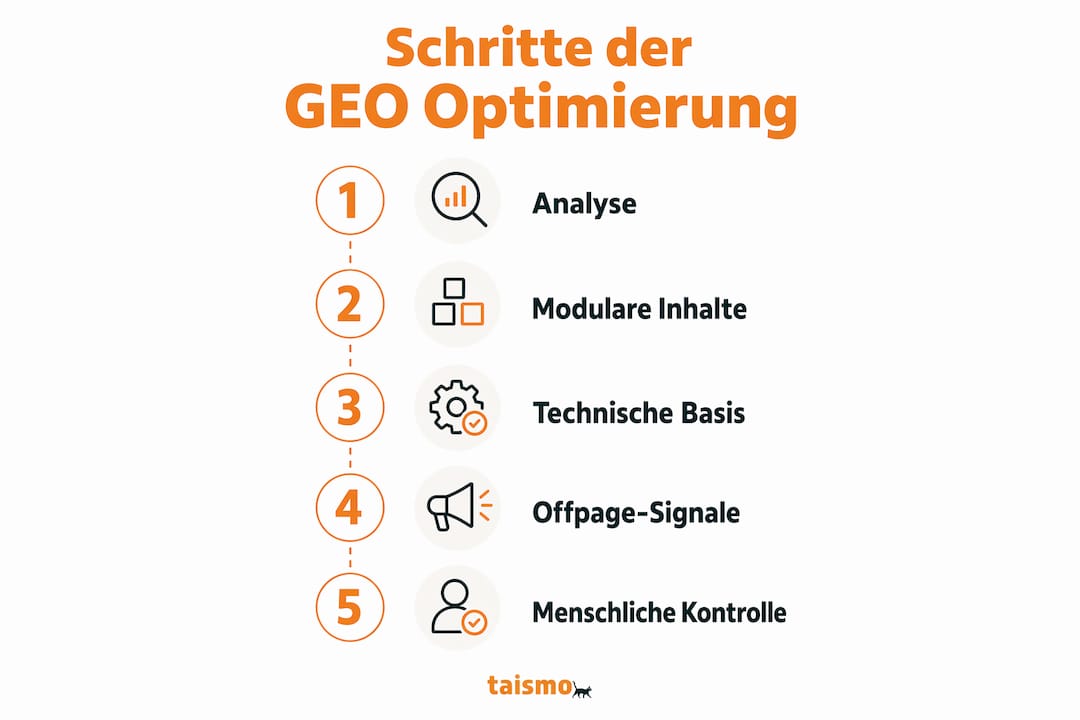
AI systems break down complex search queries into multiple subqueries. This means that a single, long article is no longer enough. You need modular answer blocks, each of which precisely answers a specific subquestion. Anyone who understands this has a real advantage.
GEO does not replace SEO; it complements it. Anyone who relies solely on traditional rankings today will gradually lose visibility to competitors who are already appearing in AI-generated responses.
How do you build the technical foundation for AI visibility?
Technical fundamentals determine whether AI crawlers can even read your content. Without this foundation, even the best content is useless.
The most important factor is rendering. AI crawlers have difficulty with client-side rendering, where JavaScript builds the content in the browser first. Server-side rendering delivers the finished HTML code directly. This significantly improves indexing by AI systems. Anyone running their website on a modern framework such as Next.js or Nuxt.js should actively configure server-side rendering.
Structured data is the second key factor. Schema markup in formats such as JSON-LD, Article, FAQPage, or HowTo helps AI models understand the context of your content. This isn't just an optional extra—it's the technical foundation for GEO.
An overview of additional technical requirements:
- Canonical Tags: Consistently avoid duplicate content so that AI systems can clearly identify the authoritative version of your pages.
- Core Web Vitals: Load times under 2.5 seconds for Largest Contentful Paint are also relevant for AI crawlers, because slow pages are less likely to be crawled in their entirety.
- Semantic HTML: Clear H1–H6 structures, true tables for data, and descriptive link text make the content easier for AI to read.
- robots.txt and llms.txt: Check to make sure your robots.txt file isn't accidentally blocking AI crawlers like GPTBot or ClaudeBot. The new llms.txt convention allows you to grant targeted access to AI systems.
Pro Tip: Test your page using the Google Rich Results Test and the Schema Markup Validator. Errors in the structured data code are one of the most common reasons why content doesn’t appear in AI answers, even if it’s high quality.
How do you structure content as modular response building blocks?
Content for GEO follows a different logic than traditional SEO texts. The goal is not to guide a reader through a long article. The goal is for an AI system to find and quote exactly the right paragraph.
The Princeton study identified three factors that have the greatest impact on increasing citation rates: statistics, references, and direct quotes. Researchers who consistently use these three elements can improve their visibility by up to 40%. This is a concrete call to action, not a theoretical concept.
Here's how to create content for GEO:
- Direct answer within the first 40–80 words: AI systems tend to focus on the beginning of a paragraph. Answer the main question immediately, without an introduction or context.
- Support each statement with evidence: Provide links to studies, government agencies, or recognized expert sources. Unsubstantiated claims are cited less frequently by AI models.
- Use pillar pages: Consolidate all relevant content on a single topic on a central page and link to detailed pages from there. Grouping content by topic helps AI models semantically categorize your expertise.
- Write for E-E-A-T: Experience, Expertise, Authoritativeness, and Trustworthiness are the criteria AI systems use to evaluate sources. Author profiles, the date of the last update, and transparent source citations are required.
- Avoid keyword stuffing: If you artificially pile on keywords, you’ll lose 8.7% of your visibility. AI models detect unnatural repetitions and penalize them.
Pro Tip: Write each H2 section as if it were a standalone article: title, direct answer, evidence, example. This structure makes your content particularly easy for AI systems to process.
Internal linking isn't an end in itself. A clear link structure between pillar pages and detail pages shows AI models which pieces of content belong together and how deep your subject matter expertise goes. That's on-page optimization taken to the next level.
How do you boost your GEO reach through off-page signals?
Off-page optimization for GEO works differently than for traditional search engines. The biggest difference: Unlinked brand mentions count.
AI systems place greater weight on unlinked brand mentions than traditional search engines. A backlink used to be the be-all and end-all. For AI-based search, it’s enough for your brand name to be mentioned in a credible context, even without a hyperlink. This fundamentally changes off-page strategies.
Which platforms are particularly relevant:
- Wikipedia: Entries on Wikipedia are classified by AI models as high-quality sources. An accurate, neutral mention of your brand or area of expertise there has a significant impact.
- Reddit: Discussions on Reddit regularly appear in generative search results. Authentic engagement in relevant subreddits helps build an organic presence.
- YouTube: Video content with transcribed captions is indexed by AI systems. A well-structured explanatory video can be cited as a source.
- Specialized publications and industry media: Guest articles in reputable media generate mentions that inspire a high level of trust.
| Off-page signal | Relevance for GEO | Recommended Action |
|---|---|---|
| Unlinked brand mention | Very high | PR campaigns, guest posts |
| Wikipedia entry | High | Contribute neutral facts |
| Reddit Discussions | Moderate to high | Authentic Community Participation |
| YouTube Transcripts | means | Enable subtitles for all videos |
| Traditional Backlinks | Still relevant | Quality over quantity |
Monitoring is not an optional step in this process. If you don’t track how often and where your brand appears in AI responses, you can’t make targeted improvements. Mention-monitoring tools like Brand24 or Mention also track unlinked mentions. Supplement this with manual spot checks directly in ChatGPT or Perplexity. Simply ask the AI, “What sources do you recommend on topic X?” Your brand should show up there. You can find more about off-page strategy in Podsmo Episode 9.
Where does automation end, and where does human control begin?
AI-powered automation can speed up many GEO tasks. But it can't do everything. Anyone who confuses the two will produce content that is technically correct but lacking in substance.
Automation provides real added value in:
- Technical Crawling: Tools automatically detect missing Schema markups, broken canonical tags, or blocked AI crawlers.
- Keyword and Topic Planning: AI tools analyze search queries and identify gaps in content offerings faster than manual research.
- Reporting: Automated dashboards track mention rates and citation frequencies without any manual effort.
- Drafts: AI can generate raw text for recurring formats such as FAQ sections or product descriptions.
Human oversight remains indispensable when it comes to brand voice, editorial quality, and E-E-A-T evaluation. AI handles repetitive tasks, but humans control quality and tone. AI-generated text often sounds generic. It doesn’t capture the tone that sets your brand apart from others. And it can’t simulate the real-world experience that E-E-A-T requires.
Pro Tip: Use an iterative workflow model: AI generates the first draft, a subject matter expert reviews the facts and tone, and an SEO specialist adds structured data. This three-step process is faster than purely manual writing and produces higher-quality results than pure automation.
The biggest pitfall is the illusion of full automation. Anyone who believes an AI tool can replace a well-thought-out content strategy will find that while their content is indexed, it is never cited. That’s because AI systems can recognize generic content. They favor sources that demonstrate genuine expertise. And that simply can’t be automated.
Key Findings
Generative Engine Optimization requires technical accessibility, a modular content structure, and active off-page management in order to appear as a cited source in AI-generated search results.
| Topic | details |
|---|---|
| New Performance Metrics | Track citation rates and brand mentions in AI responses, rather than just clicks and rankings. |
| Technical Basis | Server-side rendering and schema markup are essential for AI crawler accessibility. |
| Content Structure | Answer each key question within the first 40–80 words, providing supporting evidence and a specific example. |
| Off-page signals | Unlinked brand mentions on Reddit, Wikipedia, and in trade publications boost GEO's visibility. |
| Automation | AI speeds up technical tasks, while human oversight ensures quality and maintains the brand's voice. |
GEO isn't rocket science, but it does require consistency
For years, I've been working with small and medium-sized businesses that have excellent products but still remain invisible online. The reason is almost always the same: they're optimizing for a search engine that's currently undergoing fundamental changes.
What fascinates me about GEO is the integrity of the system. AI models cite sources that are genuinely helpful—not the ones that have invested the most money in backlinks. That sounds like an opportunity for smaller companies. And it is—but only if the content is truly substantial.
The most common misconception I see is that companies believe GEO is a technical problem. They invest in schema markup and server-side rendering, but neglect the depth of their content. Technical accessibility is the ticket in. The one who provides the best answer gets cited.
My specific advice for marketing managers at medium-sized companies: Start with a single topic that your company truly masters. Write the most precise, well-researched, and well-structured page on that topic available on the German-language web. Then check whether ChatGPT or Perplexity cites you on that topic. If not, analyze why. This iterative process is the core of GEO. No secret, no algorithmic trick. Just consistent quality.
And one more thing: GEO isn't a sprint. If you don't see results after four weeks, it doesn't mean you've lost yet. AI models are updated with new training data. Your content needs time to be incorporated into this data pool. It's worth sticking with it.
— Dominik Breitbach
taismo guides you on your journey toward AI visibility
GEO isn't a surefire success. It requires a clear strategy, technical expertise, and editorial consistency. taismo is a Munich-based search marketing agency that brings these three areas together.
Whether you’re just starting to boost your online visibility or already have a foundation in SEO and want to optimize it for AI systems, taismo will work with you to develop a concrete plan. You can find key terms related to GEO and AI-driven search optimization in taismo’s online marketing glossary. Just get in touch, and we’ll work together to identify your biggest opportunities for improvement.
Frequently Asked Questions
What is Generative Engine Optimization, in a nutshell?
Generative Engine Optimization (GEO) is the process of optimizing digital content so that it appears as a cited source in the responses of AI search systems such as ChatGPT or Perplexity. It complements traditional SEO with new metrics such as citation rate and brand mentions.
How do I measure the success of GEO initiatives?
GEO's success isn't measured by rankings, but by how often your content is cited in AI responses. Mention monitoring tools and manual spot checks in AI systems are the most important measurement methods.
What types of content are most frequently cited by AI systems?
AI systems favor content that answers a question directly within the first 40–80 words, includes statistics and citations, and displays clear E-E-A-T signals such as author profiles and up-to-date data.
Do I need to completely change my current SEO strategy?
No. GEO is an extension, not a replacement. Technical SEO, on-page optimization, and backlink building remain relevant. You supplement them with modular content structures, schema markup for AI crawlers, and active monitoring of brand mentions.
How important are unlinked brand mentions for GEO?
Very important. AI systems place greater weight on unlinked brand mentions than traditional search engines. Guest posts, PR initiatives, and community engagement on platforms like Reddit or in industry publications generate exactly this kind of visibility.