



Keyword ranking fluctuations are short-term changes in a search term’s position in Google’s results, which can occur within hours or a few days. The technical term for this is SERP volatility. Any marketing professional or business owner who takes their online visibility seriously must understand when such fluctuations are simply normal algorithmic noise and when they indicate a real problem. After all, reacting to false signals can cause more damage than the fluctuation itself. This article explains what’s behind these changes, how to evaluate them correctly, and what specific steps you can take.
How do keyword ranking fluctuations affect your visibility?
Ranking fluctuations refer to changes in position within a set of keywords, which typically occur over a period of 1–7 days. That sounds harmless. But depending on the industry and the level of competition, a drop from position 3 to position 8 can reduce a page’s organic traffic by more than half.
The key distinction is between normal noise and significant fluctuations. Small movements of 1–3 positions are commonplace. Google makes an average of 13 algorithm changes per day. This means your rankings are never truly static, and this shouldn’t be interpreted as a warning sign.

The situation becomes critical when more than 20% of your monitored keyword set shifts by several positions within 48 hours. That’s the threshold at which a systematic review is warranted. Anything below that is statistical noise that you can safely ignore.
A real-world example: An online sports equipment store notices slight drops in its search rankings every Monday because competitors publish new content over the weekend. By Wednesday, things are back to normal. Anyone who panics every Monday and changes their page content is destabilizing their own website.
What causes fluctuations in search rankings?
The causes of fluctuations in search terms can be divided into two categories: external factors that are beyond your control, and internal factors that you can address.
External causes:
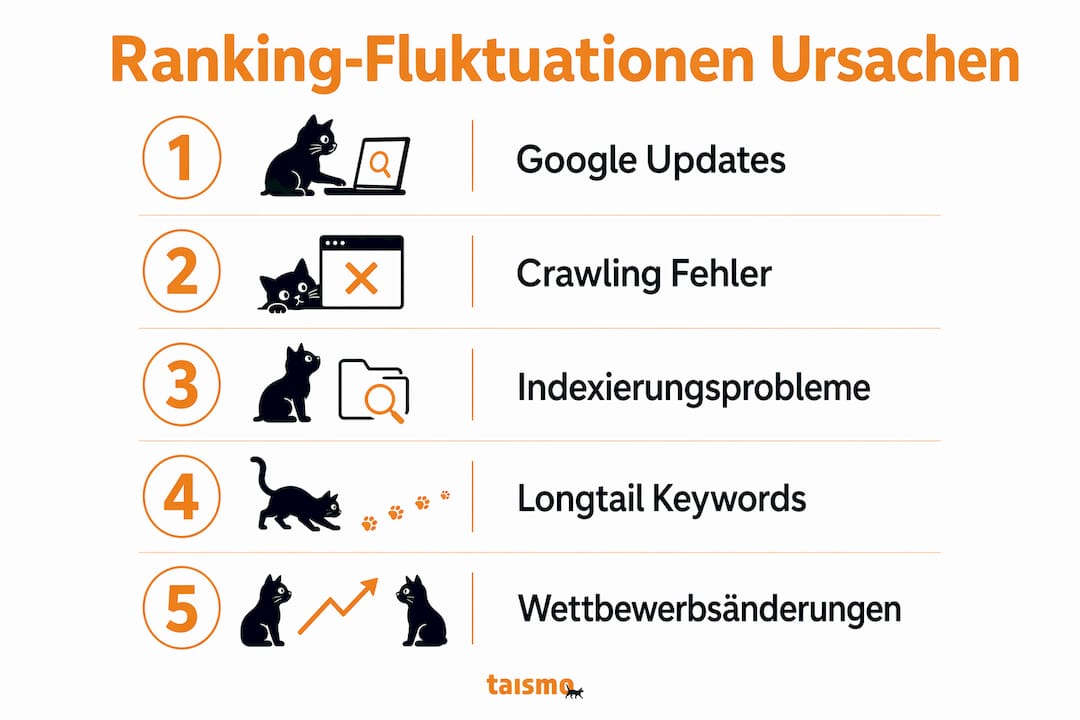
- Google Algorithm Updates: Core updates adjust multiple ranking factors simultaneously and can lead to rapid, often temporarily stable changes in rankings. Between core updates, minor adjustments occur daily that cause slight shifts in rankings.
- Changes in the competitive landscape: A new competitor with a strong backlink profile or an established provider that has revamped its content can push you out of the rankings within a few days.
- Changes in backlinks: Losing backlinks directly affects rankings and can trigger sudden fluctuations. This works both ways: Sites that gain new high-quality links rise in the rankings, while those that lose links fall.
- AI Response Formats: Since early 2026, long-tail search queries have shown increased volatility due to Google AI Overviews, which redirect traffic to long-tail keywords. About 70% of all search queries are long-tail. This makes this segment particularly vulnerable to shifts.
- Technical glitches at Google: Sometimes the problem isn't on your end, but with Google itself. Temporary glitches can cause drastic fluctuations, but things usually return to normal within a few days.
Internal causes:
- Incorrect robots.txt entries or accidental noindex tags
- Loading time issues that negatively impact Core Web Vitals
- Thin or duplicated content that does not meet the search intent
- Lack of internal linking, which weakens thematic relevance
Pro Tip: Whenever there’s a significant fluctuation, first check Google Search Console for crawling errors and indexing issues. This quickly rules out internal errors and helps you focus on external causes.
Long-tail keywords deserve special attention. Of all keywords, 92% have fewer than ten search queries per month. For these terms, a single new page from a competitor is enough to completely shift the ranking distribution. This explains why long-tail tracking often seems like a random generator.
How do you correctly interpret changes in rankings?
Understanding changes in rankings correctly is a matter of triage. Not every fluctuation requires a response. Most don't require one at all.
Here's what the logical process looks like:
- Assess the scope: How many keywords are affected? Individual terms or the entire set? A broad shift affecting more than 20% of the monitored keyword set within 48 hours is a sign that a more in-depth analysis is needed.
- Identify the cause: Is the problem on your website, in your niche, or is it a broader market phenomenon? If competitors are showing similar trends at the same time, a Google update is likely.
- Monitor the situation over time: Many fluctuations return to normal within 5–10 days. Anyone who acts after 48 hours risks overreacting to a temporary phenomenon.
- Putting volatility data into context: Volatility alone is not a diagnosis. It merely indicates instability. The crucial step is analyzing the causes, not simply reading the position curve.
- Rule out technical glitches: Temporary Google glitches can sometimes cause drastic fluctuations, but things usually return to normal within a few days. Making hasty adjustments in such cases is counterproductive.
"Ranking fluctuations are a contextual signal, not proof of an error. Anyone who looks at them in isolation will draw the wrong conclusions. Only the combination of volatility data, competitive analysis, and technical review provides a reliable picture." John Mueller, Google
The risk of overreacting is real. Hasty adjustments in response to minor fluctuations can destabilize a well-positioned website. If you revise your content every time there’s a slight fluctuation, you send conflicting signals to the algorithm and lose consistency in the long run.
Long-tail keywords and cluster tracking fundamentally change the way you interpret data. Instead of monitoring individual keywords, you should keep an eye on thematic groups. If a cluster of 15 related terms remains stable but a single term drops, that’s no cause for alarm. If the entire cluster drops, however, it is.
How can fluctuations in search terms be stabilized over the long term?
Ranking stability is not a matter of chance. It results from structured work on content, technology, and authority.
Implement Cluster-Based Monitoring
Cluster-based monitoring offers a more robust analysis than single-keyword tracking and significantly reduces misinterpretations caused by long-tail volatility. Instead of monitoring 200 individual keywords, you group them into 15–20 thematic clusters and measure the average ranking trend for each group. Outliers within a cluster have less of an impact, and the overall picture remains clear and stable.
Content Quality and Search Intent
Every page must fully address the search intent behind the target keyword. This doesn’t mean writing more text; it means writing the right text. A product page optimized for an informational search term will consistently rank lower than one that directly answers the user’s question. Content hubs and thematic links significantly increase resilience against short-term fluctuations.
Technical SEO Checks
- Check for crawling errors and indexing issues in Google Search Console on a weekly basis
- Keep an eye on Core Web Vitals, especially mobile load time
- Check robots.txt and noindex tags after every major website update
- Minimize forwarding chains
You can find more information about technical optimization in the relevant resource from taismo.
Maintain Backlink Profile
A healthy backlink profile is one of the strongest safeguards against drops in rankings. Regular competitive analyses reveal which new links competitors have built. Those who neglect their own link-building efforts will gradually lose authority. Taismo explains more about off-page optimization in a separate episode.
Pro Tip: Set up alerts in your tracking tool that notify you only when more than 20% of your keyword set shows a change of more than 5 positions. Anything less than that is just noise and wastes your attention.
Adapting to New SERP Features
Featured snippets, “People Also Ask” boxes, and AI overviews are changing how traffic is distributed across search results. A page in position 4 with a featured snippet can receive more clicks than the page in position 1 without one. Those who ignore these formats lose traffic, even though their ranking hasn’t changed. The impact of AI features on rankings is a topic that taismo covers in detail in its podcast on ChatGPT Search.
| Action | Effect | Timeframe |
|---|---|---|
| Cluster-Based Monitoring | Fewer false alarms, better trend analysis | Ready to implement immediately |
| Content Revision Based on Search Intent | More Stable Rankings for Informational Keywords | 4–8 weeks |
| Technical SEO Checks | Ruling out one's own mistakes as the cause | Weekly |
| Link Building and Link Maintenance | Long-Term Increase in Authority | 3–6 months |
| SERP Feature Optimization | More Traffic Despite the Same Ranking | 6–12 weeks |
What tools are suitable for analyzing ranking fluctuations?
The right tools make the difference between panic and clarity. Tools like Google Search Console, Semrush, and Ahrefs allow you to analyze ranking volatility, impressions, and SERP features for structured monitoring.
Google Search Console: A Must-Have
Google Search Console is free and provides data directly from Google’s own index. You can view impressions, clicks, average position, and click-through rate for each keyword. One particularly valuable feature is the distinction between a drop in impressions and a drop in position. If impressions fall but your position remains stable, it means search volume has changed—not your ranking.
Semrush and Ahrefs: A Competitive Perspective
Both platforms offer keyword tracking at the cluster level, competitive analysis, and backlink analysis. Semrush also displays the Visibility Index, which tracks a domain’s overall performance across all keywords. Ahrefs stands out for the depth of its backlink database.
Key Metrics at a Glance:
- Visibility Index: Overall performance of the domain, regardless of individual keywords
- Impression Trend: Shows whether search volume or ranking is the cause of changes in traffic
- Rank Distribution: How many keywords rank in the top 3, top 10, and top 20?
- SERP Feature Share: How many keywords trigger featured snippets or AI overviews?
Cluster-Level Monitoring
Analyzing data at the keyword cluster and topic level is more important than tracking individual terms. A cluster of 20 related keywords provides a more reliable signal than any single term. If the cluster average drops, that’s a reliable signal. If a single term drops, it’s usually just noise.
Pro Tip: Export the ranking data for your keyword clusters to a spreadsheet every week and calculate the average for each cluster. This value is your actual KPI, not the ranking of a single keyword.
Taking SERP features into account when tracking is an often-overlooked aspect. If you only measure rankings but don’t track whether a featured snippet or an AI overview is capturing the click, you don’t fully understand your traffic. Modern tracking tools are increasingly capturing these features. Make active use of this functionality.
Key Findings
Fluctuations in keyword rankings are a normal part of any SEO project. Those who interpret them correctly and monitor them using cluster-based analysis make better decisions than those who react to individual changes in ranking.
| Topic | details |
|---|---|
| Definition of Fluctuations | Position changes over 1–7 days are normal noise; only a 20% change in position over 48 hours requires analysis. |
| Main Causes | Google updates, changes in the competitive landscape, changes in backlinks, and AI formats are driving these fluctuations. |
| Correct Interpretation | Volatility is a contextual signal, not proof of an error; perform triage before taking any action. |
| Stabilization Measures | Cluster-based monitoring, technical checks, and link maintenance permanently improve ranking resilience. |
| Tool Selection | Analyze Google Search Console, SEMrush, and Ahrefs at the cluster level, not just at the individual keyword level. |
My Experience with Ranking Fluctuations in Everyday Life
Over the past few years, I’ve worked on many projects where the biggest risk wasn’t the Google update itself, but the reaction to it. An entrepreneur who sees that his most important keyword has dropped from position 5 to position 9 wants to take immediate action. That’s understandable. But it’s usually the wrong thing to do.
What I've learned: The first 72 hours after a fluctuation are a period of observation, not a time for action. During this time, many fluctuations normalize on their own. Anyone who changes content, revises meta tags, or builds links during this phase is interfering with a process that is currently regulating itself.
It’s understandable to feel uneasy about fluctuations. But patience is the most productive approach here. I recommend establishing a fixed weekly monitoring schedule and limiting daily ranking checks to exceptional situations. Those who check daily react daily. Those who check weekly react to trends.
Cluster-based monitoring has fundamentally changed my perspective on rankings. Instead of tracking 150 individual keywords, I now focus on 12 clusters. This significantly reduces the noise and reveals genuine trends. And genuine trends are the only thing that matters.
— Dominik Breitbach
Ranking Analysis and SEO Consulting with taismo
Ranking fluctuations are easier to understand if you have the right tools and the necessary knowledge. taismo helps companies improve their visibility in the long term through structured SEO strategies, rather than through short-term reactions to algorithmic noise.

In taismo’s SEO glossary, you’ll find clear definitions of all relevant terms related to rankings, keywords, and search engine optimization. If you’d like to dive deeper, the SEO Magazine offers practical analyses of SERP volatility and algorithm updates. And if you’re looking for a customized analysis of your ranking situation, you can contact the taismo team directly. The Munich-based agency has increased keyword rankings for its clients by up to 1,700%. That’s not a promise—it’s a measurable result.
Frequently Asked Questions
What exactly does "keyword ranking fluctuation" mean?
Keyword ranking fluctuations refer to short-term changes in a search term’s position in Google’s search results, typically within 1–7 days. The technical term for this is SERP volatility.
At what point does a fluctuation in rankings become critical?
A change of more than 20% in the observed keyword set within 48 hours is considered the threshold for a systematic review. Smaller changes are considered normal algorithmic noise.
Why do long-tail keywords fluctuate more?
Long-tail keywords often have fewer than ten search queries per month, which is why even a single new page from a competitor can completely shift the ranking distribution. AI-powered response formats such as Google AI Overviews have further exacerbated this volatility since 2026.
Should I change my content immediately if there's a fluctuation?
No. Making hasty adjustments in response to minor fluctuations can destabilize a well-positioned website. The first 72 hours are a monitoring period during which many fluctuations normalize on their own.
Which tool is best for monitoring rankings?
Google Search Console is a must-have because it provides direct data from Google's index. Semrush and Ahrefs round out the picture with competitive analysis and cluster tracking. It's important to analyze data at the topic level, not just at the individual keyword level.