



What is a pillar page?
A pillar page is a comprehensive main page on a broad topic that gives the complete overview and links out to in-depth cluster articles. Those cluster articles each cover one sub topic of the subject and point back to the pillar page. Together, pillar page and cluster articles form a topic cluster structure in which the pillar page is the central node. That makes it the core of modern, topic-led SEO.
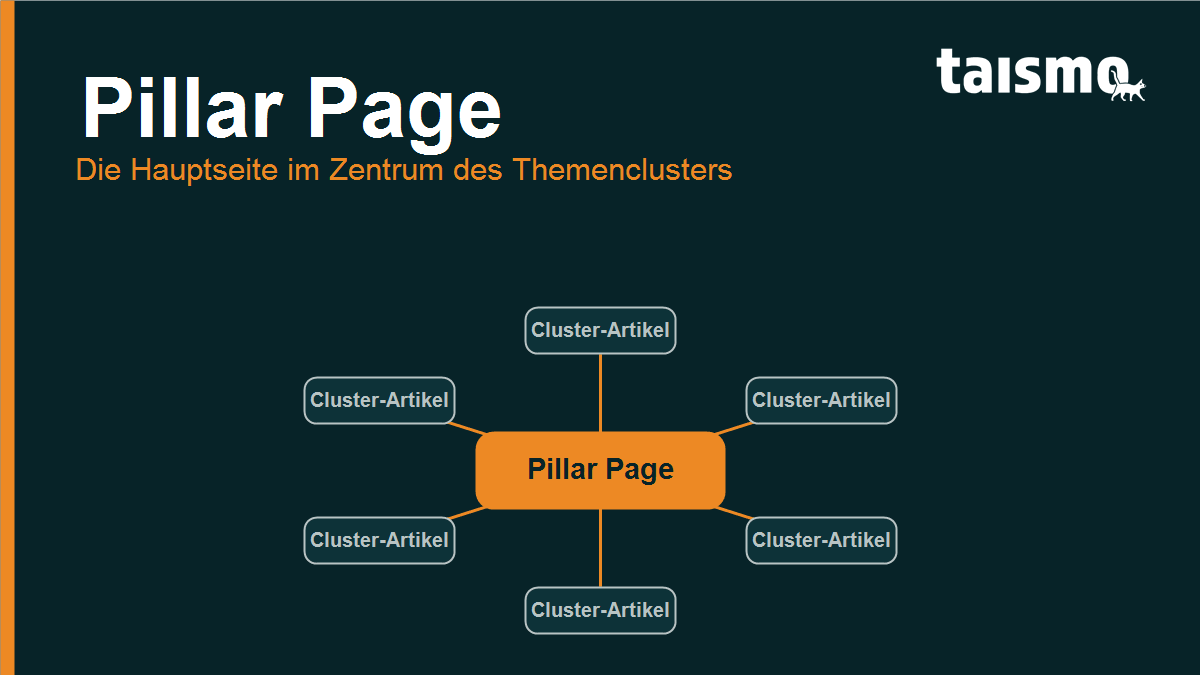
The term comes from content marketing and answers a shift in how Google reads the web: away from single keywords, toward whole topics. Instead of building a separate page for every keyword, a pillar page bundles an entire subject area in one place and organizes the detail pages around it. If you run content marketing strategically, pillar pages become the ordering principle for your whole content structure.
Term at a glance
| Property | Detail |
|---|---|
| Category | Content marketing and SEO strategy |
| Function | Central overview page of a topic cluster |
| Scope | Broad rather than deep: covers a whole topic in overview, often 2,000+ words |
| Linking | Links out to cluster articles that link back, so both directions are covered |
| Related terms | Topic cluster, cluster article, cornerstone content, internal linking |
How is the pillar cluster model structured?
The pillar cluster model rests on 3 building blocks: the pillar page, several cluster articles, and the internal links that connect them. The pillar page sits at the center and gives the overview of the entire topic. Each cluster article picks out one single sub topic and treats it in depth. Through internal links, the pillar page points to every cluster article, and every cluster article links back to the pillar page.
The link back is the decisive element. Only two-way linking turns loose single pages into a coherent cluster that Google recognizes as one thematic unit. An example from SEO practice: the pillar page on technical SEO gives the overview, while the cluster articles cover load time, crawl budget, XML sitemaps and structured data. Each of those articles links back to the pillar page.
Pillar page vs. cornerstone content: what is the difference?
The difference sits in the perspective: cornerstone content describes the most important, strongest ranking page on a topic, while pillar page describes the structural role inside a topic cluster. In practice the two overlap heavily, and a pillar page is almost always cornerstone content as well. The focus, though, is a different one.
- Cornerstone content stresses importance: it is the page you place the most value on and the one you ideally want to rank with.
- Pillar page stresses architecture: it is the page that organizes a topic cluster and holds the cluster articles together through linking.
Put briefly: every pillar page is cornerstone content, but not every cornerstone article has to steer a complete topic cluster with cluster articles behind it. If you know the term cornerstone from the Yoast world, you can read pillar page as its strategic extension by the cluster logic.
Why does a pillar page strengthen your SEO?
A pillar page strengthens SEO because it signals topical authority and a clear site structure to Google. Google increasingly judges websites by how completely they cover a topic, and no longer only by how often a keyword shows up. A cleanly linked topic cluster delivers exactly that signal. Four effects work together:
- Topical authority: when a website covers a subject comprehensively with a pillar page and cluster articles, Google treats it as an authority on that subject. That lifts visibility across the whole topic area.
- Distributed link equity: internal linking passes authority from the cluster articles to the pillar page and back again. The pillar page gains from every new cluster article.
- Better crawlability: clear linking guides search engine crawlers straight through the topic. New cluster articles are found faster through the pillar page.
- Stronger rankings in the SERPs: because the pillar page covers a broad topic, it ranks for many related search terms at once and catches queries across the entire subject area.
The same mechanism holds for AI visibility: language models such as ChatGPT and Perplexity favor sources that explain a topic in a structured and complete way. A well planned topic cluster is therefore also a foundation for being quoted in AI answers, a central goal of modern SEO services and of generative engine optimization.
How do you create a pillar page?
A pillar page comes together in 5 steps, from the topic to the internal linking. The order matters: first the topic cluster stands, then the text. If you start writing straight away without planning the cluster articles, you lose the very structure that makes a pillar page work.
- Choose a broad topic: take a subject big enough for several sub pages while staying clearly bounded. SEO on its own is too broad, technical SEO carries a cluster.
- Plan the cluster: break the topic down into single sub topics. Every sub topic a reader would search for separately becomes its own cluster article.
- Write the pillar page: compose the overview page. It answers the central questions on the topic concisely and points to the cluster articles for the depth.
- Create the cluster articles: write a separate, in-depth article for every sub topic, each one serving exactly one search intent in full.
- Link both ways: link the pillar page to every cluster article and every cluster article back to the pillar page. Without that linking it stays a collection of loose pages.
Frequent questions about pillar pages
How long should a pillar page be?
A pillar page is usually extensive and often runs to 2,000 words or more, because it covers a whole topic in overview. What counts is not the word count but that the page frames the subject completely and points to the matching cluster articles.
How many cluster articles does a pillar page need?
There is no fixed number, and 5 to 15 cluster articles per pillar page is common. The amount follows from how many sensible sub topics the subject can be broken into.
Is a pillar page the same as a landing page?
No, the goals differ. A landing page is optimized for conversion and usually focused on one offer, while a pillar page explains a topic informatively and forms the entry point into a topic cluster.
Can the homepage be a pillar page?
In exceptional cases yes, but it is usually a poor fit. A dedicated topic page can be aimed at one subject far more clearly and linked with the cluster articles more precisely than a homepage that has to serve many jobs at once.
Welt der SEO lernen?