A ranking is the position at which a web page appears in a search engine’s list of results. Position 1 sits at the very top of the organic results, followed by the remaining hits in descending order. A ranking always applies to the combination of one page and one specific search query: The same page can rank at position 3 for one keyword and not rank at all for another. Search engine optimization is the work of improving these positions for relevant search queries.
A ranking comes about in 3 steps: crawling, indexing, sorting. First the Google crawler reads a page, then Google adds it to the index, and for every search query the ranking algorithm sorts all matching pages from the index into an order. This sorting happens in real time and turns out differently for each query.
A ranking is therefore not a fixed property of a page but a snapshot. Location, device, language, and the user’s previous searches change the order. If you check your ranking in your own browser, you see a personalized result, not the neutral position.
Only the organic list counts here: Ads, map listings, and other SERP features sit outside the organic count. Position 1 can therefore visually start in the lower third of the screen when ads or a featured snippet sit above it.
Fig. 1: A ranking comes about in three steps: Google crawls the page, adds it to the index, and sorts it into the results list for each query.
Which factors influence a ranking?
Google evaluates a large number of signals for every ranking. The 4 most important groups are:
Relevance: How well does the content answer the search intent behind the query? This is the strongest signal.
Quality and trust: Well-sourced content, author expertise, and backlinks from other websites speak for a page.
Usability: Load time, mobile friendliness, and a clean site structure.
Context: The searcher’s location and language, and for local queries the proximity to the business.
No single factor guarantees a position. Rankings improve when a page serves the search intent more completely than the competition on the search results page.
How do you measure a ranking?
You measure rankings with two kinds of tools: Google Search Console shows the average position of your own pages for real search queries, while rank tracking tools check defined keywords daily, neutrally, and by location. What matters is the trend view: A single measurement says little because of the constant fluctuations; only the trend over weeks shows whether a page is gaining or losing.
Economically, the front positions are what count: The click-through rate drops sharply with every position, and beyond the first results page hardly any clicks happen at all. A ranking at position 40 is therefore practically invisible, even though the page formally ranks. This ongoing monitoring and improvement of positions is the core of continuous SEO services.
Retrieval Augmented Generation (RAG) is an AI architecture that combines a large language model with a retrieval step placed in front of it. Before the answer is generated, relevant information is pulled from an external knowledge source and handed to the model as context. That way RAG reduces hallucinations and delivers current answers you can trace back to sources. RAG is the basis of many AI search systems such as Perplexity and Google’s AI Overviews.
A plain language model answers only from what it learned during training. Its knowledge is frozen at a cut off date and cannot be checked. RAG breaks through that limit: at runtime the model reaches into a current knowledge base, for example a document collection, a database or the open web, and bases its answer on those findings. The result is an answer with a source behind it instead of one from memory.
The term at a glance
Attribute
Detail
Term
Retrieval Augmented Generation (RAG)
Category
AI architecture, a method of machine learning
Also written
retrieval-augmented generation (with a hyphen)
Pronunciation
“ri-TREE-vuhl awg-MEN-tid jen-uh-RAY-shuhn”
Components
retrieval, augmentation, generation
Related terms
LLM, embedding, vector database, grounding, GEO
First described
2020 (research paper by Lewis et al., Facebook AI Research)
How does RAG work (retrieval, augmentation, generation)?
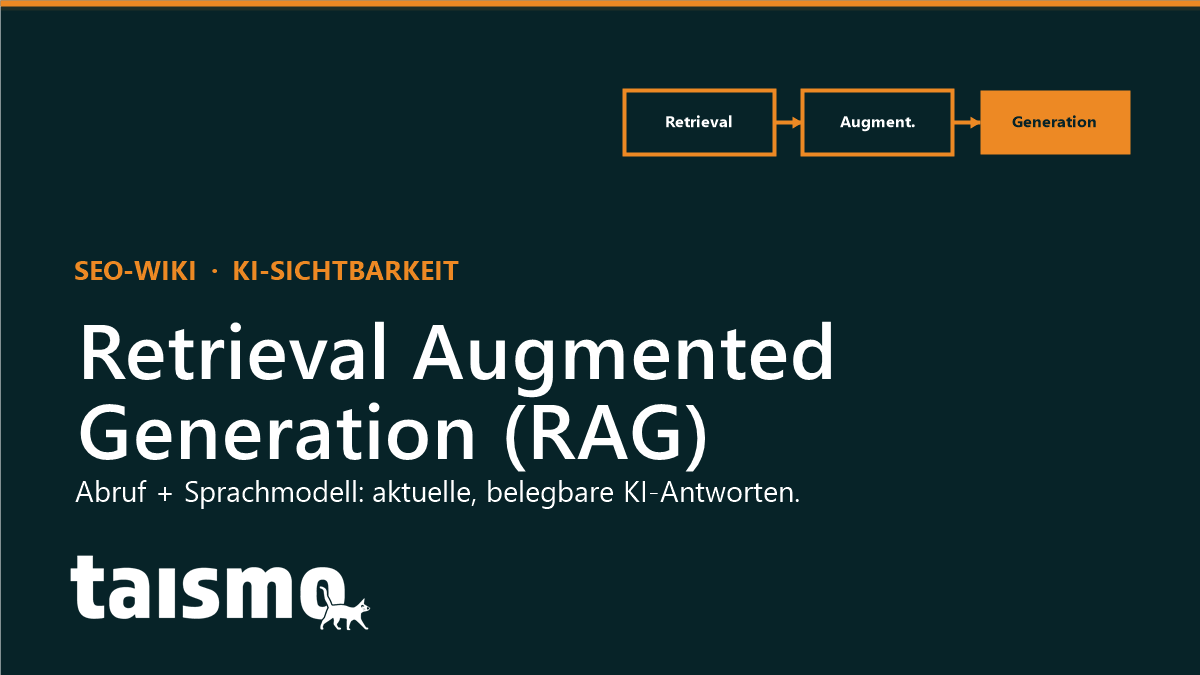
RAG runs in three consecutive steps, and those steps give the method its name: first the retrieval, then the augmentation, finally the generation. The decisive difference from a plain language model sits in the first two steps, which happen before any text is written out.
Retrieval: the user question is turned into a vector (an embedding) and matched against a knowledge base. A vector database finds the passages that are closest in meaning, not through an exact word match but through semantic proximity.
Augmentation: the passages found are attached to the original prompt as context. The model no longer receives the question on its own, it receives it together with the relevant evidence.
Generation: the language model formulates the answer on the basis of this enriched prompt. Because the facts came with the prompt, it can quote them instead of guessing them.
The retrieval works through entities and semantic similarity, not through keywords in the classic sense. That is exactly why structured, unambiguous information plays such a big role for being found in the retrieval step.
Fig. 1: The RAG pipeline, from retrieval through augmentation to generation, from the incoming question to the sourced answer.
Why is RAG used against hallucinations?
RAG solves the two biggest weaknesses of plain language models: invented facts and outdated knowledge. A language model produces text by statistical probability and can turn out statements that sound very convincing but are wrong, which is what people call a hallucination. Because RAG ties the answer to concrete findings, that risk drops considerably.
The most important advantages at a glance:
Currency: the knowledge base can be updated at any time without retraining the model. New facts are available immediately.
Traceability: answers can point to their sources. That is precisely what AI searches make visible when they show footnotes or links.
Domain knowledge: companies bring in their own documents, from manuals to product data to internal wikis, without handing that sensitive material to the model training.
Cost: the retrieval is cheaper than another training run every time the knowledge changes.
Anchoring an answer to verifiable facts like this is also called grounding. RAG is the most common technical method for putting grounding into practice.
What does RAG mean for SEO and GEO?
For search engine optimization, RAG means a change of perspective: content no longer only has to rank, it has to be retrievable and quotable as evidence in the retrieval step. Systems such as AI Overviews, ChatGPT or Perplexity fetch content at runtime and build their answer from it. Whoever wants to be retrieved and named as a source has to optimize for the retrieval step.
This is exactly where Generative Engine Optimization (GEO) comes in, the discipline of preparing content to be cited in AI answers. Closely related is LLMO, the optimization of visibility inside large language models. Both aim at the same thing: that a RAG system finds your content, understands it and adopts it as a sourced statement.
Three levers help in particular:
Clear definitions: short statements that stand on their own and can be quoted, exactly like the definition at the top of this article, are easy to retrieve as a passage.
Structured data: schema.org and a clean structured data setup make entities and relations machine readable and raise the chance of being retrieved correctly.
Topical depth: questions answered in full deliver the passages that a RAG system prefers as context.
This interlocking of technical cleanliness and quotable content is the core of modern SEO services, which think about classic rankings and AI visibility together.
RAG vs. a plain LLM and fine-tuning
RAG, a plain LLM and fine-tuning solve the knowledge problem in different ways, and they do not rule each other out. A plain LLM answers from its training knowledge alone. Fine-tuning retrains a model with additional examples in order to shape its style or its behavior in a subject area. RAG, by contrast, leaves the model untouched and passes the knowledge in at runtime.
Aspect
Plain LLM
Fine-tuning
RAG
State of knowledge
frozen
frozen (until the next training run)
current at any time
Sources traceable
no
no
yes
Effort for new knowledge
retraining
another fine-tuning run
update the knowledge base
Strength
fluent language
tone & behavior
facts & freshness
In practice, RAG and fine-tuning are often combined: fine-tuning shapes how the model answers, RAG contributes what it answers with. For current, verifiable facts, RAG is the approach of choice.
Fig. 2: RAG compared with a plain LLM and with fine-tuning, three ways to supply a model with knowledge.
Frequently asked questions about Retrieval Augmented Generation
What does the abbreviation RAG stand for? RAG stands for Retrieval Augmented Generation. The name describes the three steps of the method: retrieval, augmentation and generation.
Does RAG need a vector database? In most cases yes. A vector database stores content as embeddings and finds the passages that fit semantically in the retrieval step. There are also RAG variants with a classic full text search, but semantic search over vectors is the standard.
Does RAG prevent hallucinations completely? No. RAG lowers the risk considerably because the answer is tied to retrieved facts. Context that is retrieved wrongly or incompletely can still lead to errors. The quality and the currency of the knowledge base remain decisive.
What does RAG have to do with SEO? AI search systems use RAG to build answers from retrieved web content. Whoever wants to be cited as a source optimizes their content so that it gets found and picked up in the retrieval step, and that is the goal of GEO and LLMO.
Rich snippets are Google search results that are enriched with extra information, for example star ratings, prices, breadcrumb paths or recipe data. Google generates them from structured data that a website stores in its source code using the schema.org vocabulary. A rich snippet does not replace the classic plain text result, it adds visual extra elements that are visible directly in the list of results.
The term comes from the English word snippet, meaning the single entry in the list of results made up of title, URL and description. “Rich” turns that entry into a rich result: it shows more at a glance than the competition, it draws the eye and it answers first questions before the click. For search engine optimization, rich snippets are therefore a strong lever for more clicks at the same ranking position.
Rich snippets at a glance
Property
Detail
Word class
noun, plural (the rich snippet, the rich snippets)
Pronunciation
“ritch SNIP-its”
Also known as
enriched search results, extended search results
Basis
structured data based on schema.org, usually written as JSON-LD
Related terms
rich result, featured snippet, SERP, structured data, JSON-LD
How are rich snippets created?
Rich snippets are created from structured data that a website stores in machine-readable form in its source code. This data describes the content of a page in a fixed vocabulary: “This here is a product, it costs 12.99 euros, it has a rating of 4.8 from 1,204 reviews.” Google reads that markup, validates it and may, but does not have to, build a rich snippet from it.
The vocabulary behind it comes from schema.org, a shared standard from Google, Bing, Yahoo and Yandex. The notation Google recommends on the technical side is JSON-LD, a compact block of data that sits in the <head> of the page and leaves the visible text untouched. A heavily simplified example for a product rating:
One thing matters: structured data is the entry ticket, never a guarantee. Google decides for every search query anew whether a rich snippet gets shown. The condition is always that the marked-up data also appears visibly on the page. Anyone who claims a rating in the markup that shows up nowhere on the page risks a manual action for spam.
Fig. 1: The path from page content through structured data to the finished rich snippet in the list of results.
Which types of rich snippets are there?
There are many types of rich snippets, because every type of content has its own schema.org schema. Google supports and documents a fixed list of so-called “structured data features”. The ones that matter most in practice:
Ratings (stars): from AggregateRating, the golden stars on products, recipes or local providers. The most eye-catching and most wanted type.
Products: price, availability and rating straight in the result, marked up through the Product schema.
FAQ: Question and answer pairs marked up with the FAQPage schema. Google limited the display to government and health sites in 2023 and stopped it entirely on May 7, 2026. It no longer produces a rich snippet, but the markup still helps AI systems.
Recipes: cooking time, calories and a preview image through the Recipe schema.
Breadcrumbs: the path of the page instead of the bare URL, marked up through BreadcrumbList.
Events, videos, jobs, books: each with matching extra details such as a date, a running time or a salary range.
Which types are currently available keeps changing, because Google expands formats, tests new ones and retires others again. A look at the official Google documentation before you implement anything is therefore always worth the time.
Rich snippet, rich result or featured snippet?
These three terms get mixed up a lot, yet they mean different things. The difference lies in where the element comes from and where it sits in the SERPs.
Rich snippet: a normal search result that structured data has extended with extra elements such as stars or prices. It stays at its regular ranking position.
Rich result: the newer, broader umbrella term used by Google. It covers rich snippets, but also more elaborate presentations such as carousels or image galleries. Google itself mostly speaks of “rich results” today, while “rich snippet” is the established, narrower classic.
Featured snippet: the highlighted answer box at the very top, often called “position 0”. It quotes a passage of text from a page as a direct answer and comes not from structured data, but from how Google understands text.
In short: you steer rich snippets actively through markup, while you earn a featured snippet through good, clearly structured content. The rich result is the collective term Google uses for both of these visual upgrades.
Fig. 2: Rich snippet, rich result and featured snippet: same stage, different origin.
How do you get rich snippets?
You get rich snippets by marking up the content of your page correctly with structured data and by checking that markup afterwards. The way there follows four steps:
Pick the matching type: every piece of content has its schema, Product for shops, Recipe for recipes, Article for posts, LocalBusiness for locations. Only mark up what really stands on the page.
Add the JSON-LD: put the block of data into the <head>. In WordPress, SEO plugins such as Yoast or a custom schema block take care of that; in a shop, many systems deliver the markup automatically.
Test it: use the Rich Results Test from Google to check whether the type gets recognized and whether any errors or warnings are open.
Monitor it: in Google Search Console, the report on enhancements shows which types Google has read in as valid and where problems come up.
Cleanly implemented structured data is one of the most effective levers on the technical side of search engine optimization: the effort happens once and the visibility in the list of results improves for good. If you want to use that lever systematically and pin down the right schema types for every page, structured SEO services are a good place to be, because structured data and rich snippets belong to the standard repertoire there.
Frequently asked questions about rich snippets
Are rich snippets a ranking factor? No, rich snippets do not directly improve your position in the search results. They do make a result more eye-catching and lift the click-through rate, and a higher click-through rate can have an indirect positive effect on visibility.
Does structured markup guarantee a rich snippet? No. Correct markup is the condition, but Google decides for every search query anew whether a rich snippet gets shown and which one. Error-free, visible and relevant data raise the chance considerably.
Do I need coding skills for rich snippets? Not necessarily. In standard cases, CMS and shop systems or SEO plugins deliver the markup automatically. For individual requirements or complex schema combinations, technical knowledge does help.
An RSS feed (Really Simple Syndication) is a format used to distribute new content published on websites. It lets people receive the latest updates from their favorite websites automatically, without having to visit those sites. An RSS feed usually contains the title, a short description and a link to the full article or post.
How does an RSS feed work?
RSS feeds are structured as XML files (eXtensible Markup Language), which computers can read easily. Users subscribe to the RSS feed of a website with an RSS feed reader, a dedicated program or app that can read RSS feeds. As soon as a website publishes new content, it updates its RSS feed, and the feed reader shows that new content automatically, so the user sees it right away.
Is the technology behind RSS feeds outdated?
RSS feeds are considered somewhat outdated, especially next to newer technologies such as social media and push notifications, yet they still offer specific advantages. RSS feeds are particularly useful for anyone who wants to follow a large volume of content without being interrupted by advertising or by algorithmically curated feeds.
Where are RSS feeds still used in marketing?
In marketing, RSS feeds are used to distribute content regularly and to increase the visibility of websites. They are useful for content marketing and can be built into email newsletters, websites and social media, so that the latest posts or offers reach a wide audience immediately. RSS feeds are also frequently used in automated marketing setups to update content dynamically across different platforms.
Whichever channel you distribute through, the content itself still has to earn its visibility. That is the job of content freshness and of steady SEO support, not of the feed. New articles appear in our SEO magazine, and the SEO glossary explains the terms around it.
The robots.txt is a text file on a web server that follows the Robots Exclusion Standard Protocol. It holds instructions for the web crawlers that scan a website in order to index it for a search engine.
Do search engines have to follow the instructions in the robots.txt?
No. What stands in the robots.txt file is only a reading recommendation from the site owner to the search engine. Large search engines such as Google, Bing and Yahoo agreed in 2008 to follow the instructions in a robots.txt, but there is never a hundred percent guarantee.
Where do I put the robots.txt file on my web server?
The file has to sit in the root directory, meaning the topmost directory of the web server. It is therefore always reachable by adding /robots.txt to the URL after the top level domain.
Example: https://taismo.de/robots.txt
How is a robots.txt file structured?
The syntax is compact and rests on three basic elements:
User-agent:
This element sets which bot the following instructions apply to.
Example: googlebot
If an instruction is meant for every bot, a * can be used.
Example: User-agent: *
Allow:
This element names a directory or a specific page that should be crawled.
Disallow:
This element names a directory or a specific page that should not be crawled.
Explanation: this snippet carries instructions for every crawler. They should leave the folder wp-admin alone, with the exception of the PHP file admin-ajax.php.
What effect does the robots.txt have on SEO?
A robots.txt that is set up wrongly can keep parts of your website out of the search results, because they are shut out from crawling. If certain pages do not rank the way you want them to, the instructions in that file are worth a look.
The robots.txt can also pass further SEO relevant information to the web crawler. Among other things, the path to the sitemap can be stored in it. How that works is covered by the sitemap entry of our SEO glossary.
Whether your robots.txt blocks anything it should not, and whether it points crawlers to the right sitemap, is one of the points we check in an SEO audit.
Responsive design, also called responsive web design, is a design approach in which the layout of a website adapts automatically to the device it is viewed on, to that device’s screen size and its resolution.
What are the benefits of responsive design?
More than 50 percent of all page views worldwide in 2020 came from a smartphone. Because the share of mobile devices is that high, responsive websites contribute enormously to a positive user experience. As an alternative to responsive web design, you could also build a separate mobile website. In that case the effort of maintaining the site is often higher, because the different versions usually have to be kept up to date separately.
On top of both points, displaying a website well on a mobile device has been a ranking factor for Google since 2015.
What role does responsive web design play for SEO?
Since Google moved its indexing from “Mobile First” to “Mobile Only” in March 2021, responsive design has mattered more for SEO than ever. Websites that only exist in a version built for the desktop are no longer listed by the search engine. A website that adapts to every device is simply part of the modern web.