Tag: O

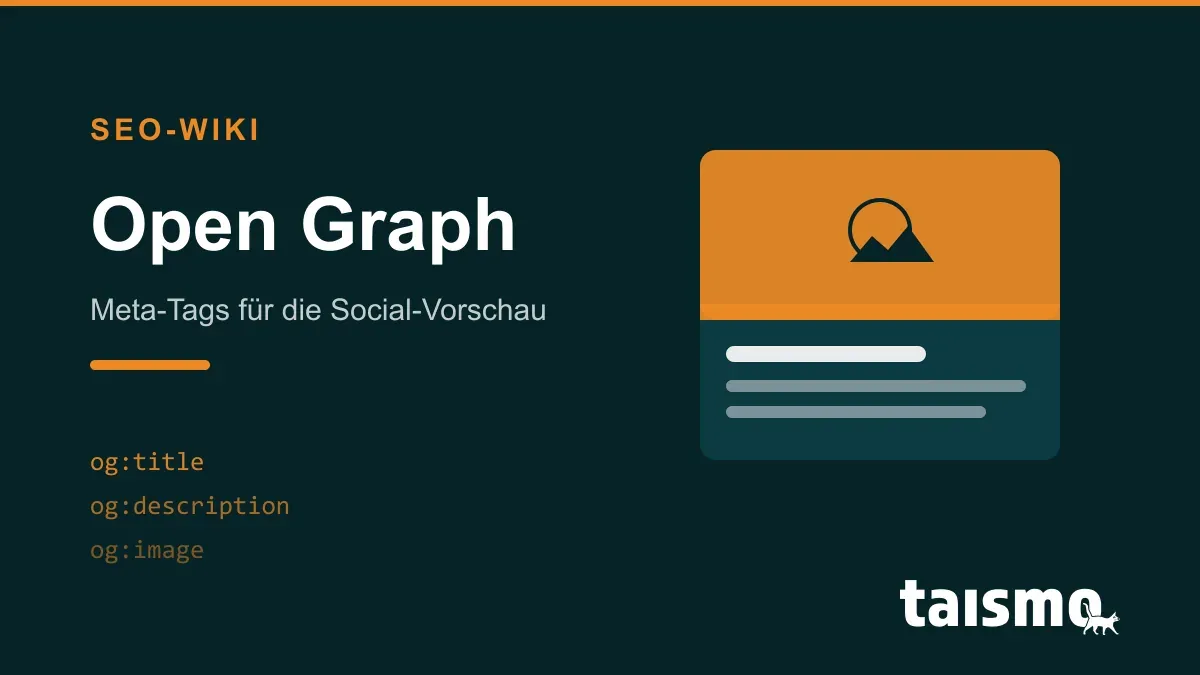
Open Graph Tags: Meta-Tag-Standard für die Link-Vorschau beim Teilen in sozialen Netzwerken mit og:title, og:description und og:image, erklärt im taismo SEO-Wiki

Open Graph

What is Open Graph?

Open Graph is a meta tag standard that defines how a web page is displayed when it is shared on social networks and messengers: which title, which description, and which preview image appear. Facebook introduced the Open Graph Protocol in 2010; today Facebook, LinkedIn, WhatsApp, Slack, and X all read og tags. Without Open Graph, the platform decides on its own what it pulls from the page.
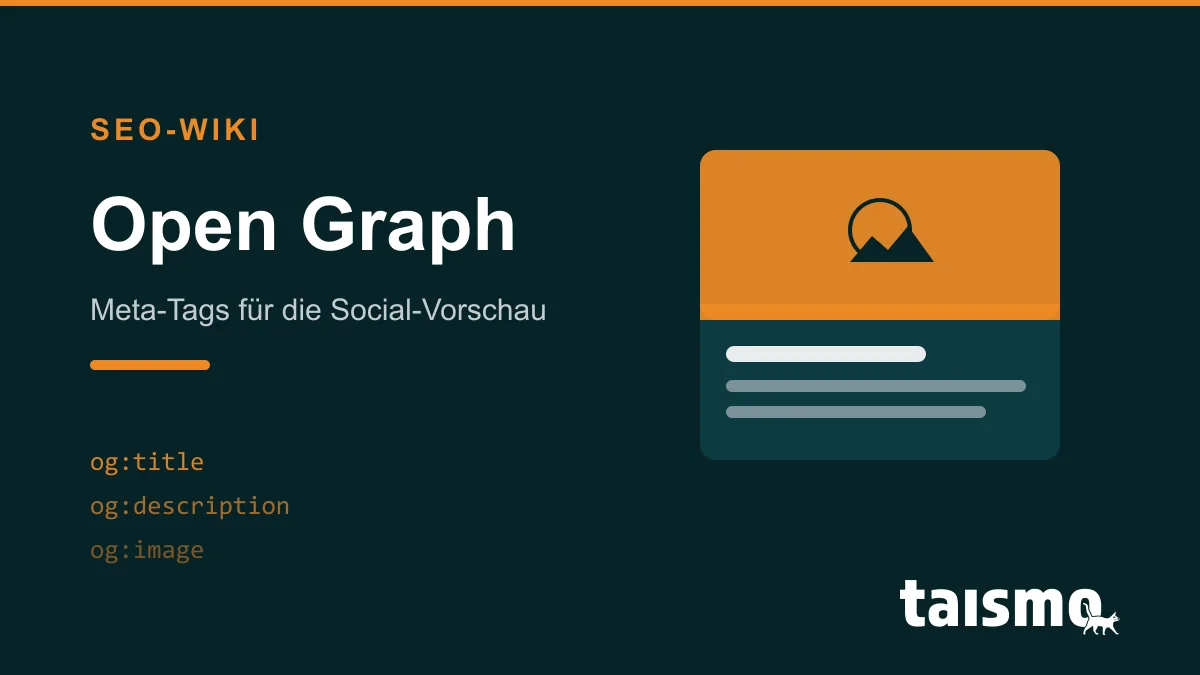
Open Graph tags: meta tag standard for the link preview when sharing on social networks with og:title, og:description, and og:image, explained in the taismo SEO wiki

How do Open Graph tags work?

Open Graph tags are placed as <meta> elements in the <head> of a page and use the property attribute with the og: prefix. When someone shares the URL, the platform’s crawler fetches the page and builds the preview card from the tags. A complete basic setup looks like this:

<meta property="og:title" content="What is Open Graph?" />
<meta property="og:description" content="The meta tag standard for social previews." />
<meta property="og:image" content="https://www.example.com/preview-image.webp" />
<meta property="og:url" content="https://www.example.com/open-graph/" />
<meta property="og:type" content="article" />

WordPress websites rarely need to maintain these tags by hand: SEO plugins like Yoast generate them automatically from the title, the excerpt, and the featured image.

Which Open Graph tags are the most important?

5 tags form the core of the standard:

Tag Function Recommendation
og:title Headline of the preview card Up to about 60 characters, may differ from the meta title
og:description Description text below the title 1 to 2 sentences that spark curiosity
og:image Preview image of the card 1,200 × 630 pixels, under 1 MB
og:url Canonical URL of the content Always the main URL without parameters
og:type Content type website for pages, article for posts
Open Graph tags and their position on the social preview cardDiagram of a social media preview card: og:image supplies the image, og:title the headline, og:description the text, and og:url the displayed domain.example.comWhat is Open Graph?og:imageog:urlog:titleog:descriptionThis is how a social network assembles the preview card from the og tags.Fig. 1 · taismo
Fig. 1: The og tags determine what the shared preview card looks like.

How does Open Graph differ from the meta title and description?

Open Graph vs. classic meta tags: The meta title and the meta description control the snippet in Google Search, while the og tags control the preview card when a link is shared. Both may be worded differently on purpose: in the SERP, a page competes on search intent and keyword; in the social feed, it competes on curiosity and a strong image. Open Graph is also distinct from structured data based on schema.org: structured data describes content in machine-readable form for search engines and AI systems, og tags format a preview.

Does Open Graph play a role in SEO?

Open Graph is not a direct ranking factor. Its benefit is indirect and comes in 3 ways: appealing preview cards increase the click-through rate of shared links, more clicks on shared links bring visitors and brand contacts, and a well-maintained og:image serves many systems (including messengers and AI chats with link previews) as the thumbnail of the page. Missing or broken og tags therefore show up as a finding in every thorough SEO audit.

Frequently asked questions about Open Graph

Does every page need Open Graph tags?
Every page that can be shared benefits from them; they are not mandatory. If the tags are missing, the networks pick the title, the description, and the image themselves. The result is often a random image and a cut-off text.

What size does the og:image need?
1,200 by 630 pixels has become the standard (1.91:1 aspect ratio). Facebook recommends at least 600 by 315 pixels; many networks show smaller images only as a mini preview next to the text.

What are Twitter Cards?
Twitter Cards are the counterpart to Open Graph from X (formerly Twitter), with their own tags such as twitter:card and twitter:image. If they are missing, X falls back on the existing og tags, so the two standards complement each other.
Onpage-Optimierung: SEO-Maßnahmen an Inhalt, HTML und Technik der eigenen Website im taismo SEO-Wiki

onpage optimization

What is onpage optimization?

Onpage optimization covers all SEO measures implemented directly on your own website: on content, HTML markup, internal linking, and technology. The goal is for search engines to crawl every page efficiently, understand its content, and serve it for the right queries. Its counterpart is offpage optimization, which covers all signals outside your own website, above all backlinks.

Onpage optimization: SEO measures on content, HTML, and technology of your own website, explained in the taismo SEO glossary

Which areas does onpage optimization cover?

The term combines “on” and “page”: measures on the page itself. Common synonyms are onpage SEO and on-page optimization; they all describe the same bundle of measures on your own domain. Onpage optimization splits into 4 areas:

Typical onpage issues in practice are duplicate meta titles, missing alt text, orphaned pages without incoming internal links, and copy that misses the search need. Such flaws slow down even strong websites: crawlers waste budget, Google misclassifies pages, and visitors bounce.

The four areas of onpage optimizationFour tiles under one shared roof: content, HTML and meta, structure and internal links, technology.Onpage optimizationContentsearch intent, structureHTML & metatitle, description, altInternal linksarchitecture, relevanceTechnologyload time, indexingFig. 1 · taismo
Fig. 1: Onpage optimization bundles four areas: content, HTML and meta, internal linking, and technology.

What separates onpage and offpage optimization?

Onpage optimization covers everything you control on your own website. Offpage optimization covers all signals from outside, above all backlinks, mentions, and reviews on third-party platforms. The two disciplines complement each other: the best backlink profile achieves little if the target page fails to answer the query, and the best content stays undervalued without external signals backing its relevance. You can find a detailed comparison with examples in our guide to on-page and off-page SEO.

How does an onpage optimization work?

In practice, onpage optimization follows a cycle of 4 steps:

  1. Analysis: A crawl of the website uncovers technical errors, weak meta data, and content gaps.
  2. Prioritization: Findings are sorted by impact; the strongest levers come first.
  3. Implementation: Content, meta data, linking, and technology are reworked page by page.
  4. Measurement: Rankings and user signals show whether the changes work; the next iteration builds on the results.

This cycle does not end after one pass: content ages, competitors catch up, and Google keeps evolving its systems. In an ongoing SEO service, the loop therefore repeats continuously.

Frequently asked questions about onpage optimization

Is onpage optimization a one-time task?
No. Onpage optimization is an ongoing process: content has to stay current, technical standards change, and new pages need structure and linking.

What does not belong to onpage optimization?
Everything outside your own website: link building, directory listings, PR work, and reviews on external platforms. Those measures belong to offpage optimization.

Which onpage factors have the strongest effect?
Content that fully answers the search intent comes first. It is followed by a precise meta title, clear internal linking, and a technically flawless, fast page.

How fast do onpage measures take effect?
Google picks up technical fixes with the next crawl, often within days. Content reworks usually need several weeks before rankings move visibly; the pace depends on crawl frequency and competition.

OVI (Online Value Index)

What is the OVI?

The OVI (Online Value Index) is a visibility index, a metric that shows how visible and how present a website is in the results of search engines such as Google. OVI is the name the German SEO tool XOVI gives to its visibility metric, and other tools run comparable indexes under their own names.

OVI explained: the Online Value Index as a visibility index for a website in the search results

Every index of this kind is built on a range of factors: the number and the quality of the backlinks, the structure of the website, the relevance and the quality of the content, plus further technical aspects. The OVI is normally expressed as a score on a scale from zero up to a maximum that depends on the calculation behind the individual tool. A higher OVI points to better online visibility.

How does the OVI affect SEO?

The OVI has a real effect on the search engine optimization of a website. It works as an indicator of how well an SEO strategy is doing, because it shows how present the site is in the search results. A high OVI can lift the click-through rate (CTR) and with it the traffic and the potential conversions. On top of that the OVI works as a benchmark: it lets you measure your own visibility against your competitors.

Reading the OVI also tells you which parts of your optimization are working particularly well and where there is still room to improve. That is what allows companies and site owners to adjust and refine their SEO strategy for a stronger online presence.

What can I do to improve my OVI?

To improve the OVI of a website you need a broad SEO strategy that covers the different sides of optimization. These are measures that help:

  • Create high quality content: content should be informative, well researched and original. It should contain the keywords that are relevant to the topic and give readers something of value.
  • Technical work: this covers the structure of the website, better loading speed and making sure the site works on mobile devices.
  • Link building: quality backlinks from trustworthy and relevant websites can improve visibility and rankings in the search results.
  • Local SEO: for companies with a local focus it matters to appear in local online directories and to collect positive reviews, which is the daily work of a local SEO agency.
  • On-page SEO: this includes work on meta tags and URL structures, plus better internal linking.
  • User signals: a better user experience helps produce positive signals such as low bounce rates and long visits, which can feed back into the OVI.

Working through these measures step by step raises the OVI over time, which means better visibility in the search results and more traffic to the website. Ongoing work of exactly that kind is what our SEO services cover.

offpage optimization

What is offpage optimization?

Offpage optimization, also called offsite optimization (offsite = outside), is one of the two building blocks of search engine optimization (SEO). Where onpage or onsite optimization (onsite = inside) covers what happens on the website itself, offpage optimization covers every measure outside your website that influences its ranking in general search engines. Offpage optimization is critical to the success of your onpage work.

Offpage optimization explained: measures outside your own website that influence its ranking in search engines

What is the goal of offpage optimization?

The goal of offpage optimization is to present your website as trustworthy and as relevant as possible, to human visitors as well as to search engine algorithms. That is how it earns a better position in organic search (ranking optimization). It happens through links to your page from credible people, websites or portals (backlinks).

How do I optimize my website?

Link building: this is where you raise the number of references pointing to your website over the long term. Two example methods of link building are guest articles (ideally on influential websites or portals, including a link to your own site) and press work (high quality backlinks earned from newspapers and large magazines). Backlinks are one of the most heavily weighted ranking factors in organic search, so they should not be neglected. Broadly speaking, every link building measure leads to your content being shared on more websites, which widens your reach.

Offpage signals are earned, not set, so they belong to continuous SEO support rather than to a one-off project. The counterpart is onpage work, where you decide everything yourself, from the text and the loading time to your internal links. Our full SEO glossary explains the terms that connect to this one.

Get insider knowledge first!
taismo Logo

© taismo GmbH

Address


Weißenfelder Str. 6
85551 Kirchheim near Munich, Germany