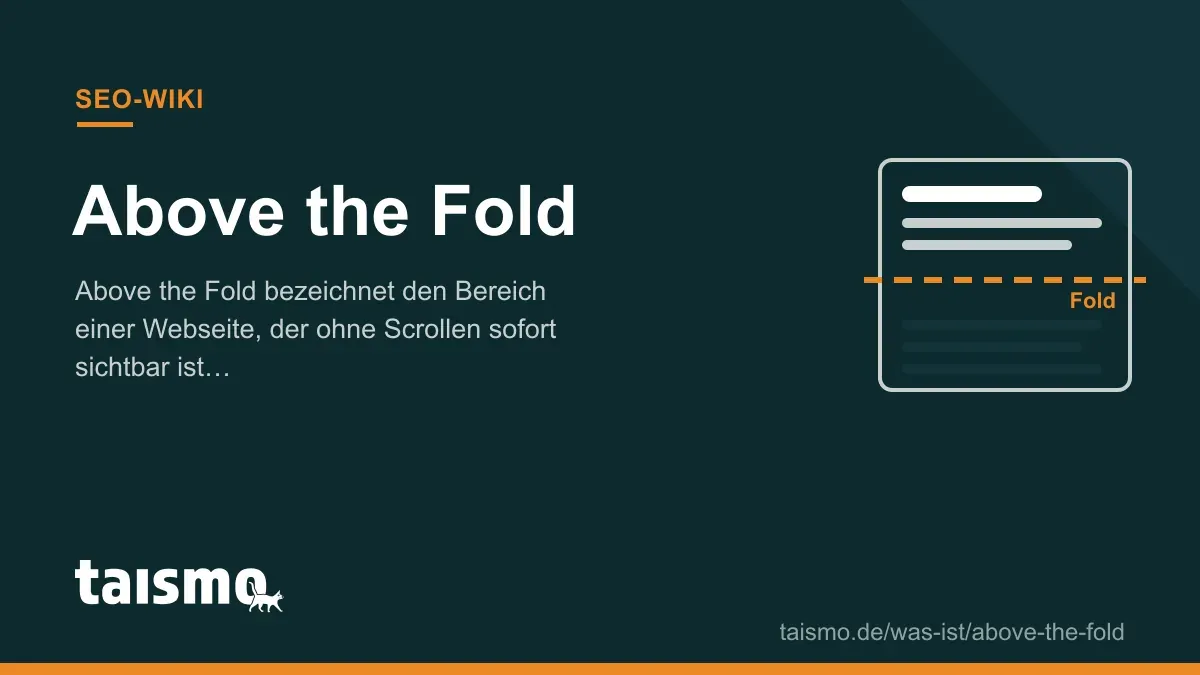
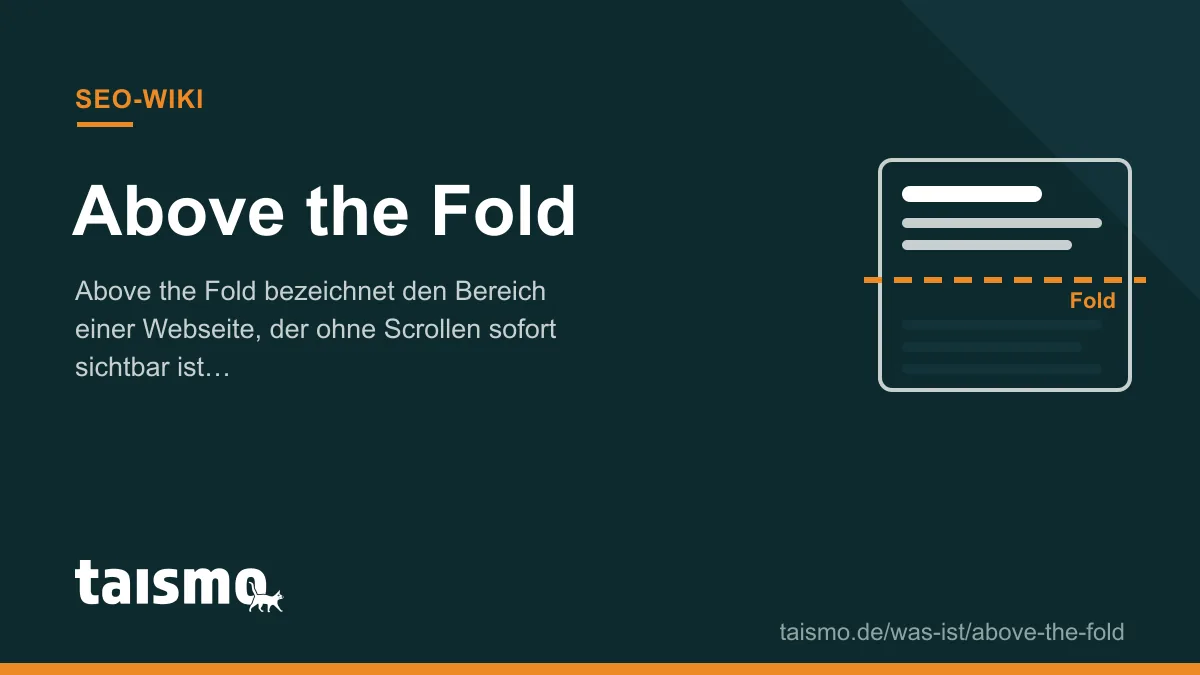
Above the fold refers to the area of a web page that is immediately visible without scrolling. The fold is the bottom edge of the browser window: Everything above it is what visitors see when the page loads; everything below it they only reach by scrolling. Where the fold sits depends on screen size and device; on a smartphone the area is much smaller than on a desktop. Above the fold decides within seconds whether a visitor stays, and it shapes key metrics such as the Largest Contentful Paint.
Term profile
Attribute
Details
Part of speech
Adverbial phrase, adopted as a fixed term in web design
The term comes from the newspaper business: Large-format newspapers lie folded at the kiosk, and only the upper half of the front page is visible, the area above the fold. That is where editors placed the strongest headline, because it decided the purchase. The web adopted the principle and replaced the paper fold with the bottom edge of the viewport. Unlike a newspaper, however, the web has no fixed fold: Every combination of device, resolution, and browser window creates its own cutoff line.
Why does above the fold matter for SEO?
Above the fold affects search engine optimization on 3 levels:
Load time measurement: The Largest Contentful Paint measures when the largest element in the visible area has finished rendering. The LCP element almost always sits above the fold, usually as a hero image or main heading. A heavy, slow-loading above-the-fold area directly worsens this metric.
Layout stability: Late-loading banners, images without fixed dimensions, or injected cookie notices shift the visible content and drive up the Cumulative Layout Shift. Both metrics belong to the Core Web Vitals, which Google uses as user experience signals.
User behavior: Visitors decide in the visible area whether the page answers their question. If they only find decoration or advertising there, they bounce. Google already demoted excessively ad-heavy above-the-fold areas back in 2012 with the page layout update.
Fig. 1: The fold splits the page: Above the fold holds the immediately visible area with the LCP element; below the fold begins underneath.
How do you design the area above the fold?
Ideally, the visible area answers 3 questions at a glance: Where am I, what do I get here, and what is the next step. In concrete terms: A meaningful H1 with the core topic, a first paragraph that answers the core question immediately, and a recognizable path to act. Heavy image sliders, autoplay videos, and large-scale advertising slow down loading and crowd out the answer.
The interplay with the technology matters: The hero image needs fixed width and height attributes and a high loading priority, while content further down may wait via lazy loading. How fast the visible area really loads is shown by a PageSpeed measurement; where the brakes sit is uncovered systematically by an SEO audit. There is no rule, however, that everything important must be squeezed above the fold: Users scroll naturally when the visible area gives them a reason to.
Frequently asked questions about above the fold
Where exactly is the fold?
There is no fixed pixel boundary. The fold sits at the bottom edge of the respective browser window and shifts with every device and resolution. Common reference values are around 600 to 900 pixels of height on desktop and the first screen on a smartphone.
Does the most important content have to sit entirely above the fold?
No. The core message and the opening belong in the visible area; details may follow below. Users scroll as soon as the beginning convinces them.
Is above the fold a ranking factor?
Not as a signal of its own. The area works indirectly through the Core Web Vitals, user behavior, and the demotion of ad-heavy layouts. If you make the visible area fast and content-rich, you improve several signals at once.
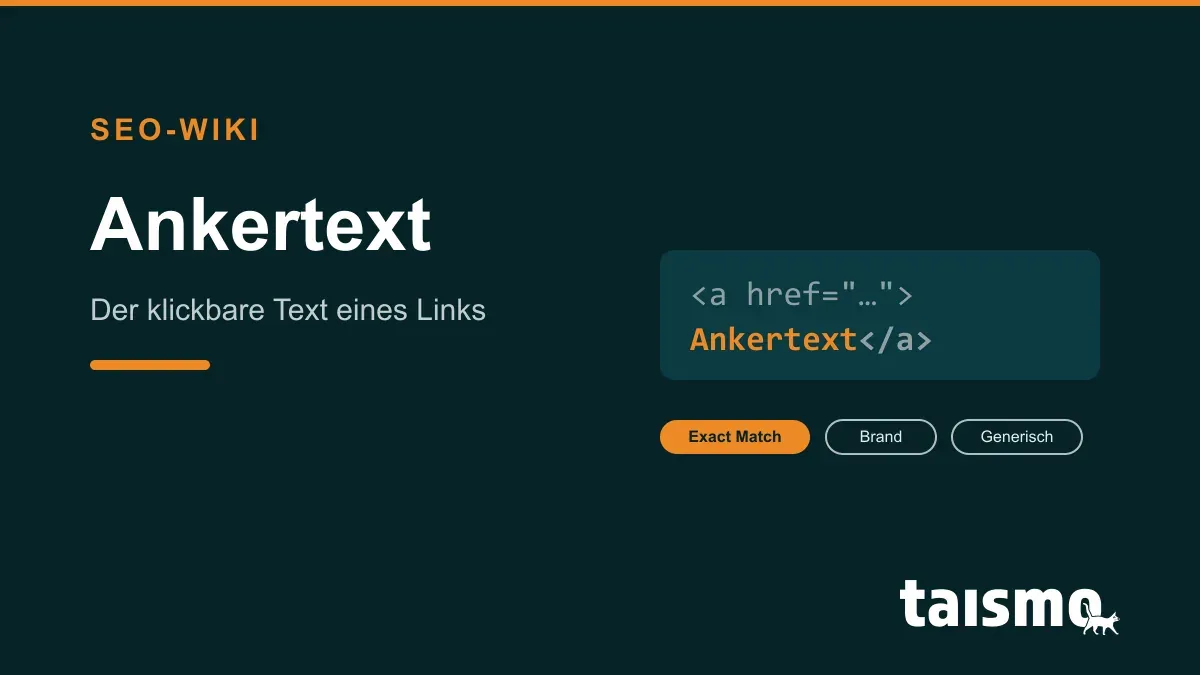
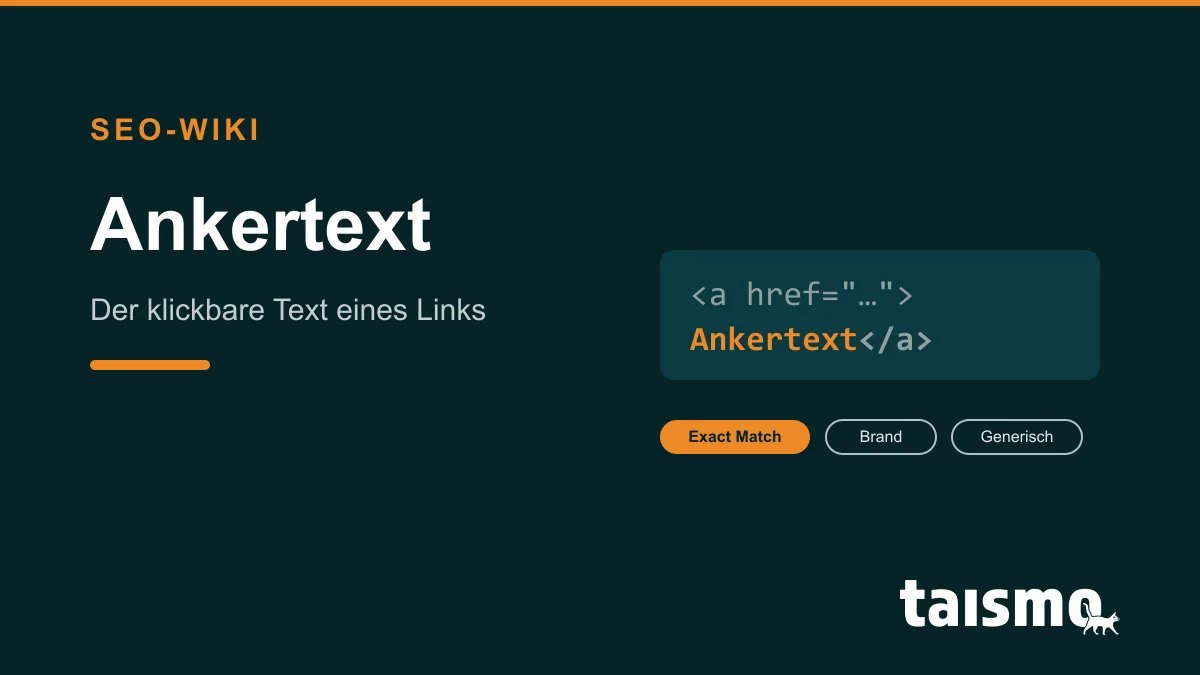
Anchor text is the visible, clickable text of a link; in HTML code it sits between the opening <a href="…"> and the closing </a>. Search engines read anchor text as a context signal: it describes what topic the linked target page covers. Precise anchor text helps users and Google alike understand where a link leads.
What types of anchor text are there?
SEO practice distinguishes 6 anchor text types:
Type
Example
Signal effect
Exact match
“SEO services”
Exact focus keyword of the target page, strongest topical signal
Partial match
“monthly SEO services for B2B”
Keyword embedded in additional words
Brand
“taismo”
Brand name, the most natural signal for backlinks
Generic
“click here”, “learn more”
No topical signal
Naked URL
“taismo.de”
Neutral, common in source citations
Image anchor
Linked image
The image’s alt attribute takes over the role of the anchor text
A natural link profile mixes all 6 types. Experience shows that brand anchors and naked URLs make up the largest share, while hard exact match anchors remain the exception.
Fig. 1: Anatomy of a link: the anchor text is the visible part between the a tags.
Why is anchor text important for SEO?
Anchor text tells Google what the target page is relevant for before the crawler even visits it. Together with the surrounding sentence, it forms the context in which the linked page is topically classified; the link also passes link juice to the target.
With backlinks, a warning applies at the same time: Google treats an unnaturally high share of hard exact match anchor text from external domains as an attempt at manipulation. The Penguin update has targeted exactly this pattern since 2012 and has been working in real time within the core algorithm since 2016. A natural backlink profile therefore mixes brand anchors, URLs, and descriptive phrasing.
How do you use anchor text correctly in internal links?
Internally, different rules apply than externally: you can consistently connect your own pages with precise, keyword-bearing anchor text without risking a penalty. 3 rules lead to the goal:
Anchor text emerges from the sentence context. The link blends into the reading flow instead of interrupting it as a “click here” foreign object.
Anchor text describes the target page. Anyone who clicks “internal linking” lands on the page about internal links, not on the homepage.
One anchor text per target page stays consistent. Changing link texts pointing to the same target dilute the topical signal.
A well-planned anchor text strategy across all internal links is one of the strongest on-page levers; that is why our ongoing SEO services review it with every new piece of content.
Frequently asked questions about anchor text
What is an example of good anchor text? Good anchor text names the link target specifically: “guide to internal linking” instead of “click here”. Readers know before the click which page to expect, and Google receives a clear topical signal.
Is “click here” bad anchor text? For SEO, yes: generic anchor text such as “here” or “learn more” carries no topical signal to the target page. Used occasionally it is harmless; as a standard it wastes relevance.
How long should anchor text be? There is no technical limit. 2 to 6 words have proven effective: long enough for a clear topical signal, short enough to stay readable within the sentence. Whole sentences as anchor text dilute the signal.
AI Mode is Google’s AI search mode: a dedicated area of Google Search that answers queries in a conversation instead of a list of links. A model from the Gemini family writes a coherent answer, links the sources it used, and answers follow-up questions in the same conversation. Google launched AI Mode in the United States in March 2025 and has since expanded it to more countries and languages; since late 2025 it has also been available in Germany.
How does AI Mode work?
AI Mode answers a query in four steps that Google has described under the name query fan-out:
Decompose: AI Mode splits the search query into several subqueries. “Which CRM is right for a team with 20 people in field sales?” becomes, for example, subsearches about vendors, pricing, and field sales features.
Search in parallel: All subqueries run against the Google index at the same time, including sources such as the Knowledge Graph and Shopping data.
Build the answer: The Gemini model summarizes the results into a single answer and links the sources the statements come from.
Ask follow-ups: Follow-up questions keep the context of the conversation. Search turns into a session instead of a single query.
You can enter queries as text, voice, or photo. The entry point is a dedicated “AI Mode” tab right next to the classic search results.
Fig. 1: Query fan-out: AI Mode splits the search query into subqueries and builds an answer with linked sources from the index results.
What is the difference between AI Mode and AI Overviews?
AI Overviews appear automatically, while you actively select AI Mode.AI Overviews are an AI summary that Google displays above the classic search results when the system considers it helpful. AI Mode, by contrast, is a full chat mode with its own interface.
Feature
AI Overviews
AI Mode
Trigger
Appears automatically for suitable queries
Actively selected via tab or prompt
Display
Block above the blue links
Dedicated chat interface
Follow-up questions
No, every search starts over
Yes, with conversation context
Classic results
Shown directly below
Only as linked sources in the answer
Both formats draw on the same index. If your content is cited in AI Overviews, it therefore has a good chance of showing up as a source in AI Mode as well.
What does AI Mode mean for websites?
AI Mode shifts the competition from a position in a list to a mention in an answer. Three consequences are measurable or foreseeable:
Fewer clicks per search: When the answer appears right in the search window, many visits never happen. AI Mode reinforces the trend toward zero-click searches.
More valuable clicks: Anyone who clicks anyway has already read the basics and arrives with a concrete intent.
A new measurement gap: Google Search Console does not report AI Mode traffic separately; clicks and impressions flow into the overall numbers without a label of their own.
In AI Mode, visibility means being linked as a source and mentioned in the answer. The discipline behind this is Generative Engine Optimization (GEO).
How does your website become visible in AI Mode?
There is no separate AI Mode ranking factor you could optimize in isolation. Five levers increase the chance of being mentioned:
Direct answers: Every important question gets a self-contained, quotable answer in the first sentence of its section.
Clear entities: Unambiguous information about your brand, people, and services makes your content attributable as an entity.
Structured data:Structured data in JSON-LD format delivers the facts in machine-readable form.
Topical authority: A fully covered topic area (topical authority) beats a single optimized article.
Crawlability: AI Mode uses the regular Google index. What Googlebot is not allowed to crawl cannot be cited either.
This work is not a side project next to search engine optimization; it is part of optimizing for AI visibility, which builds on solid SEO.
Frequently asked questions about AI Mode
Does AI Mode replace regular Google Search?
No. AI Mode is an additional mode alongside the classic search results. However, Google is gradually integrating AI elements into standard search, such as AI Overviews, so the line is increasingly blurring.
Is AI Mode the same as ChatGPT?
No. Both answer questions in a conversation, but AI Mode is built into Google Search and grounds every answer live in the Google index. ChatGPT is a standalone product by OpenAI with its own web search and its own sources.
Can I exclude my website from AI Mode?
There is no dedicated switch for AI Mode alone. The snippet controls of Google Search apply: with nosnippet, data-nosnippet, and max-snippet you limit what Google may take from a page into AI answers.
Do I see AI Mode traffic in Search Console?
Not separately. Google counts clicks, impressions, and positions from AI Mode in the regular performance data but does not report them as a separate category.
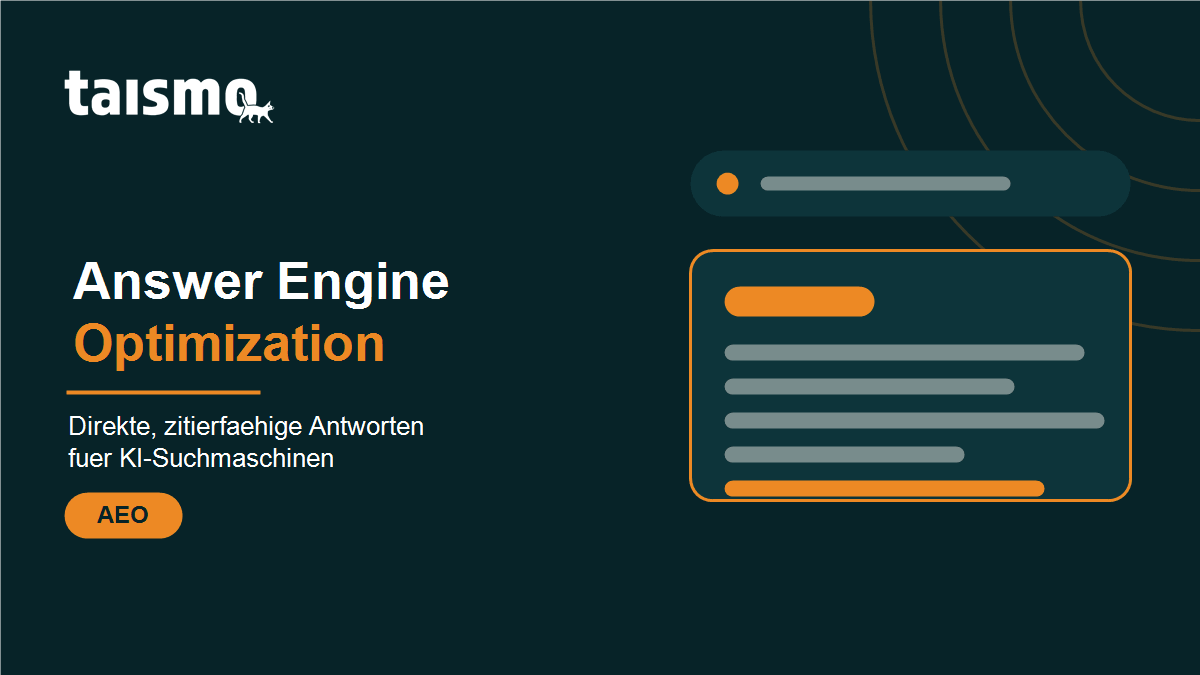
Answer Engine Optimization (AEO) is the practice of optimizing content so that answer engines serve it directly as the answer, for example Google AI Overviews, ChatGPT, Perplexity or voice assistants. Instead of aiming only at blue links in a result list, AEO aims at having a machine word the answer itself and use your content as its source. The focus lies on direct, clearly structured and quotable answers that a system can take over without a detour.
Answer engine optimization is a response to a shift in search behavior. More and more people ask a question and expect a finished answer, not ten links they have to click through themselves. AEO makes sure that answer comes out of your content and that your name is named as the source.
The term at a glance
Attribute
Detail
Term
Answer Engine Optimization
Abbreviation
AEO
Pronunciation
AN-ser EN-jin ahp-tuh-muh-ZAY-shun
Category
subdiscipline of search engine optimization (AI visibility)
Goal
appear as a direct, quotable answer inside answer engines
Related terms
SEO, GEO, LLMO, featured snippet, AI Overviews, voice SEO
What does answer engine optimization mean exactly?
Answer engine optimization means preparing content so that an answer engine serves it as a direct answer. An answer engine is a system that returns one single, worded answer to a question instead of a list of results. That includes Google AI Overviews, ChatGPT, Perplexity, Microsoft Copilot and voice assistants such as Alexa or Google Assistant.
The difference from the classic result list is fundamental. In classic search, people pick from several links themselves. With an answer engine, the machine has already made that choice and presents a summarized answer. AEO works exactly at that point: the content has to be so unambiguous and so verifiable that the machine can take it over and quote it safely.
Three properties make content easy for answer engines to take over: a direct answer in the first sentence, a clear structure of headings, lists and tables, and verifiable facts with figures and sources. If one of them is missing, the machine tends to reach for a competing source instead.
How do answer engines work?
Answer engines work in three steps: they understand the question, retrieve matching content and word an answer out of it. Technically, most systems combine a large language model with live research on the web, a method known as retrieval-augmented generation.
First the system breaks the user question down into its intent. Then it searches an index or the open web for passages that serve that intent. From the best passages, the language model produces a coherent answer and often points to the sources it used with a footnote or a link. That selection step is exactly where it is decided whether your content gets cited.
Fig. 1: How an answer engine turns a question into a cited answer. AEO works on the selection and wording step.
Because many answer engines disclose their sources, AEO has become measurable. You can check whether and how often your content shows up in AI Overviews or in Perplexity as evidence. How these generative answers come about in detail is covered by the term Generative Engine Optimization.
AEO vs. SEO vs. GEO: what is the difference?
SEO, GEO and AEO pursue the same goal, visibility in search, but they start at different output formats. SEO optimizes for the classic result list, GEO for generative answers, AEO for the direct answer to one concrete question.
SEO (search engine optimization): optimizes pages so they rank high in the classic result list. People click a link themselves.
GEO (generative engine optimization): optimizes content so that generative AI systems build it into their summarized texts and name it as a source.
AEO (answer engine optimization): optimizes content for the direct, often short answer to one concrete question, in a featured snippet, in an AI Overview or read out by voice.
The three approaches overlap strongly and do not rule each other out. Content that answers a question cleanly in the first sentence often wins a featured snippet, gets cited by generative systems and gets read out by voice assistants at the same time. In practice we treat AEO and GEO as closely related building blocks of one AI visibility strategy. Closely related as well is LLMO, the targeted optimization for large language models.
Fig. 2: SEO, GEO and AEO compared. Same goal, different output formats.
Which measures belong to AEO?
Answer engine optimization covers six concrete measures that make content easy for answer engines to take over. They build on classic SEO and sharpen it toward direct answers.
Answer the question in the first sentence: every section delivers its core statement right away, before it explains it. Answer engines prefer to pull that first sentence.
Create a clear structure: headings as natural questions, short paragraphs, lists from three points on and tables for comparable data. Structure makes single passages extractable.
Mark up structured data: schema.org markup such as FAQPage, DefinedTerm or HowTo helps machines identify the content type without doubt. Structured data is a core lever of any AI visibility.
Back up your facts: figures, data and traceable sources raise the chance of being cited. Machines prefer statements they can verify.
Strengthen entities and authority: consistent details about brand, author and topics, plus experience and depth (E-E-A-T), make a source trustworthy.
Optimize for voice search: natural, spoken phrasing serves voice assistants. The term voice SEO explains the detail.
These measures interlock. A glossary article that delivers its definition cleanly in the first sentence, marks it up with DefinedTerm schema and backs it with figures is a textbook case of AEO. That is exactly the principle we build our clients’ content on in our SEO services.
Why is AEO becoming more important?
AEO is becoming more important because answer engines increasingly step between people and websites. Google serves an AI Overview above the result list for many queries, and millions of people research straight inside ChatGPT or Perplexity without opening a classic search engine at all.
That shift has a noticeable consequence: visibility is created inside the answer more and more often, not only in the ranking. When a machine answers the question, part of the audience never clicks any further. Whoever shows up as a source in that answer stays visible; whoever only ranks in the classic way loses reach to the answer box.
For companies that means AEO is not a replacement for SEO but its logical extension. The classic result list stays relevant, yet answer engines are turning into a second, growing channel. Optimize for it early and you secure a place in the answers before competitors take the channel. Our work on GEO and AI visibility starts exactly there.
Frequently asked questions about answer engine optimization
Is AEO the same as SEO? No, AEO is a subdiscipline of search engine optimization. SEO aims at good rankings in the result list, AEO at the direct answer to a question by an answer engine. AEO builds on SEO fundamentals and sharpens them toward quotable answers.
How do I measure the success of AEO? You check whether your content shows up as a source in answer engines, for example in Google AI Overviews or in the footnotes of Perplexity. Visibility in featured snippets and your share of citations in AI answers work as additional metrics.
Do small companies need AEO? Yes, small and midsized companies benefit in particular, because answer engines weight content quality and clear answers higher than sheer domain size. A precisely answered technical term can get cited against large competitors too.
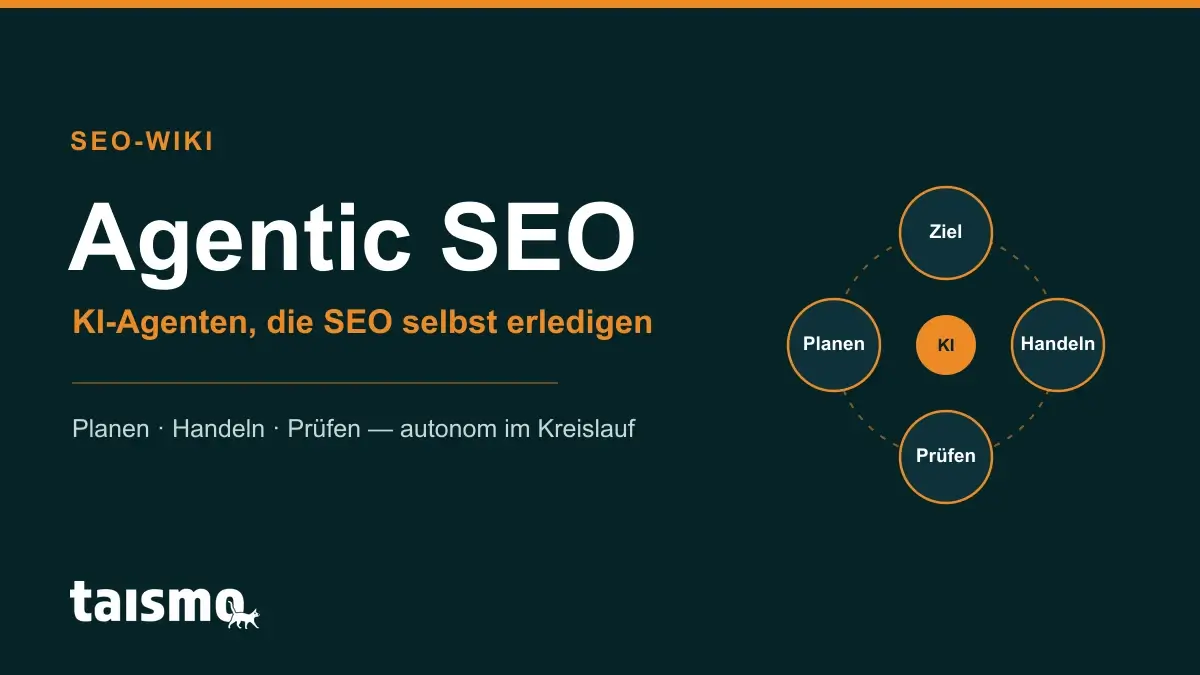
Agentic SEO describes the use of autonomous AI agents that plan, carry out and continuously readjust SEO tasks on their own, from keyword research through content analysis to technical monitoring. Unlike a chatbot that waits for every single instruction, an agent pursues a given goal independently across many steps and draws on tools of its own, a memory and a decision logic. The human sets the strategy, the guardrails and the approval, while the agent takes on the operational legwork.
How does Agentic SEO differ from classic SEO automation?
The difference lies in the independence. Classic automation runs a rigid, predefined sequence: “Every Monday, pull the rankings and send a spreadsheet.” It does exactly that, no more and no less. An AI agent instead gets a goal and decides for itself how to get there. If a ranking drops, it can check the affected page on its own, compare it with the competitor, suspect a cause and formulate a proposed measure, without anyone triggering each of those steps individually.
Agentic SEO also sets itself apart from generative AI such as a plain chatbot: a generative model reacts passively to a prompt and then waits for the next input. An agent works proactively towards a goal and chains several work steps together logically.
How does an AI agent work in SEO?
At its core, an SEO agent rests on four building blocks that together make its autonomous work possible:
Goal and instructions: an overarching task and fixed guardrails that the agent lines its decisions up with, without needing a new instruction for every step.
Tools: direct access to interfaces, for example keyword databases, SERP queries, crawlers or the site’s own CMS, so that actions are really carried out instead of only described.
Memory: context across individual tasks, so that earlier results and patterns feed into later decisions.
Decision logic: the ability to judge interim results and derive the next step from them, the loop of planning, acting and checking.
In practice, several specialized agents often work together: a research agent finds topic gaps, a content agent turns them into a briefing, an analysis agent checks the result, and at the end there is human approval.
Fig. 1: Several specialized AI agents work towards one goal, the final approval stays with the human.
Agentic SEO, GEO, AEO and LLMO: what is the difference?
These terms often get mixed up, but they describe two different perspectives. Agentic SEO looks at the agent as the one doing the SEO work. Generative Engine Optimization (GEO), Answer Engine Optimization (AEO) and LLMO look at the agent as the one searching: they optimize content so that AI systems find it, understand it and cite it in their answers.
Term
Perspective
Core question
Agentic SEO
agent as the one doing
How do AI agents get my SEO work done?
GEO / AEO / LLMO
agent as the one searching
How does my content become visible in AI answers?
Classic automation
rigid script
How do I repeat a fixed sequence?
Both sides belong together: the more autonomous search systems become (agentic search), the more important it gets to prepare content so that machines read it unambiguously and can quote it, which is classic GEO terrain and the core of our GEO work. Agentic SEO is often the operational tool that makes exactly that preparation efficient.
Which SEO tasks do AI agents handle today?
Agents are especially strong at data heavy, recurring work. Typical fields of use:
Research and ideas: uncover topic gaps, compare competitor content, spot emerging terms early.
Content: analyze top ranking pages, find semantic gaps, propose internal links, watch performance after publication.
Technology: report crawling errors, observe the effects of algorithm updates, prioritize anomalies.
Monitoring: keep watching rankings and technical signals and raise an alert automatically when they drop.
Does Agentic SEO replace the SEO expert?
No. Agents take over the data work and the legwork, but strategy, creativity and the final judgment stay with the human, the principle of “human in the loop”. An agent can measure a topic gap, but it cannot decide whether that gap fits a company’s positioning. It can produce text, but it cannot guarantee that the text is factually right and sounds like the brand. Without control, you risk hallucinations, interchangeable content and blind spots when Google introduces new signals. A hybrid model therefore makes sense: clear governance, documented approvals and a team that steers the agents, as in our SEO management, where AI tools speed up the analysis but people make the decisions.
Frequently asked questions about Agentic SEO
Is Agentic SEO the same as GEO?
No. Agentic SEO describes AI agents that carry out SEO work. GEO (Generative Engine Optimization) describes how content becomes visible in AI answers. Agentic SEO is often the tool, GEO is the goal.
Do you need programming skills of your own for Agentic SEO?
Not necessarily. First agents can be set up through existing platforms and automation tools. What counts is clean data, clear goals and a human control instance, not the code itself.
AI Overviews are AI-generated answer blocks that Google shows at the very top of its search results. A customized Gemini model summarizes information from several web sources into one short overview and links to the pages it used. AI Overviews sit above the classic organic results and are meant to answer a query directly on the results page, without a click. They are the production successor to the Search Generative Experience (SGE) and have been rolling out in Germany since March 2025.
AI Overviews change how visibility in search comes about: it is no longer only your position in the result list that counts, but whether your page is picked up as a source in the AI answer and linked. That is exactly why AI Overviews are the central reference point of Generative Engine Optimization (GEO).
The term at a glance
Attribute
Detail
Part of speech
noun, plural (the AI Overviews)
Pronunciation
ay-eye OH-ver-vyooz
Hyphenation
AI Over·views
Also known as
AI summaries, AI answers
Technology
customized Gemini model
Predecessor
Search Generative Experience (SGE)
Launched
USA: May 2024 · Germany: March 2025
Related terms
SGE, AI Mode, featured snippet, GEO, SERP
How do AI Overviews work?
AI Overviews work in three steps: Google interprets the query, a Gemini model picks and synthesizes matching web sources, and the result appears as a summarized answer block with links to those sources. The decisive difference from normal search is that the answer is worded generatively and does not come from a single page.
For AI Overviews, Google uses a technique called “query fan-out”: several related queries are derived from one question in the background, and their results are brought together. The AI answer draws by preference on content that already ranks well in the organic results and that presents information clearly and verifiably. Every source it uses is shown as a link, so people can check the statements on the original page.
Fig. 1: How an AI Overview is created. From the search query, a Gemini model picks several sources and turns them into an AI answer with source links.
One thing matters here: Google confirms no fixed ranking factors specific to AI Overviews. The pages chosen as sources are above all those with high topical relevance, a clear structure and verifiable facts, which are the same signals that count in classic search.
When do AI Overviews appear in search?
AI Overviews do not appear for every query. They show up above all for informational and complex questions where a summarizing answer adds value. For simple navigational searches (a specific brand, for example) or purely transactional queries they often stay away.
Google is also cautious with sensitive YMYL topics (“Your Money or Your Life”) such as health, finance or law, where a wrong AI statement could do real damage. Whether an AI Overview is served, and how, is something Google decides dynamically per query, and it keeps testing the trigger. You cannot steer that directly for a single website, but you can watch it in Google Search Console: if your click-through rate drops while impressions stay stable, that is often a sign of an AI Overview sitting above your result.
What is the difference between an AI Overview, a featured snippet and SGE?
The difference lies in the source, the way the text is produced and the status of the format. A featured snippet highlights one single paragraph quoted verbatim from exactly one source. An AI Overview, in contrast, produces a new text that brings several sources together. SGE was the experimental stage that AI Overviews grew out of.
Featured snippet: an extracted passage from one page, taken over unchanged, with a direct link. It has existed for years as “position zero”.
AI Overview: a generatively worded summary drawn from several pages, with several source links. In production since 2024 and 2025.
Search Generative Experience (SGE): the test name of the feature in Google Search Labs (from May 2023). SGE has been retired; the production version is called AI Overviews.
Fig. 2: AI Overview, featured snippet and SGE compared. The number of sources, the type of text and the status set the three formats apart.
Do not confuse the AI Overview with AI Mode: AI Mode is a separate, conversational search mode in its own tab, while an AI Overview is a single block inside the normal results page.
What impact do AI Overviews have on SEO and click-through rate?
AI Overviews reinforce the trend toward zero-click search: many people get their answer straight from the AI block and no longer click a result. For purely informational queries that can noticeably lower the click-through rate of the organic results, because the summary replaces the click.
At the same time a new opportunity opens up: a page that is linked as a source in the AI Overview gains visibility and brand recognition, often in a more prominent spot than it would have held in the classic list. So the effect cuts both ways. Instead of watching positions alone, the goal shifts toward being cited as a trustworthy source in the AI answers. Ignore that shift and you lose reach; work with it and you secure presence in a new search format. That is why keeping an eye on AI Overviews belongs in every SEO audit today.
How do you optimize content for AI Overviews?
You optimize content for AI Overviews by making it clear, verifiable and easy to quote. AI Overviews are not a separate lever: solid SEO remains the foundation, complemented by the mindset of Generative Engine Optimization. The most important approaches:
Answer questions directly: the core answer belongs in the first one or two sentences of a section, followed by the detail. AI systems prefer to take over statements that stand on their own and can be quoted.
Clear structure: headings phrased as natural questions, short paragraphs, lists and tables. That makes it easier for the model to extract single facts cleanly.
Verifiable facts and figures: concrete values, sources and definitions instead of vague wording raise your chances of being picked as a reliable source.
Strengthen E-E-A-T: build up experience, expertise, authority and trust through E-A-T signals such as named authors, a legal notice and external evidence.
Structured data:structured data in JSON-LD format helps Google understand your content and entities unambiguously.
Keep content current: pages maintained regularly, with strong content freshness, are drawn on more often than outdated ones.
Because AI Overviews draw by preference on pages that already rank strongly, solid SEO stays the precondition. If you want lasting visibility in the AI answers and in the search results, you need continuous SEO support that develops the technical base, the content and your quotability together.
Frequently asked questions about AI Overviews
What are AI Overviews on Google? AI Overviews are AI-generated summaries that Google shows above the organic search results. A Gemini model condenses several web sources into one short answer and links to them.
Can you turn AI Overviews off? AI Overviews are a fixed part of Google Search and cannot be switched off globally for good. People can call up a plain list of links without the AI block through the “Web” filter, but that applies only to the single search.
What is the difference between AI Overviews and SGE? SGE (Search Generative Experience) was the experimental test version in Google Search Labs from May 2023. AI Overviews are the production successor, served in the USA since 2024 and in Germany since March 2025.
How do you get into Google’s AI Overviews? There is no guarantee, but your chances rise with clearly structured content that answers questions directly, offers verifiable facts, holds good rankings and shows strong E-E-A-T signals as well as structured data.
The alt tag, short for alternative text, is a text description of an image that sits in the HTML code of a page. It makes the content of an image available to screen readers and search engines. That matters above all for users with a visual impairment, because the alternative text can be read aloud when the image itself is not visible.
Alt text is an attribute of the image element and not a tag of its own, even though the name alt tag has stuck. It is a fixed part of web development and of online marketing.
How do you set an alt tag?
To add an alt tag to an image on a web page, you use the alt attribute inside the <img> tag of the HTML code. The alt text should be short but meaningful and should describe the content and the context of the image clearly. Here is a simple example:
<img src="/example-image.jpg" alt="Example image of a blue sky with white clouds">
In this example the alt attribute gives a clear description of what the image shows. It is worth including relevant keywords, without overloading the text or adding information that has nothing to do with the image.
Are alt tags important for SEO?
Alt tags play an important role in search engine optimization (SEO), because they help search engines understand what an image shows. That improves the accessibility of your website and raises the chance that your images turn up in the image search results. Alt tags also reinforce the context of a page when they carry relevant long-tail keywords, which can improve the SEO performance of the whole page.
Keep in mind that overloading alt tags with keywords, a practice known as keyword stuffing, can be judged negatively by search engines and can work against your SEO. So the focus belongs on precise, relevant descriptions that help visitors and search engines alike.
Alt texts belong on every image of a site, which is why missing alt attributes are one of the standard checks in our SEO audit.
Advertorials are advertising designed to look like an editorial article. They read like a regular article or blog post, but they are in fact an advertising campaign meant to promote a product or a service. Advertorials are used in magazines, in online publications and on social media platforms.
Why do advertorials exist?
Advertorials are contested, but they can be an effective way for companies and brands to promote their products or services. What matters is that they are used in a transparent and honest way, so that they win the trust of readers instead of losing it.
In short, an advertorial is a form of advertising built in the shape of an editorial article, in order to create a higher level of credibility and trust with readers. Contested as they are, they can work for companies and brands as long as they are used transparently and honestly. In that respect advertorials sit close to content marketing and influencer marketing, where paid and editorial content also meet.
What rules apply to advertorials?
Advertorials have to be clearly labeled as advertising, so that readers know they are not reading neutral editorial content. An advertorial should also state the intentions behind the article clearly and honestly, including an obvious note that the piece is advertising.
Where paid placements fit next to your organic work is a question of strategy, and it is part of day-to-day SEO support.
A/B testing is a method for finding out which of two variants works better when you have a decision to make. It can be a decision about design, about copy or about wording, or about anything else that influences your traffic or your reach.
How does A/B testing work?
An example: a trades business is looking online for new staff in renovation work. For that job the company publishes two job ads with different wording:
Wording A: “We are looking for a tradesperson”
Wording B: “We are looking for a renovation specialist”
Which of the two job ads goes down better with the target audience?
An A/B test answers that fairly easily. The audience is split into a group A and a group B, and each group gets shown one of the variants. Afterwards you can evaluate which wording had the greater effect. In this case the clicks on the link to the job ad and the completed application forms would serve as the indicator. Tests of exactly that kind are part of how we build campaigns in social recruiting.
What should I watch out for in A/B testing?
What matters is that you change only one variable at a time, so the test can give a clear answer about what caused the better performance. If you test the wording and the design at the same time, you cannot say which of the two made the difference.
A/B tests should also be run again and again, because algorithms and audiences keep changing and developing. A design or a wording that worked well a year ago and appealed to a lot of people can put those same people off today.