



What is Agentic SEO?
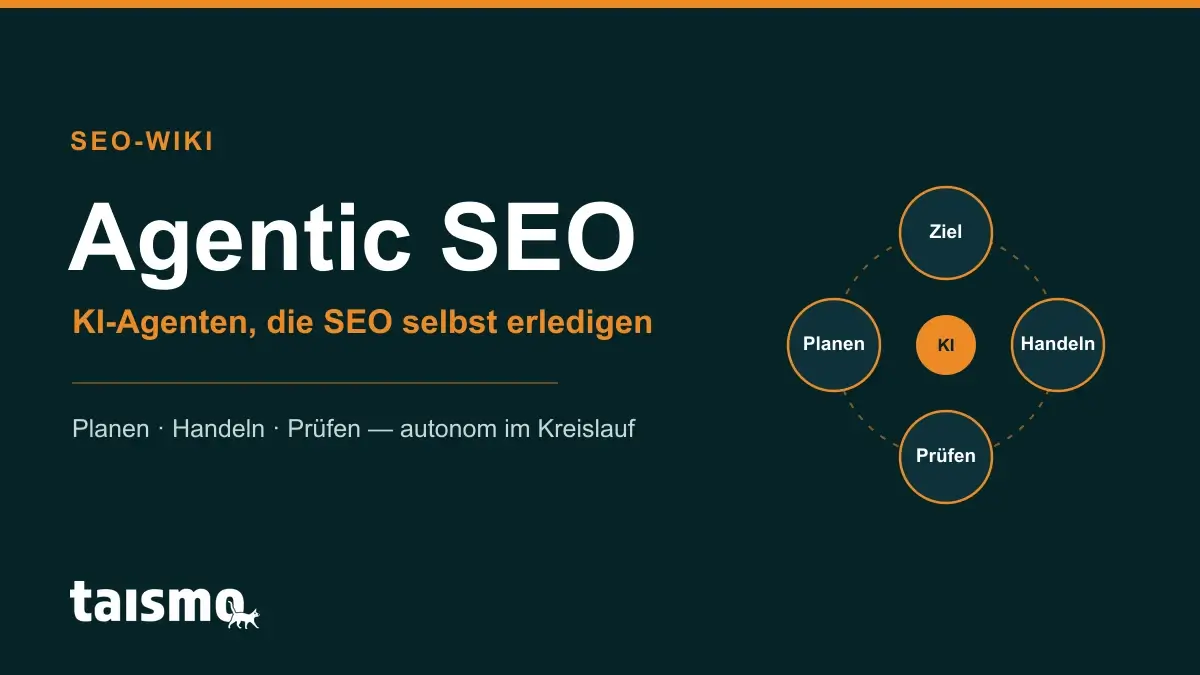
Agentic SEO describes the use of autonomous AI agents that plan, carry out and continuously readjust SEO tasks on their own, from keyword research through content analysis to technical monitoring. Unlike a chatbot that waits for every single instruction, an agent pursues a given goal independently across many steps and draws on tools of its own, a memory and a decision logic. The human sets the strategy, the guardrails and the approval, while the agent takes on the operational legwork.
How does Agentic SEO differ from classic SEO automation?
The difference lies in the independence. Classic automation runs a rigid, predefined sequence: “Every Monday, pull the rankings and send a spreadsheet.” It does exactly that, no more and no less. An AI agent instead gets a goal and decides for itself how to get there. If a ranking drops, it can check the affected page on its own, compare it with the competitor, suspect a cause and formulate a proposed measure, without anyone triggering each of those steps individually.
Agentic SEO also sets itself apart from generative AI such as a plain chatbot: a generative model reacts passively to a prompt and then waits for the next input. An agent works proactively towards a goal and chains several work steps together logically.
How does an AI agent work in SEO?
At its core, an SEO agent rests on four building blocks that together make its autonomous work possible:
- Goal and instructions: an overarching task and fixed guardrails that the agent lines its decisions up with, without needing a new instruction for every step.
- Tools: direct access to interfaces, for example keyword databases, SERP queries, crawlers or the site’s own CMS, so that actions are really carried out instead of only described.
- Memory: context across individual tasks, so that earlier results and patterns feed into later decisions.
- Decision logic: the ability to judge interim results and derive the next step from them, the loop of planning, acting and checking.
In practice, several specialized agents often work together: a research agent finds topic gaps, a content agent turns them into a briefing, an analysis agent checks the result, and at the end there is human approval.
Agentic SEO, GEO, AEO and LLMO: what is the difference?
These terms often get mixed up, but they describe two different perspectives. Agentic SEO looks at the agent as the one doing the SEO work. Generative Engine Optimization (GEO), Answer Engine Optimization (AEO) and LLMO look at the agent as the one searching: they optimize content so that AI systems find it, understand it and cite it in their answers.
| Term | Perspective | Core question |
|---|---|---|
| Agentic SEO | agent as the one doing | How do AI agents get my SEO work done? |
| GEO / AEO / LLMO | agent as the one searching | How does my content become visible in AI answers? |
| Classic automation | rigid script | How do I repeat a fixed sequence? |
Both sides belong together: the more autonomous search systems become (agentic search), the more important it gets to prepare content so that machines read it unambiguously and can quote it, which is classic GEO terrain and the core of our GEO work. Agentic SEO is often the operational tool that makes exactly that preparation efficient.
Which SEO tasks do AI agents handle today?
Agents are especially strong at data heavy, recurring work. Typical fields of use:
- Research and ideas: uncover topic gaps, compare competitor content, spot emerging terms early.
- Content: analyze top ranking pages, find semantic gaps, propose internal links, watch performance after publication.
- Technology: report crawling errors, observe the effects of algorithm updates, prioritize anomalies.
- Monitoring: keep watching rankings and technical signals and raise an alert automatically when they drop.
Does Agentic SEO replace the SEO expert?
No. Agents take over the data work and the legwork, but strategy, creativity and the final judgment stay with the human, the principle of “human in the loop”. An agent can measure a topic gap, but it cannot decide whether that gap fits a company’s positioning. It can produce text, but it cannot guarantee that the text is factually right and sounds like the brand. Without control, you risk hallucinations, interchangeable content and blind spots when Google introduces new signals. A hybrid model therefore makes sense: clear governance, documented approvals and a team that steers the agents, as in our SEO management, where AI tools speed up the analysis but people make the decisions.
Frequently asked questions about Agentic SEO
Is Agentic SEO the same as GEO?
No. Agentic SEO describes AI agents that carry out SEO work. GEO (Generative Engine Optimization) describes how content becomes visible in AI answers. Agentic SEO is often the tool, GEO is the goal.
Do you need programming skills of your own for Agentic SEO?
Not necessarily. First agents can be set up through existing platforms and automation tools. What counts is clean data, clear goals and a human control instance, not the code itself.