An embedding is the representation of a piece of content, such as a word, sentence, or image, as a long series of numbers (a vector) that captures its meaning mathematically. Content with similar meaning receives similar number series and sits close together in the so-called vector space. Search engines and AI systems use embeddings to compare texts by meaning instead of by wording.
Term profile at a glance
Attribute
Details
Part of speech
Noun (“embedding”)
German equivalent
Einbettung
Typical size
768 to 3,072 numbers (dimensions) per vector
Related terms
Vector database, semantic search, RAG
Field
Machine learning, AI search
How does text become a vector?
A trained AI model converts text into a vector: it reads the text and outputs a fixed number of values, often 768 or 1,536. Each of these numbers describes an aspect of meaning that the model learned during training on billions of text examples. A single value is not readable for humans; what carries meaning is the pattern of the whole number series.
A comparison makes it tangible: “bakery” and “pastry shop” produce similar vectors, “bakery” and “car repair shop” clearly different ones. The distance between two vectors can be calculated, and the smaller it is, the more similar the meaning. This even works across languages: the German “Bäckerei” and the English “bakery” sit close together in vector space although they share no spelling.
Fig. 1: From text to vector: the model translates meaning into numbers; similar terms sit close together in the vector space.
What is a vector database?
A vector database is a database that stores embeddings and finds the most similar stored entries for a query vector within milliseconds. For this, AI applications split texts into sections (chunks), create an embedding per section, and store it in the vector database. When a user asks a question, the question itself is converted into a vector and compared against the stored inventory; the matches are the sections closest in meaning.
This is exactly how retrieval-augmented generation works: an AI assistant fetches the best-matching sections from the vector database and formulates a grounded answer from them instead of guessing freely.
Why do embeddings matter for AI search?
Embeddings decide which content AI search finds at all: what gets compared is not the wording of a page but its meaning. For content, 3 consequences follow:
Self-contained paragraphs win: AI systems compare sections, not whole pages. A paragraph that is understandable without the rest of the text gets recognized as a match on its own.
Clear definitions produce precise vectors: A sentence following the pattern “X is Y” lands far ahead in the similarity comparison for definition questions.
Consistent terminology bundles meaning: Using the same technical term throughout, instead of rotating synonyms, creates a sharp semantic profile.
Are embeddings the same as keywords?
No. A keyword is a visible search term, an embedding is an internal numeric representation of meaning. Embeddings also recognize content as relevant that does not contain the searched word at all, because they compare meaning instead of character strings.
Can I influence the embeddings of my website directly?
Not directly, the vectors are produced by the respective model. What you can influence is the input: clearly written, self-contained paragraphs with consistent terminology produce precise embeddings and get recognized as matches for fitting questions.
Does Google use embeddings?
Yes. Google has been using neural systems such as RankBrain, BERT, and MUM for years, which process queries and content as vectors. The AI answers in Google Search also rely on semantic similarity instead of pure word matching.
Evergreen content is content that stays relevant for years and continuously attracts visitors, because its topic is not tied to events, seasons, or trends. The name comes from evergreen plants: just as their leaves stay green, evergreen content does not lose its validity. Typical formats are definitions, tutorials, and foundational guides.
Term profile at a glance
Attribute
Details
Part of speech
Noun phrase (“evergreen content”)
Literal meaning
After evergreen plants that never shed their leaves
Synonyms
Timeless content, evergreen articles
Opposite
News content, seasonal content
Field
Content marketing, content strategy
How does evergreen content differ from news content?
Evergreen content and news content differ above all in their traffic curve: news content creates a short spike and then drops to almost zero, evergreen content builds visitor numbers slowly and holds them for years.
Attribute
Evergreen content
News content
Trigger
Timeless problem or foundational knowledge
Current event
Traffic curve
Slow build-up, then constant
High spike, fast decline
Lifespan
Years
Days to weeks
Upkeep
Regular updates of the details
None; the piece ages by design
Example
“What is a keyword?”
“Google announces a new update”
In content marketing, both types complement each other: evergreen content carries the base load of visitors, news content shows recency and closeness to the field. An editorial plan made only of news has to fight for reach every single week; an evergreen foundation works permanently.
Fig. 1: Traffic curves compared: news content creates a short spike, evergreen content carries traffic for years.
Which formats work as evergreen content?
5 formats have proven themselves as evergreen content:
Definitions and glossaries: Questions like “What is X?” are searched permanently.
Checklists and templates: Practical tools get saved, shared, and revisited.
Foundational guides: Lasting problems such as planning a move or understanding a tax return never lose their audience.
FAQ collections: Bundled answers to the most common questions of a field.
Extensive evergreen pieces that carry a core topic of a website are often expanded into cornerstone content and linked internally with particular strength. In SEO services, this evergreen foundation is usually the first stage of an editorial plan, because it delivers predictable traffic.
How do you maintain evergreen content?
Evergreen means low-maintenance, not maintenance-free: even timeless content ages in its details. A proven maintenance cycle has 4 steps:
Set a review date: Every evergreen article gets a fixed review rhythm, commonly 6 to 12 months.
Update the details: Bring numbers, screenshots, examples, and external links up to date.
Add internal links: Connect new, thematically fitting articles to the existing piece.
Make updates visible: Maintain the modification date on the page and in the schema markup.
How strongly search engines weight recency depends on the topic; the article about content freshness explains the mechanics. For evergreen topics one rule holds: factual correctness beats artificial freshness. A new date without a real revision improves nothing.
Frequently asked questions about evergreen content
How long does evergreen content stay relevant?
As long as the underlying problem exists: a definition or a foundational tutorial can bring visitors for 5 years and longer. The precondition is that details such as numbers, screenshots, and examples are updated regularly.
Do glossary articles count as evergreen content?
Yes, glossary articles are a prime example: the question “What is X?” is searched permanently, and the answer changes only in details. That is why glossaries form the evergreen foundation of many content strategies.
How often should you update evergreen content?
A review every 6 to 12 months is common. For topics with fast change, such as AI or legal requirements, the cycle shortens; for stable foundational topics, an annual check of facts, links, and examples is enough.
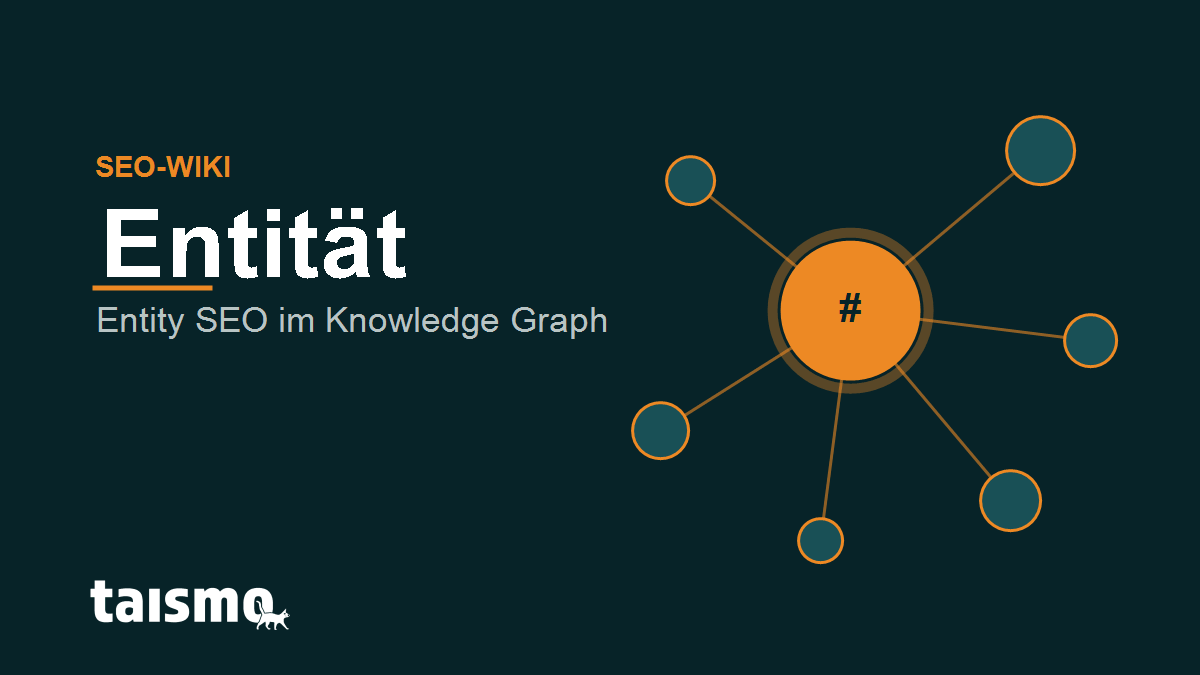
An entity is a uniquely identifiable thing or concept that exists in its own right and can be told apart from everything else, for example a person, a place, a company, a product or an abstract idea. In SEO, an entity is such a node in Google’s Knowledge Graph, tied to a unique ID that carries its properties and its relationships to other entities. Entities are the foundation of semantic, entity-based SEO: Google understands content not through single keywords, but through the things a text describes and the way they connect.
The term comes from philosophy and computer science, where it simply describes a “being”, an object with an identity of its own. Google adopted the principle in 2012 with the Knowledge Graph, under the motto “things, not strings”. Since then the search engine no longer sorts content by words alone, but by the objects and meanings behind them.
The term at a glance
Feature
Detail
Part of speech
noun (an entity, plural: entities)
Pronunciation
“en-ti-ty”, stress on the first syllable
Syllables
en·ti·ty
Origin
from Late Latin entitas (“being, existence”)
Field
semantic SEO, Knowledge Graph, entity SEO, GEO
Related terms
Knowledge Graph, named entity, structured data, ontology, entity SEO
What is an entity in search?
In search, an entity is a real or abstract object that Google stores as an independent node with a stable identifier in the Knowledge Graph. Every entity carries a machine-readable ID (a Machine ID in the format /m/… or /g/…) that tells it apart from every other thing, no matter what a user calls it.
An entity consists of three building blocks: a type (person, place, organization, product), a set of properties (attributes such as founding year, population or color) and relationships to other entities. The city of Munich, for example, is a place entity with the property “around 1.5 million inhabitants” and the relationship “located in → Bavaria”. It is exactly this structure that makes an entity understandable to a machine.
The difference to classic web search is fundamental. Google used to count words and how often they occurred. Today it recognizes the object behind the word, links it to everything it knows about that object and delivers knowledge boxes, knowledge panels and answers in the SERP.
Fig. 1: An entity as a node in the Knowledge Graph, connected to its type, its properties, its unique ID and neighboring entities.
How does Google recognize entities?
Google recognizes entities through natural language processing, above all through named entity recognition (NER). An algorithm breaks a text apart, picks out proper names and technical terms and matches them to a known entity in the Knowledge Graph. Four signals carry the most weight:
Named entity recognition: Google finds the names of people, places, brands and concepts in running text and resolves their meaning from the context.
Co-occurrence: When two entities appear together in many trustworthy sources, Google infers a relationship. If a brand is mentioned next to a service again and again, Google connects the two.
Structured data: Markup written in JSON-LD tells Google directly which entity a page describes. The term structured data explains more about that.
Knowledge sources: Google matches entities against open databases such as Wikidata, Wikipedia and the Google Business Profile and takes on the facts documented there.
The sameAs property inside structured data plays a key role here. It links your own entity to its records on Wikidata, LinkedIn or in business directories and confirms to Google that all of them describe the same thing. The more consistent the evidence, the more confident Google is in the match.
Entity vs. keyword: where is the difference?
A keyword is a string of characters that a user types in; an entity is the unambiguous concept behind it. The keyword “Golf” has several meanings: it can stand for the car, for the sport or, in German, for a gulf. An entity, by contrast, is always unambiguous. The VW Golf, the sport of golf and the Persian Gulf are three separate entities, each with its own ID.
That clarity solves the biggest problem of pure keyword optimization: ambiguity. Google no longer has to guess which meaning is intended, it reads it from the context of the surrounding entities. When “Golf” sits next to “horsepower”, “gearbox” and “trunk”, the car entity is the one that is meant.
Fig. 2: A keyword is ambiguous, an entity is unambiguous. The word “Golf” splits into three clearly separated entities.
In practice this means that keywords and entities do not rule each other out, they work together. The keyword stays the trigger of the search, the entity is the meaning that Google serves. Anyone who only counts keywords optimizes the surface; anyone who names and classifies entities cleanly meets the intent.
Why do entities matter for SEO and GEO?
Entities matter for SEO and GEO because Google and AI systems alike assemble their answers from entities and their relationships, not from single words. Whoever is anchored in these knowledge networks as a clearly defined entity gets pulled in as a source more often, in classic search results as well as in AI answers.
Three developments make entities the central SEO lever:
AI answers and AI Overviews: Large language models and the AI overviews in Google Search prefer facts that are documented as unambiguous entities. This is the core of Generative Engine Optimization (GEO).
Voice search and semantic understanding: Spoken queries are longer and richer in context. Google answers them through entities and their attributes, not through an exact word match.
Trust and authority: A brand that exists as an entity of its own, with consistent facts, sends strong E-E-A-T signals. Google attaches experience, expertise and trustworthiness to the entity, not to a single URL.
In short: rankings increasingly happen where Google has understood a brand, a topic and their connections as an entity. Visibility in AI search follows the same logic.
How do you optimize for entities?
You optimize for entities by making your own core entities unambiguous for machines and by embedding them in a clear topical network. Entity-based SEO follows five steps:
Name entities consistently: write your brand, your services and your core topics the same way everywhere, without rotating synonyms. Every fact belongs in a sentence of its own with a clear entity anchor.
Mark up structured data: declare the entity of a page explicitly in JSON-LD (for example Organization, Person or DefinedTerm) and point to Wikidata and profiles with sameAs.
Build a network of entities: link related topics as a cluster. A pillar page bundles the main topic, while detail pages such as this glossary entry connect the individual entities with each other.
Establish your brand as an entity: records in trustworthy sources (Wikidata, business directories, the Google Business Profile) create the evidence Google needs for a node of its own.
Deliver context and completeness: answer every logical follow-up question about an entity so that Google can capture type, properties and relationships in full.
In practice these steps interlock: clean content, precise schema markup and a well planned internal linking network form the foundation together. That is exactly what ongoing SEO support works on when it plans for semantic SEO and AI visibility from day one.
Frequently asked questions about entities
What is the difference between an entity and the Knowledge Graph? An entity is a single node, a concrete thing such as a person or a place. The Knowledge Graph is the whole network of millions of such entities and the relationships between them.
Does my brand need a Wikipedia entry to be an entity? No. An entry on Wikipedia or Wikidata strengthens an entity, but it is not a condition. Google also forms entities from structured data, consistent mentions and a well maintained business profile.
How do entities and structured data relate to each other? Structured data is the most direct way to tell Google about an entity. In JSON-LD you declare the type, the properties and, through sameAs, the identity of an entity, so Google does not have to guess.
An exact match domain (EMD) is a domain whose URL contains exactly the main keyword of the website topic. The wider term is the keyword domain, a URL built from the keyword or the keyword combination the site is being optimized for. The purpose of an exact match domain is to raise relevance for specific search terms and improve visibility in the search results. Domain names like this are often used to create an immediate association with a topic or a product, which can be an advantage for marketing.
What were EMDs used for in the past?
Keywords in domain names traditionally played a decisive role for rankings in search engines. Exact match domains noticeably improved the visibility of websites and became popular for exactly that reason.
The effectiveness of EMDs for rankings in the Google search results (SERP) has declined since then. Google decided against penalizing every website with an exact match domain, but it did demote the rankings of EMDs that carry spammy content.
Examples of exact match domains
Examples of exact match domains are most telling when they stand for frequently searched products or services. Domain names such as autovermietung.com (car rental), billigeflüge.de (cheap flights) or online-marketing.de are clear cases in which the domain carries the main keywords potential customers might be searching for. Domains like these are usually in high demand, because they contain the exact terms people type into a search engine.
What are the advantages of exact match domains?
Exact match domains offer several advantages for SEO. Their influence on search rankings was weakened by Google’s EMD update, and high-quality content now has a bigger effect on positions in the SERPs. Another advantage of keyword domains is that the searched keyword appears in bold in the domain, which can lift the click-through rate (CTR) from the search results.
In search engine optimization, EMDs are still relevant, especially in combination with high-quality content, even though the EMD update reduced their ranking advantage. Beyond that, EMDs can support branding by conveying a clear, memorable picture of the service or product on offer. They can also contribute to the authority of a website in a given field, because they signal relevance and specialization on one topic.
How do exact match domains help your SEO strategy?
Exact match domains can be a useful tool in an SEO strategy, because they improve relevance and rankings for specific search terms, particularly when they are combined with WDF*IDF optimization, a text analysis method that compares term frequency in your text against the frequency in competing documents.
The Google update of 2012 reduced the influence of EMDs on rankings. Search engines still tend to read a domain that matches a search term exactly as particularly relevant for that topic, which can improve the position of the page in the results.
EMDs can also shape search behavior and generate direct type-in traffic. Historically, EMDs were very effective, and keyword domains continue to play a part in link building and in direct type-in traffic. What matters is that an EMD alone is not enough. The website also has to offer high-quality content and a good user experience to be judged positively by search engines.
A practical example from the SEO Contest 2026
How strongly an exact match domain performs in a fast moving market is something we are testing live in the big SEO contest. For that we secured the EMD serponado.de and put it up against established authority domains as a specialized directory of the participants.
Browse the full SEO glossary for the terms that connect to this one, or see how we work with domains, content and technology in our SEO services.
E-E-A-T stands for experience, expertise, authoritativeness and trustworthiness. The concept is a central part of Google‘s guidelines for judging the quality of a website, and it is used to assess how reliable and credible content on the internet is.
Google added the first E, for experience, in December 2022. Until then the concept carried three components and was written E-A-T.
Experience: this is about first hand experience with the subject. Someone who has used a product, visited a place or worked through a process writes about it differently from someone who has only read about it.
Expertise: this is about the subject knowledge and the competence of the author in a specific field. A high degree of expertise is expected above all for subjects that call for specialist knowledge, such as medical or financial advice.
Authoritativeness: this aspect refers to the reputation and the credibility of the author or the website. Authority is earned through recognition by other experts and influential voices in the same field, and through positive user reviews.
Trustworthiness: being trustworthy means that the information is reliable, accurate and safe. It also covers transparency about advertising, data protection and the security of the website.
How do you use the E-E-A-T concept?
To put E-E-A-T to work, website owners and content creators should keep a few key elements in mind:
Create high quality content: content should be well researched, factually correct and up to date. It should also be cut to the needs and the questions of your target audience.
Show expertise: authors should state their knowledge and their experience clearly, for example through relevant qualifications, publications or other proof of specialist knowledge.
Build reputation: positive reviews, citations in respected publications and recommendations from experts in the field raise the authority of a website.
Earn trust: a secure website, clear privacy policies and transparency about advertising and sponsoring are essential if you want people to trust what they read.
Why E-E-A-T matters for SEO
E-E-A-T plays a substantial role in search engine optimization (SEO), because Google favors websites with strong experience, expertise, authoritativeness and trustworthiness. It carries the most weight on Your Money or Your Life (YMYL) pages, which deal with financial, health related or safety related subjects.
Better positions in the search results: websites with strong E-E-A-T signals tend to have a better chance of being listed further up in the search results.
More credibility, more loyal readers: websites that are seen as trustworthy and authoritative attract more visitors and improve their engagement and their time on the page.
Protection against algorithm updates: websites that follow the E-E-A-T principles are better protected against the negative effects of Google algorithm updates, because they deliver high quality content.
Where your own site stands on these signals is one of the first questions we work through in our SEO services.