
Why Brand Authority Matters in SEO: The Real Game-Changer
Brand authority is the strongest quality signal you can send to Google today. Anyone who thinks SEO is just a matter of keywords and backlinks has missed the changes of recent years. Google increasingly views brand authority as a sign of trust and factors this signal directly into its ranking decisions. Behind this lies a mechanism called “familiarity bias”: Users are more likely to click on familiar brands; the algorithm detects this and rewards it with higher rankings. So if you’re wondering why brand authority matters in SEO, the answer is clear: because it influences click behavior, time on page, and long-term traffic in a way that no technical fix can replace.
How do search engines measure brand authority?
Google does not measure brand authority using a single metric. The algorithm combines multiple signals to form an overall picture that develops over the course of several months.
The most important evaluation framework is E-E-A-T: Experience, Expertise, Authoritativeness, and Trustworthiness. Google has incorporated this framework into its Search Quality Rater Guidelines. It describes the characteristics a source must have in order to be considered trustworthy. A brand that transparently communicates its experience, demonstrates expertise, and builds trust through a consistent presence sends exactly the signals the algorithm is looking for.

In addition, Google tracks brand search queries. When users actively search for your brand name, the algorithm interprets this as a signal of demand. High click-through rates on brand listings in search results amplify this effect. This is the familiarity bias at work: Well-known brands are clicked on more often, which further increases their relevance to the algorithm.
One factor that is often underestimated is brand mentions without links. Google can recognize brand mentions on the web even when no hyperlink is included. These so-called “unlinked mentions” are considered proof of legitimacy. They show that others are talking about your brand without you having asked them to.
An overview of the most important measurement signals:
- Brand Searches: How often do users search directly for your brand name?
- Click-through rate on brand listings: Do users choose your result over others?
- E-E-A-T Signals: Are authors, sources, and content clearly identifiable as trustworthy?
- Brand Mentions: How often is your brand mentioned on the web, with and without a link?
- Topic Authority: Does your content cover a topic consistently and in depth?
Pro Tip: Set up Google Alerts for your brand name. That way, you’ll see right away where your brand is mentioned, and you can respond specifically to unlinked mentions or request links.
Brand Authority, SEO Techniques, and Content: What's the Difference?
Many marketing professionals treat technical SEO, content, and brand authority as three separate projects. That’s a mistake. They are different, but they only work when combined.
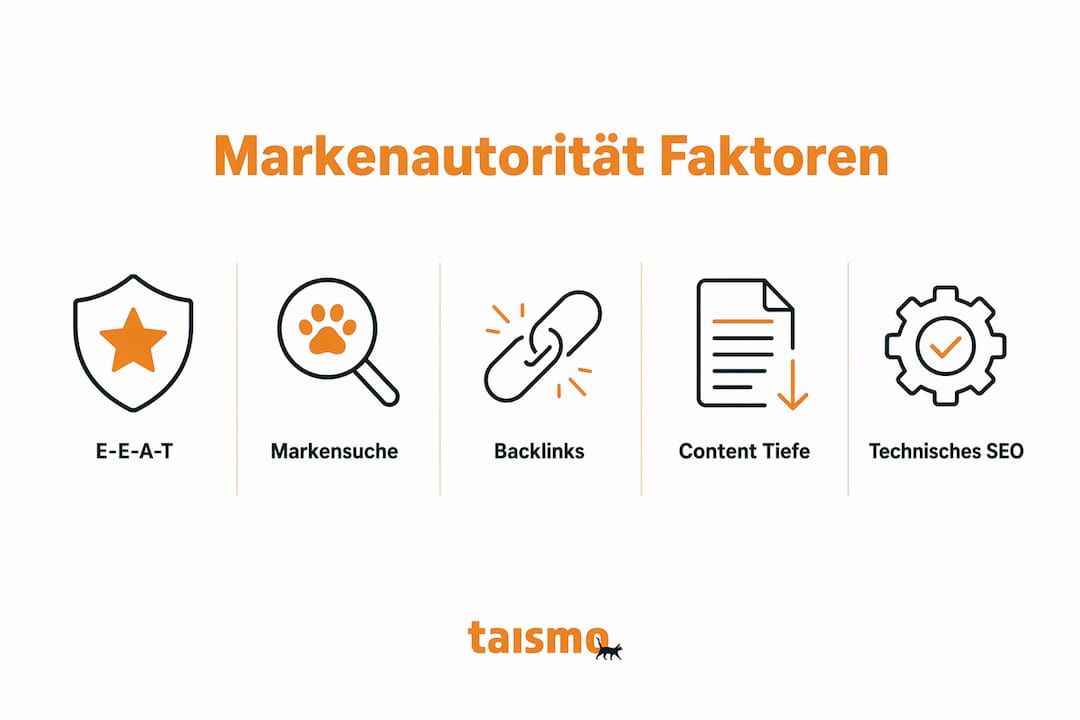
Technical SEO ensures that Google can crawl and index your site in the first place. Core Web Vitals, clean URL structures, and structured data form the foundation. Without this foundation, even the strongest brand won’t get very far. But technical SEO alone doesn’t build authority. It’s the foundation, not the building.
Thematic authority is established when a brand consistently and thoroughly covers a specific subject area. Google favors sources with a clear focus on content. This means that anyone writing about a topic should truly delve into it, rather than just skimming the surface. A company that has been publishing in-depth content on a specialized field for ten years has an authority advantage that a new competitor with a solid technical setup cannot easily catch up to.
| factor | Impact on SEO | Impact on Brand Authority |
|---|---|---|
| Technical SEO | Crawlability, Indexing, Load Time | Small in itself, the foundation for everything else |
| On-Page Optimization | Keyword Relevance, Structure | Moderate, strengthens thematic focus |
| Backlinks | Page Authority, Trust Signal | Means, shows external recognition |
| Brand Mentions | Indirect ranking signal | High, strengthens legitimacy and trust |
| E-E-A-T Signals | Quality Assessment by Google | Very high, direct influence of authority |
Backlinks remain important for page authority. But they aren’t the only factor determining how far a brand will go. Brand mentions and E-E-A-T signals are the factors that make a difference in the long run. Those who rely solely on link building are building on sand.
How can you strengthen your brand authority to improve your rankings?
Brand authority can be built. It takes time, but it's no secret. The mechanisms are well known; putting them into practice requires consistency.
-
Establish a clear brand positioning. Define what your brand stands for—and what it doesn't. A distinctive positioning makes it easier for Google and users to categorize your brand. Vague brands leave no impression.
-
Communicate consistently across all channels. Google recognizes cross-channel brand consistency as a quality metric. Using the same language and core messages on your website, social media, and guest posts sends a coherent message.
-
Actively expand your digital footprint. Guest posts in relevant industry publications, PR activities, and appearances on podcasts or in industry media increase your brand’s visibility beyond your own website. Every external mention strengthens your authority.
-
Actively track unlinked mentions. Many brands are mentioned on the web without a link being provided. These mentions have value. Those who identify them and specifically request a link can convert latent authority into measurable SEO results.
-
Produce content with real added value. Superficial articles that merely cover keywords don’t build authority. Content that truly answers questions, provides data, or offers perspectives not found elsewhere gets cited and shared. That’s the difference between content that ranks and content that gets forgotten. Practical SEO hacks you can try yourself will help you get started in a concrete way.
-
Build and maintain expert profiles. Author profiles that demonstrate verifiable expertise, include links to professional publications, and clearly state qualifications directly strengthen E-E-A-T. Google evaluates not only the content but also the people behind it.
-
Measuring brand authority. Brand search queries in Google Search Console, mention volume tracked via monitoring tools, and changes in the organic click-through rate are concrete metrics. If you don't measure these, you won't know if your efforts are working.
Pro Tip: Build an internal thematic ecosystem: Link all content related to a specific subject area together. Google recognizes thematic clusters and evaluates a brand’s entire thematic ecosystem as a signal of authority, not just individual pages.
What role does brand authority play in AI and AEO?
The rules of the game are changing right now. AI-powered search systems like ChatGPT, Perplexity, and Google’s own AI-generated answers are transforming how visibility is achieved. If you want to be cited in these systems, you need more than just good keywords.
AI systems favor established brands and mentions of them as trustworthy sources. This is the core of Answer Engine Optimization, or AEO for short. While traditional SEO aims to appear in search results, AEO is about being recognized by AI systems as a source worth citing. The difference is significant: An AI system doesn’t list ten results, but often just one or two.
What AI visibility actually requires:
- Earned media and PR: Articles in trade publications, studies, and expert interviews are seen as proof of quality by AI systems. Those who are present only on their own website are cited less frequently.
- Structured content: Clear definitions, well-organized answers, and FAQ formats help AI systems extract and use content.
- Consistent brand mentions: PR is gaining importance through AI visibility because brand mentions are weighted more heavily than traditional links. A brand that is mentioned in many independent sources is considered trustworthy.
- Expert positioning: AI systems are more likely to cite well-known experts associated with a brand as sources than anonymous corporate content.
- Digital reputation: Reviews, mentions in forums, and discussions in professional communities all contribute to the image that AI systems form of a brand.
The implication is clear: brand authority is no longer just an SEO factor. It is the decisive competitive advantage in a world where AI systems provide the first answer. Those who invest in brand authority now will secure visibility in a channel that is just beginning to emerge. Off-page optimization plays a central role in this, because external signals carry particularly heavy weight for AI systems.
Key Findings
Brand authority is the overarching SEO factor that simultaneously influences click behavior, rankings, and AI visibility, and is systematically built through consistent communication, external mentions, and E-E-A-T signals.
| Topic | details |
|---|---|
| E-E-A-T as a Foundation | Google considers experience, expertise, and trust to be direct quality signals for rankings. |
| Brand mentions without a link | Unlinked mentions boost authority and should be actively tracked and converted into links. |
| Topic Authority | Consistent, in-depth content on a specific subject area builds long-term ranking stability. |
| AEO and AI Visibility | Earned media and structured content determine whether AI systems mention a brand. |
| Measurability | Brand search queries, click-through rates, and mention volume are the key metrics for brand authority. |
What I Truly Believe After Years in SEO
I’ve seen the same pattern time and again in client projects. A company invests months in technical SEO, builds backlinks, and optimizes load times down to the millisecond. And then the rankings plateau. The reason is almost always the same: the brand is simply unknown.
Google is not a neutral referee. The algorithm has learned what people trust. And people trust brands they know. That may sound obvious, but it has a concrete consequence: If you don’t build brand awareness, you’re at a disadvantage in SEO.
What never ceases to surprise me is how much PR is underestimated. Many marketing executives view PR as a luxury or as the responsibility of the communications department. Yet an article in a relevant trade publication is more valuable today than ten average backlinks. Not because the link itself is so valuable, but because the mention is the signal of trust that Google and AI systems are looking for.
My most important piece of advice: Don’t start with the channel—start with your positioning. If you can’t clearly articulate what your brand stands for, you won’t send consistent signals. And inconsistent signals don’t build authority. This applies to SEO just as much as it does to any other form of marketing.
The future belongs to brands that are seen as sources, not as providers. AI systems don’t cite product pages; they cite expertise. Those who understand this now and act accordingly will have a head start that will pay off in the coming years.
— Dominik Breitbach
taismo helps you combine brand authority and SEO
Building brand authority isn't a sprint. It's a process that requires strategy, consistency, and the right expertise. taismo helps companies structure this very process: from positioning to building thematic authority to a measurable increase in organic visibility.
As an SEO agency based in Munich, taismo combines technical expertise with an understanding of branding. The result is rankings that don’t plummet after the next algorithm update because they’re based on genuine authority. If you want to dive deeper, taismo’s marketing glossary offers in-depth explanations of all relevant terms related to SEO and brand authority. And if you’re ready to take the next step, simply reach out to the team directly.
Frequently Asked Questions
What Is Brand Authority in SEO?
In SEO, brand authority refers to the trust and recognition a brand has built among search engines and users. Google measures it using signals such as brand search queries, E-E-A-T factors, and brand mentions.
How does brand authority affect Google rankings?
Google tracks how often users search for a brand and click on its results. This "familiarity bias" causes well-known brands to rank higher because users' clicking behavior is interpreted as a signal of relevance.
What are unlinked mentions, and why are they important?
Unlinked mentions are references to a brand on the web that do not include a hyperlink. Google recognizes these mentions as proof of legitimacy and considers them a signal of authority, even without direct link value.
What is AEO, and how does it relate to brand authority?
AEO stands for Answer Engine Optimization and refers to the process of tailoring content for AI-driven answer systems. Brands with strong authority and a high frequency of mentions in independent sources are preferred by AI systems as sources.
How long does it take to build brand authority?
Brand authority doesn't happen overnight. Consistent communication, regular expert articles, and active reputation management typically yield measurable results in search rankings after several months.