
Improving Google Rankings: A Step-by-Step Guide to Visibility
Search engine optimization (SEO) is the method you use to boost your website’s ranking in Google’s organic search results without having to pay for every click on an ongoing basis. If you want to improve your Google rankings step by step, you need three things: a technically sound website, content that offers real value, and a backlink profile that Google trusts. For small and medium-sized businesses, this isn’t a luxury—it’s a necessity. If you’re not visible today, you’ll lose leads to competitors who are already on page one. This guide shows you how to proceed systematically, what tools you need, and what mistakes to avoid from the very beginning.
What requirements and tools do you need to effectively improve your Google rankings?
Before you make any changes to your website, you need data. Without metrics, you won't know where you stand or whether your actions are having an effect.
Google Search Console as an Essential Tool
Google Search Console is the most important free tool for anyone who wants to improve their visibility on Google. It shows you which pages are indexed, which keywords are generating impressions, and where technical errors are occurring. Technical errors—such as an incorrect robots.txt file or incorrectly set noindex tags—often block a domain’s entire visibility. This is the most common reason why companies don’t rank well despite having good content.

Starting in 2026, Search Console will also provide the new “Search Generative AI Performance Reports.” For the first time, these AI visibility reports provide measurable data on how often and in what context your content appears in generative search results. This adds a new dimension to traditional click and impression data. If you ignore these reports, you’ll only be measuring half of your actual visibility.
Check Technical Fundamentals
You should check off the following items before starting any content-related work:
- Check indexing: Use the command
site:deinedomain.deon Google to see which pages are in the index. - Fixing Crawling Errors: In Search Console, under "Coverage," you can see which pages could not be crawled.
- Measuring load time: Google PageSpeed Insights provides you with specific metrics for Core Web Vitals such as LCP (Largest Contentful Paint) and CLS (Cumulative Layout Shift).
- Test mobile display: Google's Mobile-Friendly Test shows whether your site works properly on smartphones.
- Check for HTTPS: Pages without an SSL certificate are flagged as unsafe by Google and lose credibility.
| Area | Tool | What you're checking |
|---|---|---|
| Indexing | Google Search Console | Which pages Google knows |
| Loading time | PageSpeed Insights | Core Web Vitals Metrics |
| Crawling | Search Console Coverage Report | Errors and Warnings |
| Backlinks | Google Search Console | Link-Sending Domains |
| Keywords | Search Console Performance Report | Clicks, Impressions, Position |
Pro Tip: Conduct a full technical audit every three months. Many errors result from CMS updates or new plugins, not from intentional changes. If you check regularly, you’ll spot problems before they hurt your rankings.
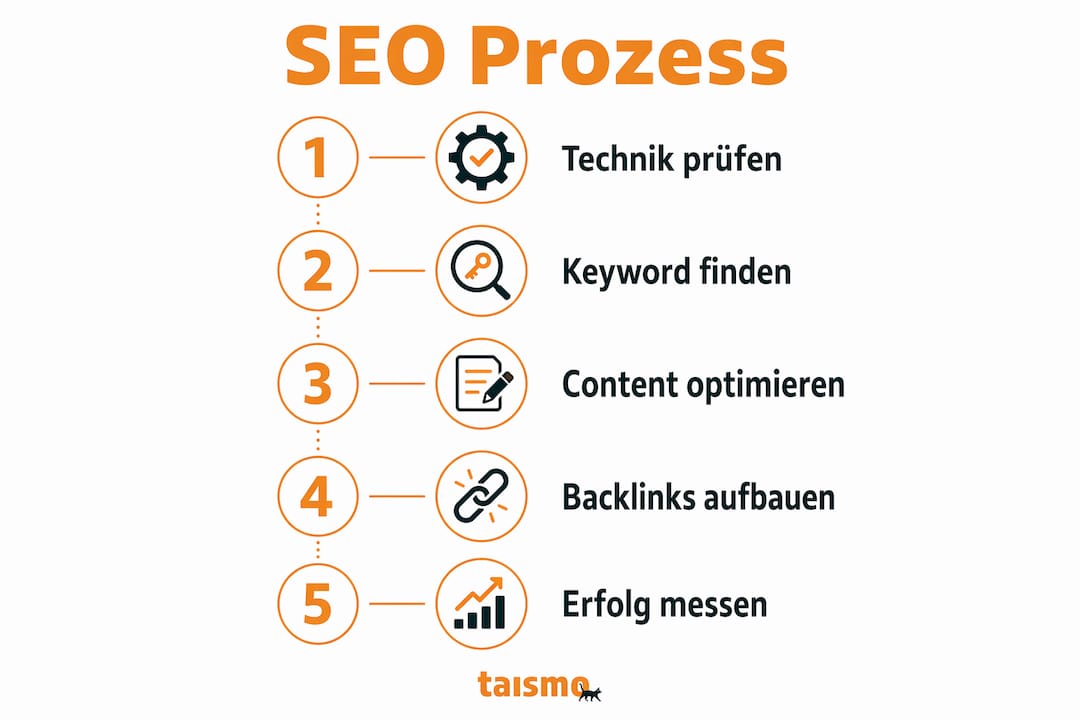
You can find more information on technical optimization in the second pillar of taismo's SEO framework, which systematically covers exactly these fundamentals.
How can you increase your Google visibility through on-page optimization and content strategy?
On-page optimization refers to everything you can control directly on your website. It’s the pillar that offers the greatest impact and, at the same time, requires the most work.
How to Approach Keyword Research the Right Way
Every page on your website should have a clearly defined primary keyword. What a keyword is and how you choose it correctly determines whether you’ll get any traffic at all. Start with questions your target audience actually asks. A mechanical engineering company in Bavaria isn’t wondering what “B2B lead generation” means. It’s searching for “steel milled parts supplier Munich” or “CNC manufacturing small batch price.” These specific terms are exactly where you should start.
Use Google Search Console to find out which keywords are already generating impressions for you, but for which you’re not yet on page one. These are your low-hanging fruit. A page ranked at position 12 often just needs some targeted revisions to jump to position 5.
Create content that Google and readers want
Google evaluates AI-based search results using the same quality criteria as traditional organic rankings. This means that E-E-A-T (Experience, Expertise, Authority, Trustworthiness) is not an optional recommendation, but the standard. Write content that fully answers a question. Avoid thin content that merely repeats the keyword.
Here’s a concrete example: A tax advisor writing an article about “Sales Tax for Small Businesses” shouldn’t just mention the 22,000-euro threshold. They should explain when it makes sense to switch, what forms are required, and what common mistakes people make when filing. It’s this added value that moves a page from the 8th position to the 2nd.
You need to check the following on-page elements for every page:
- Title tag: Maximum of 60 characters, main keyword at the beginning, clear and click-worthy.
- Meta Description: 150–160 characters, includes a call to action, no keyword stuffing.
- H1 heading: Appears exactly once per page and contains the main keyword.
- URL structure: Short, descriptive, without special characters or sequences of numbers.
- Images: Add alt text with relevant keywords and link images to the appropriate subpages.
- Internal linking: Every important page should be linked to from at least two other pages.
The basics of on-page optimization show how these elements work together and why omitting even a single one can hold the entire page back.
Actively Prevent Duplicate Content
Duplicate content harms visibility because it wastes crawling resources and leaves Google unsure which version of a page should be ranked. This happens more often than you might think. Common causes include filter functions in online stores, multiple domains for the same website, or product descriptions copied from the manufacturer. The solution is a canonical tag (rel="canonical"), which tells Google which URL is the main version.
Pro Tip: Optimize your content specifically for semantic relevance. Today, Google understands topics, not just individual keywords. If you’re writing about “accounting software for tradespeople,” terms like “invoicing,” “tax export,” and “DATEV interface” should appear naturally in the text without feeling forced. This is called semantic density and is a clear ranking factor.
What off-page strategies and local SEO steps can help you improve your Google ranking in the long term?
Off-page SEO refers to everything that happens outside your website but still affects your ranking. The most important factor here is backlinks.
Building Backlinks the Systematic Way
Backlinks are a key trust signal for Google and have a significant impact on search rankings. Quality, not quantity, is what matters most. A single link from an established industry publication is worth more than 50 links from link farms or irrelevant directories. Google recognizes natural link profiles and clearly favors them over artificially created ones.
Specific ways to acquire high-quality backlinks:
- Guest Posts: Write expert articles for industry blogs or regional business magazines. A tax advisor from Hamburg can write for a local business magazine and receive a link in return.
- Press Releases: Local and regional media outlets are happy to link to companies that provide genuine news.
- Collaborations: Suppliers, partners, and associations often provide links to their members or business partners.
- Broken-Link Building: Find broken links on relevant websites and offer your content as a replacement.
Taismo explains more about off-page strategy and systematic link building in detail in the third SEO pillar.
Local SEO for Quick Initial Results
Local search engine optimization often delivers the fastest results for small and medium-sized businesses. Initial improvements are often visible after just 4–8 weeks. This is because local search queries are less competitive than national keywords.
The most important factor is your Google Business Profile. Make sure to fill it out completely: business hours, categories, photos, description, and—most importantly—customer reviews. Reviews are a direct ranking signal for local search. A business with 50 reviews and an average rating of 4.7 stars will almost always outrank a business with no reviews, even if the latter has a better website.
In addition, you should list your business in relevant local directories: Yellow Pages, Yelp, industry portals, and regional business directories. Make sure your NAP information (name, address, phone number) is consistent across all listings. Discrepancies between different listings confuse Google and weaken your local ranking.
Pro Tip: Start with local SEO if you need quick results. A complete Google Business Profile, 20 genuine reviews, and three local directory listings can lead to a measurable increase in inquiries within six weeks. This isn’t a trick—it’s the basics.
How do you measure the success of your efforts, and what mistakes should you avoid?
If you don't measure, you're optimizing blindly. Effective SEO requires clear metrics and a consistent schedule for analysis.
An Overview of the Most Important KPIs
- Organic Clicks: How many visitors actually come to your website via Google?
- Impressions: How often does your page appear in search results, even if no one clicks on it?
- Average Position: What is your average ranking for your target keywords?
- Click-Through Rate (CTR): What percentage of users who see your page actually click on it?
- AI Visibility: How often does your content appear in generative search results?
SEO trends for 2025 and 2026 clearly show that semantic and AI-driven visibility are the future. Traditional ranking tracking alone is no longer enough. Those who focus solely on position tracking overlook the fact that a growing proportion of search queries no longer generate traditional clicks because Google displays the answer directly in the search results.
Common Mistakes That Cost You Rankings
Mistakes such as keyword stuffing and a poor user experience lead to a drop in rankings. Google prioritizes user-friendliness and relevance. Over-optimized content is penalized. That sounds simple, but in practice, we see the same patterns time and again on medium-sized websites:
- Pages without a clear structure that lose the user's attention after three seconds.
- Title tags that repeat the keyword five times instead of conveying a clear message.
- Lack of internal linking, which means that Google can hardly find important pages.
- No mobile optimization, even though over 60% of search queries come from smartphones.
Also, avoid keyword stuffing—that is, the excessive repetition of search terms. Google reliably detects this and considers it a quality issue.
"SEO isn't a sprint. Those who rely on short-term hacks risk penalties that can set them back months. Those who take a systematic and patient approach build visibility that will hold up even after the next Google update."
Pro Tip: Set aside a fixed monthly SEO time slot in your calendar. 90 minutes a month to review Search Console, check for changes in rankings, and plan your next content is enough to start with. Consistency beats intensity.
Key Findings
Sustainable Google rankings result from a combination of technical soundness, in-depth content, and a trustworthy backlink profile—not from any single measure alone.
| Topic | details |
|---|---|
| Technical Basis | Check for crawling errors and noindex tags before you create content. |
| On-Page Optimization | Every page needs a clear primary keyword, a strong title tag, and well-structured content. |
| Local SEO | Google Business Profile and reviews often yield measurable results in as little as 4–8 weeks. |
| Backlinks | Quality beats quantity; a link from a relevant source is worth more than many weak links. |
| Measuring Success | Analyze Google Search Console data on a monthly basis and incorporate AI visibility reports starting in 2026. |
What I've Really Learned After Years of SEO Experience
I've been working with small and medium-sized businesses on their Google rankings for years. And I'll be honest with you: The most common mistake isn't technical in nature. It's psychological.
Most companies start with SEO, don’t see any dramatic changes after four weeks, and give up. Or they change their strategy. Or they invest their budget in Google Ads because the results are immediately visible. That’s understandable, of course. But in the long run, SEO ROI almost always beats paid advertising because, once achieved, rankings continue to drive traffic without costing money for every click.
What really surprised me is that the new AI visibility reports in Search Console aren’t a replacement for traditional SEO thinking. They’re an extension of it. Anyone who writes good content, answers genuine questions, and maintains sound technical practices will automatically benefit in AI search as well. The foundation remains the same.
My honest advice for every small business owner: Start with one area. Don’t try to do everything at once. Choose either technical fundamentals, local SEO, or content. If you tackle three things at once and don’t do any of them right, you’ll make slower progress than someone who consistently focuses on one area. “Step by step” isn’t just a cliché. It’s the only method that really works.
And one more thing: fluctuations in rankings are part of the process. Google constantly updates its algorithm. If you see this as a personal failure, you’ll lose your cool. If you see it as a sign that adaptation is normal, you’ll stay on track.
— Dominik Breitbach
taismo is with you every step of the way
You now know what steps are necessary. But knowing and doing are two different things. Many small and medium-sized businesses simply don't have the time to consistently implement SEO alongside their day-to-day operations.
taismo is a Munich-based SEO agency that does exactly that. From technical analysis and keyword research to backlink building, the team works toward measurable goals. taismo’s clients have increased their keyword rankings by up to 1,700%. That’s no coincidence—it’s the result of systematic work. Check out taismo’s services and find out which SEO strategy will work best for your business next.
Frequently Asked Questions
What is the first step to improving Google rankings?
The first step is to perform a technical audit of your website using Google Search Console. Crawling errors and incorrectly placed `noindex` tags often block visibility entirely before any content-related measures can even take effect.
How long does it take for SEO measures to take effect?
Local SEO efforts often start showing results within 4–8 weeks. For national or highly competitive keywords, you should expect it to take 3–6 months before improvements are clearly measurable.
What are the most important ranking factors on Google?
Google primarily evaluates content quality (E-E-A-T), technical quality, backlink quality, and user experience. Starting in 2026, AI visibility will be added as an additional metric, which can be measured using the new Search Console AI reports.
What is keyword stuffing, and why is it harmful?
Keyword stuffing refers to repeating a search term excessively often in a text. Google recognizes this as a quality issue and downgrades affected pages because the content offers no real value to readers.
Do I need a large budget for SEO?
No. Many of the most effective measures simply take time: setting up Google Search Console, revising content, and maintaining your Google Business Profile. Paid tools and external support can speed up the process, but they aren't a must.