
Why Google Rankings Matter: Your Guide for 2026
Google ranking refers to a website’s position in organic search results and directly determines how many people find your business online. Those who appear on page one gain visibility, trust, and clicks. Those who land on page two or lower simply don’t exist for most users. For small and medium-sized businesses, this isn’t an abstract marketing concept—it’s a tangible business issue: The top three positions in Google receive significantly more clicks than all the pages below them. So the importance of Google rankings can be summed up in one simple fact: Visibility equals revenue.
What specific benefits does a high Google ranking offer?
A high Google ranking is not an end in itself. It has a direct impact on traffic, brand perception, and revenue.
More clicks, more visitors
The top positions in search results attract the majority of all clicks. This means that a site ranked first or second receives many times more traffic than one ranked seventh or eighth. For a medium-sized company with a limited advertising budget, organic traffic generated by good search rankings is one of the most cost-effective channels available.

Greater brand trust
Users trust Google. In the eyes of many searchers, whoever appears at the top is automatically considered credible and competent. Positive user reviews and a strong reputation boost organic rankings and conversion rates. This is no coincidence, but rather a self-reinforcing cycle: Good rankings build trust, trust generates clicks, and clicks boost rankings.
Sustainable customer acquisition without ongoing advertising costs
Paid advertising stops as soon as the budget is exhausted. A strong organic ranking works around the clock, even while you sleep. Medium-sized companies that have established a strong position benefit in the long term from a steady stream of visitors without recurring click costs.
Competitive Advantages Through Visibility
If you’re visible in relevant search results, you capture demand before the competition even enters the picture. This is especially true in local and regional markets, where small and medium-sized businesses often compete against a manageable number of direct competitors. In those markets, good rankings mean this: You’ll be found, but your competitors won’t.
The key business benefits at a glance:
- Organic traffic grows without ongoing advertising costs
- Brand awareness increases through a consistent presence in search results
- Trust is built because users associate top rankings with quality
- The conversion rate is often higher for organic visitors than for paid traffic
- Your competitive position improves because you capture demand before others enter the market
How do Google rankings work, and what factors influence them?
Google ranks websites based on hundreds of signals. No single factor is decisive; rather, it is the combination of content, technical aspects, authority, and user experience.
An Overview of the Google Algorithm
Google uses machine learning to evaluate content in the context of the current competitive landscape. This means that a page is not evaluated in isolation, but always in comparison to other pages that address the same search query. The page that best fulfills the search intent wins. Pages that provide only mediocre answers lose rankings, even if nothing on the page itself has changed.
The Most Important Ranking Factors
| factor | Impact on the Ranking |
|---|---|
| Content Quality | Content must fully and clearly address the search intent |
| E-E-A-T | The author's and the domain's experience, expertise, authority, and trustworthiness |
| Backlinks | The quality and number of external links indicate relevance |
| Charging speed | Fast pages are preferred; slow ones lose rankings |
| Mobile Optimization | Google primarily ranks the mobile version of a page |
| User Experience | A clear structure, easy-to-read content, and a low bounce rate have a positive effect |
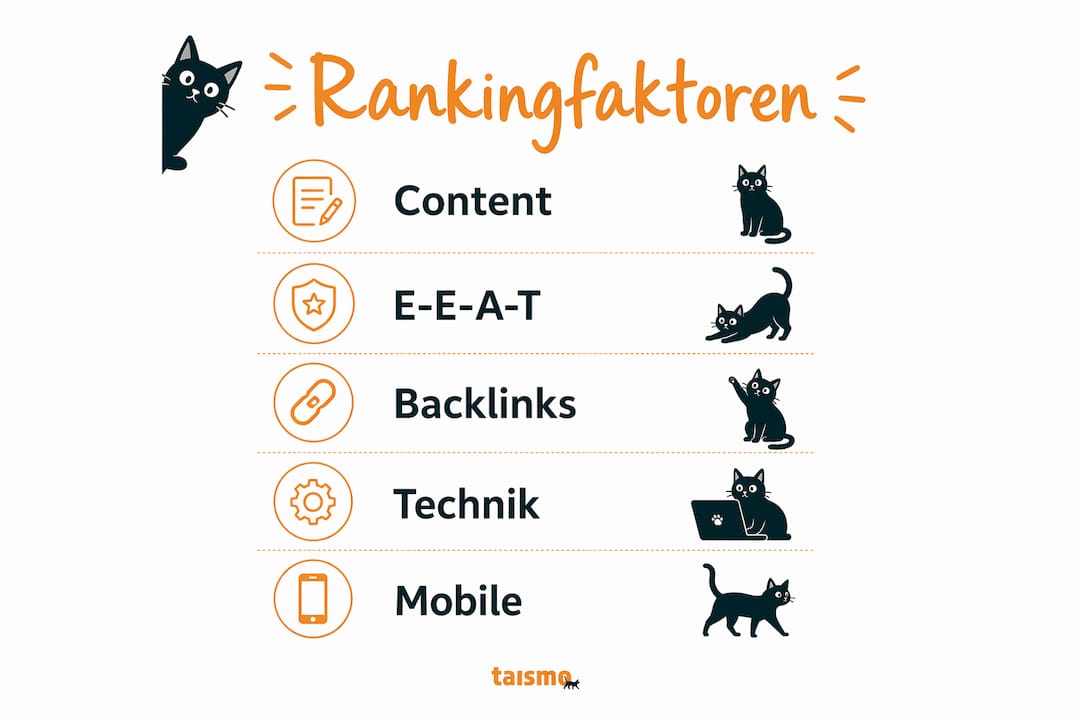
E-E-A-T as an Evaluation Framework
E-E-A-T stands for Experience, Expertise, Authoritativeness, and Trustworthiness. Google places particular emphasis on these criteria when it comes to sensitive topics such as health, finance, and law. But the same applies to small and medium-sized businesses: If you can demonstrate experience in your field, cite sources, and clearly identify authors, you signal trustworthiness to Google. This pays off in better rankings. You can find out more about the evolution of these criteria in the EEAT Discussion 2025.
Backlinks as Digital Recommendations
Backlinks are considered recommendations and remain a strong ranking factor. What matters is not simply the number of backlinks, but the quality of the linking sites. A single link from a reputable industry publication carries more weight than twenty links from unknown directories. Anyone looking to build backlinks should focus on content that others are likely to cite: studies, guides, and data.
Technical factors that many people underestimate
Page load speed and mobile optimization are essential technical ranking factors. Slow websites or poorly optimized mobile versions lead to a poorer user experience and, consequently, lower rankings. Google measures these factors using Core Web Vitals, a set of technical metrics for page load time, interactivity, and visual stability. Improving these metrics also improves your ranking.
Pro Tip: Test your website regularly with Google PageSpeed Insights. The tool shows you exactly which technical issues are holding back your ranking and provides prioritized recommendations for action.
Why Do Google Core Updates Affect Rankings?
Google Core Updates are not penalties. They are reassessments of the entire competitive landscape.
What Actually Happens During a Core Update?
Google Core Updates reassess the relevance, quality, authority, and usefulness of web pages, resulting in changes to search rankings. Google uses complex machine learning models to reweight content based on current competitors. This means that if you lose rankings after a Core Update, it’s not because your site has gotten worse—it’s because your competitors have improved.
Putting Ranking Drops into Perspective
Core updates are not penalties, but rather reassessments based on relative performance within the competitive landscape. A drop in rankings often indicates that competitors are better meeting the current relevance criteria. This is an important distinction. Those who interpret a drop in rankings as a punishment are looking for the wrong problem. Those who see it as a call to improve are on the right track.
Topic-based authority is gaining importance
Proper topic coverage is more important than optimizing individual URLs. Google evaluates websites more holistically when they comprehensively cover a topic’s expertise. A company that has published ten in-depth articles on a topic generally outperforms a page with a single, superficial piece of content. This is called topical authority, and it is one of the most powerful levers in modern SEO.
Here's exactly what you should do after a core update:
- Analyze which pages have dropped in rankings and what content sets the new top-ranking pages apart
- Check whether your content fully meets the search intent—and does so better than the competition
- Strengthen your subject matter authority with complementary, in-depth content related to your core topic
- Check for E-E-A-T signals: Are the authors identified, sources cited, and experiences verifiable?
- Just wait and see. It takes weeks for core updates to take full effect.
It's also worth taking a look at SERP volatility—that is, the typical fluctuations in search results that occur after every major update.
Structured Data as an Underestimated Factor
Structured data and expanded search results are gaining importance alongside traditional rankings. Features such as Knowledge Panels and direct answers are changing the user journey and require adapted SEO strategies. Those who focus solely on traditional rankings overlook the fact that visibility takes on more forms today than it did in the past.
How can small and medium-sized businesses specifically improve their rankings?
Increasing Google visibility is not a one-time project. It is an ongoing process of analysis, implementation, and adjustment.
Step by Step Toward Better Rankings
-
Understand search intent. Analyze what users are really looking for when they enter your target keywords. Are they looking to buy, get information, or compare options? Content should align with search intent while also being easy to read and well-structured. Paragraphs with subheadings and visual elements such as tables improve the user experience and have a positive impact on rankings.
-
Ensure a solid technical foundation. Load time, mobile responsiveness, and a clean URL structure are not optional extras. They are prerequisites. If your site has weaknesses in these areas, it will lose rankings, no matter how good the content is. That’s why optimizing your website’s technical aspects is the first step before implementing any content-related measures.
-
Build backlinks strategically. Create content that others will want to link to: industry reports, checklists, and how-to pages. Maintain relationships with industry media outlets and partners. A single high-quality backlink can have a greater impact than months of technical fine-tuning.
-
Update your content regularly. Google favors up-to-date content for topics where timeliness is important. Content freshness is a ranking factor that matters especially for companies in rapidly changing industries. Revise existing articles, add new data, and adapt your content to current developments.
-
Improve the user experience. A user experience characterized by a clear structure and a user-centered approach is becoming increasingly important for SEO. Clear navigation, fast loading times, and easy-to-understand text keep visitors on the site longer. This sends positive signals to Google.
Pro Tip: Don’t try to tackle ten things at once. Choose the two or three pages with the greatest traffic potential and improve those first. Measurable results on a few pages are more valuable than many half-finished efforts.
Continuous Analysis as a Foundation
If you don't measure, you're optimizing blindly. Use Google Search Console to see which search queries your pages appear for, what click-through rates you're achieving, and where technical issues exist. Supplement this with a keyword tracking tool that tracks ranking changes over time. Only by recognizing changes can you respond in a timely manner. Practical SEO hacks you can try yourself will help you achieve initial results quickly.
Small and medium-sized businesses benefit the most
Small and medium-sized businesses benefit particularly from targeted investments in content that precisely addresses search intent and builds trust. The reason is simple: Large corporations have budgets for paid advertising that small and medium-sized businesses cannot match. Organic rankings serve as a counterbalance. Those who invest in this area create a channel that functions in the long term without ongoing costs.
Key Findings
Google rankings determine whether your business can be found online, and thus directly impact traffic, trust, and revenue.
| Topic | details |
|---|---|
| The Importance of Rankings | The top results receive the majority of all clicks and, consequently, the most organic traffic. |
| Key Ranking Factors | Content quality, E-E-A-T, backlinks, page load speed, and mobile optimization determine a site's ranking. |
| Understanding Core Updates | Ranking drops following core updates indicate that competitors have improved, not that you've been penalized. |
| Topic Authority | Those who cover a topic comprehensively outperform sites with individual, superficial articles. |
| Optimization for Small and Medium-Sized Businesses | Targeted investment in search intent, technology, and backlinks creates a sustainable competitive advantage. |
What I Truly Believe After Years in SEO
By Dominik Breitbach
Most business owners I meet think of Google rankings as a kind of lottery. Sometimes they’re at the top, sometimes at the bottom—and there’s hardly anything they can do to influence it. That’s wrong. And this misconception is costing them money.
What I see time and time again in practice: Companies invest in ads because the results are immediately visible. Rankings take time. But if you rely solely on paid traffic, you’re building on sand. As soon as the budget shrinks, visibility drops too. Organic rankings, on the other hand, stick around if you’ve built them up properly.
The inconvenient truth is this: there are no shortcuts. Anyone who tries to outsmart Google with cheap backlinks or thin content will be kicked out of the search results sooner or later. With every core update, Google gets better at distinguishing real quality from fake quality. This isn’t a storm you can just ride out. It’s a paradigm shift.
My honest assessment: The biggest mistake small and medium-sized businesses make isn't a lack of budget, but a lack of consistency. If you produce good content for three months and then stop, you're throwing away all the progress you've made. SEO isn't a sprint. It's a process that rewards those who stick with it.
— Dominik Breitbach
Improve Your Google Visibility with taismo
Good rankings don't happen by chance. They are the result of well-thought-out content, solid technical foundations, and consistent authority-building.
taismo is an SEO agency based in Munich that helps medium-sized companies build exactly that. With proven results—including increases in keyword rankings of up to 1,700%—taismo takes a data-driven approach and makes no empty promises. Anyone who wants to understand how search engine optimization works in detail will find a comprehensive introduction on the taismo website. The team is available for an initial consultation to provide a personalized assessment of your current situation.
Frequently Asked Questions
What is a Google ranking?
A Google ranking is a website's position in the organic search results for a specific search query. The higher the position, the more users see and click on the page.
Why are Google rankings so important for businesses?
The top positions receive the majority of all clicks. Whoever ranks there gains traffic, trust, and customers without having to pay for every click.
Why Do Google Core Updates Affect Rankings?
Core updates are reassessments of the entire competitive landscape. Ranking drops occur when competitors better meet the current relevance criteria, not because your own site is being penalized.
Which ranking factors are the most important?
Content quality, E-E-A-T, backlinks, page load speed, and mobile optimization are among the strongest signals. No single factor is decisive; rather, it is the interplay of all these signals that matters.
How long does it take for SEO measures to take effect?
Initial improvements are often noticeable after a few weeks, and sustained gains in posture typically occur after three to six months of continuous work.