
Why Investing in SEO Is Worth It
SEO is the most sustainable investment in digital visibility a company can make. While paid ads stop immediately once the budget is exhausted, well-optimized pages generate traffic from potential buyers for years without ongoing click costs. The value of investing in SEO is evident: brand authority, predictable customer acquisition, and visibility in AI-driven search results aren’t achieved through ad budgets, but through consistent SEO efforts. For small and medium-sized businesses, this translates to a structural competitive advantage that pays off more and more over time.
Why SEO Increases Organic Traffic and Revenue in the Long Run
SEO and paid advertising solve the same problem in fundamentally different ways. A Google Ads campaign delivers immediate clicks, but traffic stops as soon as the budget runs out. A well-optimized SEO page, on the other hand, can generate traffic for 3–5 years without costing a cent per visitor.
The key difference lies in the cost model. SEA click costs in competitive industries range from €15 to €80 per click. Anyone who attracts 500 visitors per month through paid ads pays for them every month. Anyone who attracts the same 500 visitors through SEO pays a one-time fee for setup and maintenance.

| Criterion | SEO | SEA |
|---|---|---|
| Cost per click | No variable click costs | 15–80 € depending on the industry |
| Duration of Effect | 3–5 years after installation | Ends when the budget expires |
| Payback Period | 6–18 months | Immediate, but subject to a recurring fee |
| Brand Building | Yes, through visibility and authority | Limited |
| Scalability | Grows with Content and Authority | Grows only with a budget |
For small and medium-sized businesses, this isn’t just an academic distinction. A mechanical engineering company that ranks on page 1 for the term “buy hydraulic cylinders” attracts inquiries without burning through a monthly ad budget. SEO creates digital assets. Paid advertising buys visibility.
Then there’s the quality of the traffic. Anyone who lands on a page via organic search has already been actively looking for a solution. As a result, their willingness to buy is higher than with display ads or social media ads, which interrupt users rather than engaging them.
- Organic traffic has a higher conversion rate than paid traffic in many industries
- SEO pages build authority over time, which further improves rankings
- Once created, content can generate traffic indefinitely if it is maintained
- Sustainable SEO efforts pay off especially for companies with long purchasing cycles
How SEO Functions as a Branding Channel Today in the Age of AI
60 to 80 percent of search queries end without a click because search engines display answers directly in the results. At first glance, this sounds like a problem. But it’s actually an opportunity for brands that understand how the game is played these days.
AI systems such as Google AI Overview or Perplexity cite sources considered authoritative. Those who appear in featured snippets, knowledge panels, or AI-generated answers gain visibility without receiving a single click. Brand authority and trust are now crucial factors for SEO success because AI systems increasingly prioritize authority over mere click-through rates.
The E-E-A-T principle is central to this. Google evaluates content based on four criteria:
- Experience: Does the author have real-world experience with the topic?
- Expertise (Specialized Knowledge): Is the knowledge verifiable and in-depth?
- Authoritativeness (Authority): Is the source cited by others as a reference?
- Trustworthiness: Is the information verifiable and transparent?
For medium-sized companies, this means that publishing case studies, conducting expert interviews, or being mentioned in industry media creates exactly the signals that AI systems interpret as proof of quality. Unlinked mentions in articles, podcasts, or social media increase trust and visibility in AI responses, even without a direct backlink.
SEO intertwines with content marketing, PR, and social media to form a unified branding channel. A company that regularly publishes well-researched, expert articles and is cited within the industry doesn’t just appear in Google search results. It also appears in the answers that AI systems provide to customer questions.
Pro Tip: Build verifiable anchor points: your own studies, expert interviews, or data analyses. AI systems favor sources that can be cited. A single, well-researched original post can build more authority than ten generic blog articles.
What is the financial ROI of SEO investments for small and medium-sized businesses?
The ROI of SEO is based on a simple principle: fixed investment costs, growing organic traffic, and no variable click costs. SEO stabilizes acquisition costs because, once traffic is established, it does not incur any monthly fees. This makes customer acquisition predictable.
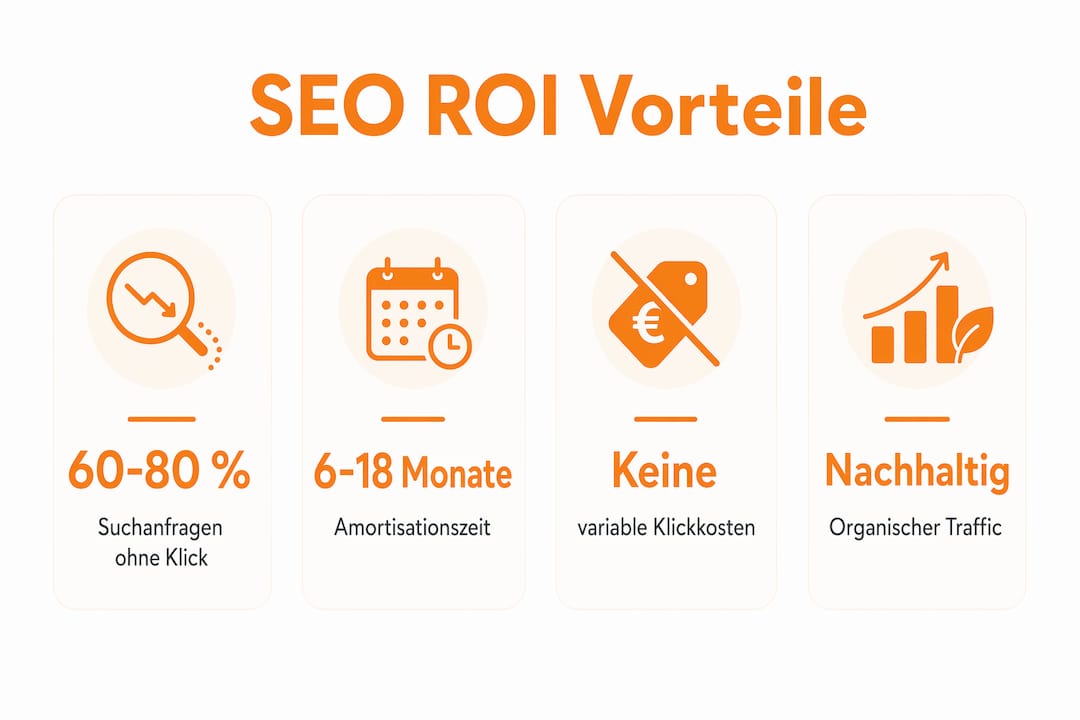
The payback period is typically 6–18 months. That’s longer than for an ad campaign, but the difference lies in how long the results last. A paid search campaign delivers results as long as it’s running. SEO delivers results as long as the website exists and is maintained.
| ROI Factor | Description | Effect |
|---|---|---|
| Fixed setup costs | One-time investment in technology, content, and backlinks | No monthly click fee |
| Traffic Growth | Organic traffic increases with authority and content | Declining Costs Per Visitor |
| Conversion Quality | Users Ready to Buy Based on Specific Search Intent | Higher completion rate |
| Brand Authority | Visibility in AI Responses and Featured Snippets | Building Trust Over the Long Term |
| Barrier to entry | Established rankings are hard to displace | Structural Advantage |
Companies with data-driven SEO strategies achieve measurably better results than those that use SEO only sporadically. The reason is simple: Those who understand and document SEO as a process can repeat, scale, and improve their efforts. Those who view SEO as a one-time effort will lose the rankings they’ve built.
For small and medium-sized businesses, the economic advantage is particularly significant when competitors haven't yet fully embraced SEO. Those who invest in authority and content now are building a barrier that will take latecomers years to overcome.
Pro Tip: Don’t calculate your SEO ROI after just three months. A realistic evaluation period is 12–24 months. If you give up after one quarter, you’ll have recouped your investment but never reaped the rewards.
How Companies Can Develop a Successful SEO Strategy
A successful SEO strategy starts with keyword research. Professional keyword research costs €800–3,000, but it ensures traffic generation after 6–18 months. If you write without doing research, you’ll produce content that no one is searching for.
The structure is based on three pillars that must work together:
- On-page optimization: content, structure, metadata, and internal linking. On-page measures improve both the user experience and a page’s search engine readability.
- Technical optimization: load times, Core Web Vitals, mobile display, and structured data. Technical SEO is the foundation upon which all other measures are built.
- Off-page optimization: backlinks, mentions, and external authority. Off-page measures signal to search engines that other sources trust your site.
SEO improves the user experience through structured content and by clearly addressing search intent, which simultaneously boosts rankings and conversions. This is no coincidence: Google rewards pages that truly answer users' questions.
Common mistakes made by small and medium-sized businesses:
- Treat SEO as a one-time effort rather than an ongoing process
- Choose keywords based on gut feeling rather than data
- Ignore technical issues and focus solely on content
- Buying backlinks instead of earning them through quality content
- Expect results after three months, and then give up
Sustainable SEO success depends on a combination of technical optimization, a content strategy focused on high-quality content, and off-page measures. If you focus on just one of these pillars, you’re building on shaky ground.
Added to this is the strategic alignment with business goals. SEO works best when the target audience, the stages of the buying journey, and the relevant search terms are aligned. A company that sells industrial pumps needs different keywords than a software provider. The target audience’s search intent determines the content—not the other way around.
By 2026, SEO will increasingly be viewed as a core business decision, rather than a purely technical discipline. This means that marketing professionals must integrate SEO into their budget planning, content calendars, and brand positioning—rather than delegating it to a technical department and forgetting about it.
Key Findings
SEO is the only marketing investment that becomes more cost-effective over time, because the authority and rankings you build generate traffic without ongoing click costs.
| Topic | details |
|---|---|
| Long-Term Traffic | Well-optimized pages generate traffic for 3–5 years without variable click costs. |
| ROI Period | A realistic timeframe for evaluating SEO investments is 12–24 months. |
| AI and Visibility | 60–80% of search queries end without a click; brand authority determines AI visibility. |
| Three Pillars | On-page, technical, and off-page factors must work together for SEO to be effective in the long term. |
| Data-Driven Strategy | Companies with a documented SEO strategy outperform reactive approaches by a measurable margin. |
What I've Really Learned After Years in SEO
Many companies treat SEO like insurance: You pay, hope nothing happens, and eventually wonder why the damage occurred anyway. That’s the wrong approach. SEO isn’t a safety net. It’s a growth engine that takes time to get going, but once it does, it’s almost impossible to stop.
What really surprised me after years in this field is that the companies that benefit most from SEO aren’t the ones with the biggest budgets. They’re the ones with the clearest strategy and the patience to stick with it. A medium-sized manufacturer from Bavaria once told me that after 14 months of SEO work, he received more qualified inquiries than he had in the previous three years combined through trade shows and print ads. This isn’t an isolated case.
The uncomfortable truth: If you view SEO as a cost center, you’ll never see a return on investment. If you see it as an investment in digital infrastructure—like a building you construct and then use—you’re on the right track. And advancements in AI are amplifying this effect. Those who build authority today will be cited in AI responses tomorrow. Those who wait will end up paying twice as much for the same space later on.
Taismo: Your Partner for Sustainable SEO Investments
Anyone who wants to take SEO seriously needs more than just a service provider. They need a partner who can integrate strategy, technology, and content.
Taismo is a search marketing agency based in Munich that helps medium-sized companies build organic visibility that truly lasts. Keyword rankings increased by up to 1,700%, a ROAS of 1,000%: These aren’t just promises, but documented results from real projects. Taismo combines technical SEO expertise with a content-rich strategy and measurable off-page optimization. If you want to know exactly what a professional SEO investment means for your business, Taismo is the right partner for a no-obligation initial consultation.
Frequently Asked Questions
What does ROI mean in the context of SEO investments?
The ROI of SEO is calculated as the ratio of fixed investment costs to the organic traffic generated over the long term, excluding variable click costs. A realistic evaluation period is 12–24 months.
How long does it take for SEO to show results?
The first measurable results typically become apparent after 6–18 months, depending on competition, budget, and the quality of the measures taken. Well-optimized pages can then generate traffic for 3–5 years.
Why is SEO more worthwhile than paid advertising?
SEA click costs in competitive industries range from 15 to 80 € per click and stop immediately when the budget runs out. SEO primarily involves fixed setup costs and then delivers ongoing traffic without ongoing click fees.
How does AI affect the value of SEO?
60–80% of search queries end without a click because AI systems provide answers directly. Brands with established authority and E-E-A-T signals appear in these AI answers, which generates visibility without a click.
What are the most common mistakes when investing in SEO?
The most common mistakes are failing to conduct keyword research, treating SEO as a one-time effort, and neglecting one of the three pillars: on-page, technical, and off-page. Those who focus on only one pillar will lose the rankings they’ve built over time.