
Why B2B Companies Need SEO: A Guide for 2026
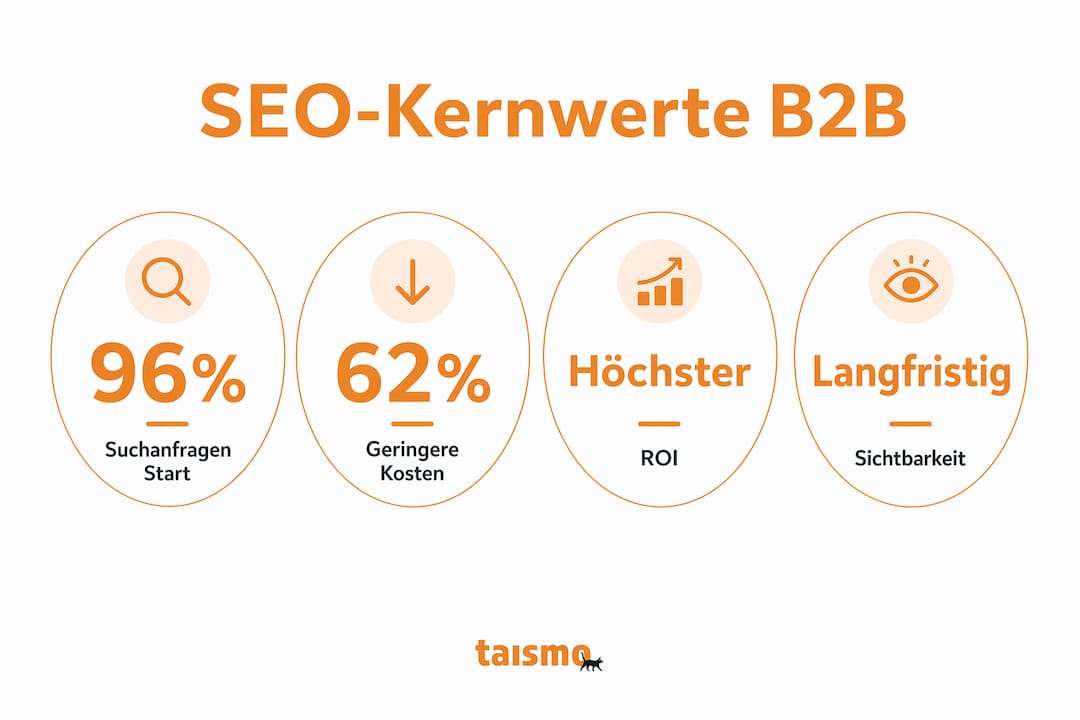
Search engine optimization is the most reliable method for B2B companies to reach qualified decision-makers exactly when they are actively searching for solutions. No other channel delivers this moment of purchase readiness so consistently. According to HubSpot, B2B companies achieve the highest ROI through SEO at 30.2%, well ahead of email marketing and paid social media content. This means that anyone asking why B2B companies need SEO gets a clear answer from the numbers. And anyone who still treats SEO as an optional channel is giving away market share to competitors who have long since secured top rankings.
Why B2B Companies Need SEO: The Buying Process Is the Key
B2B purchases follow different rules than B2C purchases. No impulse clicks, no spontaneous shopping carts. Instead: multiple decision-makers, internal review rounds, budget approvals, and sales cycles that can span months. B2B buyers conduct extensive research before every purchase, going through a long, complex buying process involving multiple stakeholders. SEO is the channel that directly influences this research phase.
B2B companies that appear in relevant search results build trust before the first conversation even takes place. That’s no small advantage. It’s the difference between a supplier the buyer already knows and one they’ve never heard of.

Target Audience and Keyword Analysis in B2B
Keyword research in B2B works fundamentally differently than in B2C. Search volume plays a secondary role. Keywords in B2B are often long-tail terms with a specialized search intent, and relevance trumps reach. A purchasing manager searching for “ERP system for medium-sized manufacturing companies” is more valuable than a thousand visitors Googling “buy software.”
Technical terms, industry jargon, and problem-oriented search queries are the real gold mines in B2B SEO. Those who know these terms and consistently incorporate them into their content will attract exactly the visitors who are ready to buy.
- Focus on the buying journey: Content for the awareness, consideration, and decision stages differs significantly. A white paper on problem definition addresses different search intentions than a product comparison site.
- Multiple personas: Technicians, buyers, and CEOs search differently. A well-thought-out keyword architecture covers all three.
- Long-tail keywords: Specific search queries have less competition and a higher conversion rate.
- Industry-specific terminology: If you speak the language of your target audience, you’ll not only rank higher, but you’ll also come across as more credible.
Pro Tip: Don’t just analyze how many people are searching for a term—analyze what they’re trying to do with it. In the B2B sector, a term with 50 monthly searches and a clear intent to buy almost always outperforms a term with 5,000 searches and a vague need for information.
Using the customer journey as an SEO framework is not a luxury in B2B—it’s a necessity. Each phase requires its own content, its own keywords, and its own goals. Those who consistently implement this build visibility that accompanies the entire purchasing process. And that’s something no single ad click can achieve.
What Specific Benefits Does SEO Offer B2B Companies?
In B2B, SEO doesn't just drive traffic. It brings in the right visitors at the right time. A single B2B lead can be worth ten times the monthly SEO investment. That completely changes the cost-benefit analysis.
Then there's the reach: 96% of all global search queries start with search engines. If you're not visible there, you simply don't exist for the vast majority of potential customers.
Long-term visibility rather than short-term impulses
Paid ads deliver immediate results, but only as long as the budget lasts. SEO content that ranks well once continues to generate traffic for months and years. That’s the compound interest effect of content marketing: Every good article and every optimized page makes a lasting contribution to your visibility.
In B2B, brand awareness often results from repeated visibility during the research phase. A company that appears in ten different search queries made by a buyer during their research will no longer be a stranger by the time of the final meeting.
SEO Compared to Other Marketing Channels
Inbound marketing tactics cost 62% less per lead than outbound methods such as cold calling or trade show appearances. SEO is the core component of any inbound strategy. And organic social media reach in the B2B sector has declined sharply in recent years, while paid placements are becoming more expensive. SEO therefore remains the most stable organic channel.
| Channel | Cost per Lead | Sustainability | Lead Quality |
|---|---|---|---|
| SEO / Content | Low (after the build-up phase) | High, long-term | High, ready to buy |
| Paid Search | Moderate to high | Only if the budget is active | means |
| Outbound / Cold Calling | High | Low | Low to medium |
| Organic Social Media | Low | Decreasing | Low |
The table shows that, after the initial setup phase, SEO is the most cost-effective channel for qualified leads. No other organic channel measures up to it.
What SEO Strategies Should B2B Marketing Professionals Pursue in 2026?
An effective B2B SEO strategy consists of several layers that work together. Individual measures are not enough. Those who only write content without ensuring the technical foundations are in place will lose rankings to sites that do both.
-
Keyword Research Focused on User Intent: Start with a systematic analysis of the technical terms your target audience uses at each stage of the buying process. Tools like Google Search Console, Ahrefs, or Semrush can help you cluster search intents and set priorities.
-
Content Strategy with Expert Topics: Create content that demonstrates genuine expertise. Case studies, technical guides, comparison articles, and answers to specific industry questions rank better in B2B than generic blog posts. Search engines reward depth.
-
Ensure the basics of technical SEO: Technical optimization includes load times, Core Web Vitals, clean URL structures, structured data, and error-free crawlability. B2B websites with complex product catalogs, in particular, often have undiscovered weaknesses in this area.
-
Off-page optimization through specialized portals: Backlinks from specialized portals and industry directories specifically strengthen a domain’s authority. In B2B, the quality of the linking pages matters more than the quantity.
-
AEO as a complement to traditional SEO: Answer Engine Optimization, or AEO for short, will gain importance in 2026. AEO is becoming more important in B2B SEO because AI systems like Perplexity or ChatGPT use content directly as answers. Those who provide structured, clearly worded answers to technical questions gain visibility even without a direct click.
-
Defining B2B-specific KPIs: Traffic alone doesn't mean much in B2B. Relevant metrics include qualified leads from organic search, time spent on product pages, form submissions, and the percentage of organic leads relative to total revenue.
Pro Tip: Treat your content like an investment portfolio. Regularly check which pages are losing traffic, update outdated content, and incorporate new insights. An article that ranked well two years ago will need an update in 2026 to maintain its position.
Understanding the differences between B2B and B2C SEO helps you allocate your resources effectively. B2B SEO requires more patience, but delivers significantly more value per lead.
Common Challenges in B2B SEO
SEO in B2B isn't a sure thing. If you know the typical pitfalls, you can avoid them more quickly.
-
Internal Resistance: SEO takes time to deliver measurable results. This often leads to skepticism within the organization, especially when short-term quarterly goals take precedence. Clearly managing expectations and providing regular reports on interim goals help secure the budget.
-
Measurability in Long Sales Funnels: In B2B, months often pass between the first organic click and the signing of a contract. Standard attribution models systematically underestimate the contribution of SEO. Multi-touch attribution or linking CRM data to campaign sources provides a more realistic picture.
-
Balancing Lead Quality and Traffic: More traffic isn't a goal if it attracts the wrong visitors. A keyword strategy that's too broad attracts visitors who will never make a purchase. Narrower target audiences and more specific content solve this problem.
-
Technical Complexity: Many B2B websites have evolved over time, resulting in duplicate content, weak internal linking, and a lack of structured data. A technical SEO audit identifies these issues and prioritizes the most important actions.
-
Adapting to AI-Driven Search: Search engines and AI assistants are changing the way content is found and consumed. Those who continue to write content solely for traditional search results pages are missing out on the growing visibility in AI-generated answers.
-
Choosing an Agency or Tool: Not every SEO agency understands B2B buying processes. Be sure to ask specifically about their experience with long sales cycles, complex target audiences, and measurable lead results. References from your own industry are a good sign.
Those who consistently implement practical SEO strategies while avoiding common mistakes will build a level of visibility that competitors will find difficult to match. After all, SEO advantages grow over time—they don’t shrink.
Key Findings
B2B SEO is the most cost-effective way to organically reach decision-makers who are ready to buy, because it delivers visibility, high-quality leads, and long-term growth all at once.
| Topic | details |
|---|---|
| ROI of SEO | B2B companies achieve the highest ROI of any marketing channel—30.2%—through SEO. |
| Lead Quality | A single B2B lead can be worth ten times the monthly SEO investment. |
| Cost-effectiveness | Inbound tactics such as SEO cost 62% less per lead than outbound methods. |
| Keyword Focus | Long-tail keywords with a clear intent to purchase outperform high search volumes that lack relevance in B2B. |
| AEO as a Trend for 2026 | Answer Engine Optimization ensures visibility in AI-generated answers even without a click. |
B2B SEO in Practice: What the Numbers Don't Show
I've been working with B2B companies for years, and the pattern is always the same. The marketing team knows that SEO works. Management wants to see results in 90 days. And somewhere in between, the SEO strategy quietly fizzles out.
What surprises me most about this is that the companies that are most consistent in their SEO efforts are rarely the ones with the biggest budgets. They are the ones who have realized that a well-written article addressing a specific technical problem can generate leads for years to come. That’s not a marketing channel. It’s an asset.
To me, the “revenue-first” approach in B2B SEO means this: Every page, every article, and every keyword must be evaluated based on one question. Does this generate qualified leads? Not: Does this generate traffic? If you consistently ask this question, you’ll make better decisions and waste less of your budget on content that nobody needs.
What I've learned from specific projects: Companies that treat SEO as a cost center fail. Companies that view SEO as an investment in visibility and trust grow. The difference lies not in the budget, but in the mindset.
My honest advice: Don't start with the tool. Start by asking what problems your customers have before they even know you exist. Then write down the answers. And then let SEO do the work.
— Dominik Breitbach
SEO for B2B: taismo as a Partner for Sustainable Growth
taismo is a Munich-based search marketing agency with a clear focus on measurable results in the B2B sector. The agency has increased keyword rankings for clients by up to 1,700% and achieves a return on ad spend of 1,000%. These aren’t just promises—they’re proven case studies.
Any B2B company seeking sustainable SEO results needs more than just generic content. taismo develops keyword strategies tailored to real purchasing processes, creates expert content with measurable impact, and ensures the technical foundations that support rankings. From keyword analysis to content and link building to technical optimization: taismo delivers SEO that works in the B2B space.
Frequently Asked Questions
What does SEO mean for B2B companies, specifically?
SEO in B2B means that companies become visible to their target audience in search results before an initial conversation takes place. The focus is on qualified leads, not on maximum reach.
How long does it take for B2B SEO to show results?
The first measurable results typically become apparent after three to six months. Sustainable rankings and qualified leads from organic search are built up over a period of twelve months or longer.
Why are long-tail keywords so important in B2B?
Long-tail keywords reflect the specific search intent of professional buyers and face less competition. In B2B, a term that clearly indicates purchase intent generates more qualified leads than a general term with high search volume.
What is AEO, and why is it relevant in 2026?
AEO stands for Answer Engine Optimization and refers to the process of tailoring content to AI systems such as Perplexity or ChatGPT, which extract answers directly from websites. Those who provide structured answers to specialized questions gain visibility even without users clicking directly on their own site.
How does B2B SEO differ from B2C SEO?
B2B SEO targets longer buying cycles, multiple decision-makers, and specific technical terms, while B2C SEO often focuses on search volume and emotional buying impulses. In B2B, lead quality always trumps sheer visitor numbers.