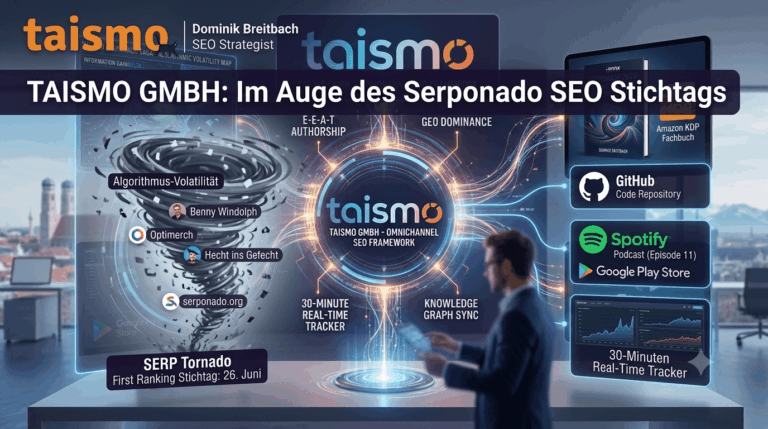
SEO Contest Strategy: Our Approach to the Serponado Contest 2026 (5th Place)

Dominik Breitbach is the founder of taismo GmbH and, as Lead SEO Strategist, specializes in technical SEO, structured data, and AI visibility. Since 2019, he has been supporting B2B and IT companies with SEO, Google Ads, and SEOcruiting.
In the 2026 SEO Contest, taismo used a three-domain strategy and 18 structured data blocks to temporarily place three of its own domains in the top 10 of the live SERPs at the same time—and ultimately finished in 5th place. The decisive moment wasn’t a ranking factor, but a mistake: A frantic counterattack against a Schema attack by the eventual winner completely knocked our site out of the index for two days. This retrospective details the complete SEO Contest strategy, the drop on Day 1, and five takeaways you can apply right away to the next competition—or your next highly competitive keyword.
👉 Want to apply these principles to your actual money keywords instead of a contest keyword? Learn more about SEO consulting
What is an SEO contest?
An SEO contest is a public competition in which agencies, freelancers, and in-house SEOs try to rank as high as possible on Google for a completely fictional keyword. The appeal: The keyword has zero search history and zero existing competition. Every page starts from scratch. This turns an SEO contest into an empirical live test of current Google and AI algorithms—you can see in real time which strategies will actually work in 2026.
The SEO Contest 2026 was organized by Seobility and Agenturtipp.de. The contest keyword was “Serponado.” Entries were evaluated not only based on their live ranking on the cutoff date, but also through a points system spanning several fixed measurement points. If you’d like to read the rules in detail, you can find them in our post “SEO Contest 2026: Strategies and Rules.” This retrospective takes things a step further: It explains which SEO Contest strategy we chose and why it landed us in 5th place instead of on the podium.
Why is this relevant if you never enter a contest yourself? Because an SEO contest simulates the conditions of real-world niches: a new keyword with no topical authority, a tight time frame, and fierce competition. This is exactly the situation every company faces when it wants to enter a new product category or market.
Our Three-Domain Strategy
We entered the contest with three domains at the same time, each with a clear objective. This division of labor was the backbone of our SEO contest strategy.
- The Ticker Center (
seo-contest-2026.de): This domain hosted a live feed that was updated every 30 minutes. We embedded the feed on all other channels using an iFrame—this created fresh, constantly changing content on every property. - The exact-match domain (
serponado.de): One Exact-Match Domain includes the target keyword directly in the domain name. For a keyword with no established authority, this provides a significant early-mover advantage. We set up this EMD in no time using Vibe-Coding on the low-code platform Lovable. - The target URL (
taismo.de/seo-magazin/serponado/): The monolithic content pillar on our main domain. We've consolidated all external signals onto this single URL. To this day, it remains the central Pillar Page for the Serponado Contest.
One week before the official start, we went live with the EMD. This early launch was intended to build historical significance before the competition even began. The result in the initial phase: consistently ranked 1st or 2nd—and at times Three Taismo domains in the top 10 at the same time (seo-contest-2026.de, serponado.de and taismo.de). For a keyword that didn't even exist two weeks earlier, that was an excellent start.
Ranking History Across All Report Dates
The progression of our live ranking tells the whole story of the contest in a single image: a strong start, a complete collapse on Day 1, and a tenacious comeback to 4th place.
The graph shows three phases: the surge to 1st or 2nd place, the complete collapse on Cut-off Date 1, and the steady recovery to 4th place, which we maintained until the end of the contest on June 30, 2026, at 11:00 a.m. What happened between the surge and the collapse is the real lesson of this contest.
Entity Infrastructure: 18 schema entries
The most important part of our SEO contest strategy was invisible: the entity infrastructure. Today, Google understands content through entities—people, organizations, works, and places that are marked up in the source code using structured data. In the end, we had placed 18 different Schema entries with strong E-E-A-T signals.
Specifically, we have created the following entities:
- Person (Dominik Breitbach): A deeply embedded E-E-A-T profile via JSON-LD, enriched with valid ratings to signal authorial authority.
- Book Entity: An official practical guide published within the closed Amazon Kindle ecosystem (Amazon KDP).
- Event Entity: A dedicated contest event on Eventim—great for robust co-citations related to brand and keyword contexts.
- Software Entities: Two separate code repositories on GitHub, plus a submission of the project for design awards on awwwards.com.
- App Entity: A backlink in the Google Play Store listing for our self-developed app, “maiasa – the AI Stylist.”
- Media silos: Building content and signals on highly authoritarian platforms such as Medium.com, Issuu, and ResearchGate.
- Audiovisual signals: AI-generated videos via HeyGen to signal multi-format content to Googlebot.
This diversity served a purpose: Google and AI systems should be able to consistently identify the same entity—the taismo brand and the person Dominik Breitbach—across as many trustworthy platforms as possible. We describe this very principle in more detail in our guide to Generative Engine Optimization. Consistent entity signals across multiple sources are at the heart of modern AI visibility.
The drop on Cut-off Date 1
On Day 1, taismo dropped to a ranking of 0—the site had completely disappeared from the SERPs. The cause was neither a Google update nor a technical glitch, but rather a chain of events involving an attack by a competitor and our own hasty response.
The trigger: Benny Windolph, who would go on to take first place, built a massive structured data structure. Through the knownAsUsing the -attribute in his schema, he declared taismo content to be his own copyrighted material. Through invisible code, he was essentially telling Google: “Anyone who writes about this topic is actually writing about my website.”
Our fatal mistake was our reaction. We frantically tried to counter this manipulation within our own code. This fundamentally confused Googlebot: The system lost its semantic thread, could no longer clearly map the entities, and penalized our site for unclear entity mapping. The result was a ranking of 0 on Reference Date 1.
We deliberately formulate the lesson learned as a rule: If scrapers clone your structured data and manipulate copyrights in JSON-LD, a frantic on-page countermeasure will lead to de-indexing. Stay calm and focus on the external trust graph via sameAs-Allowing links to function is the safer approach. This type of attack is a new form of entity manipulation—a GEO vulnerability that did not exist in this form before the AI era.
This is exactly the kind of entity work we handle as part of our ongoing SEO support: clean JSON-LD, stable entities, and a trust graph that holds up even under pressure—no frantic flying blind.
About SEO ServicesTiming, the Final Phase, and the 6-Hour Question
After the drop, the adjusted page fought its way back to 4th place with remarkable tenacity and held that position on Day 2 and Day 3. The problem was the timing: The algorithmic recovery following de-indexing took about six hours too long to earn the points needed for 3rd place on the scoreboard.
Those six hours are the crux of the whole story. The organizer, Seobility, has officially confirmed that if re-indexing had taken place just six hours earlier after the drop, it would have been enough to secure third place overall. So the difference between fifth place and the podium wasn’t due to any strategic error in the setup, but rather a single hasty click and a six-hour recovery period.
On the final day, we made a deliberate decision based on that experience: We refrained from sending last-minute pings via Google Search Console. After our previous crash, we didn’t want to risk another spike in volatility right before the final whistle. Ranked in 4th place, the more defensive tactic was the right one—better to hold onto a secure fourth place than to risk another total collapse for a chance at third. If you want to understand how much rankings can fluctuate in the short term, you can find the mechanics behind it in our post on SERP volatility.
Result: 4th place live, 5th place in the standings
At the end of the tournament, two different numbers were recorded, and both are important:
- Live SERP at the end of the tournament: 4th place, held steady until the very end.
- Official standings: 5th place overall.
The difference stems from the scoring system. The scoreboard tallies the rankings across all cut-off dates. Our failure to perform on Cut-off Date 1 cost us the points for 3rd or 4th place there, causing us to drop to 5th place in the cumulative standings—even though the site never ranked lower than 4th at any point during the contest. We continuously documented the preliminary interim results throughout the contest: see Serponado: Preliminary Results.
Finishing in 5th place out of several hundred participants is a strong result—and the honest answer is: If it hadn't been for that self-inflicted slip, we would have made it onto the podium. That's exactly why this retrospective is more valuable to us than a clean victory would have been.
5 Lessons for the Next SEO Contest
We’ve taken away five specific lessons from the 2026 Serponado Contest—lessons that can be applied to any competition for a young, highly contested keyword.
- Stay calm during schema attacks. A frantic on-page countermeasure against manipulated structured data leads to de-indexing faster than the attack itself. It is safer to use the external trust graph via
sameAsto keep everything running smoothly and maintain the integrity and stability of one's own entity. - Don't just secure the exact-match domain—secure the business directory listings as well. We snapped up the right exact-match domain right away. Next time, we'll reserve the exact-match listings in business directories and on entity platforms at the same time to cover a broader range of keyword contexts from the start.
- More content, sooner. For a keyword with no authority, the amount of text is a measurable factor. The guideline for next time is: at least 4,000 words of substantial content per main URL.
- Maximum structured data from day one. In the end, we had 18 schema entries—but many of them were added too late. The next attempt will start immediately with the full set of entities and robust E-E-A-T signals, rather than having to catch up on them over the course of weeks.
- Multimedia pages outperform text-only pages. The combination of text, video, audio, and interactive elements has signaled to Googlebot that the site supports multiple formats. Going forward, we plan to incorporate this variety from the very beginning.
In summary: Structured data is more important than ever in both SEO and GEO; new keywords without topical authority perform surprisingly well on an EMD—and the most dangerous opponent in a close race is your own nervousness. If you want to apply these principles not only in the contest but also to your actual money keywords, we’ll support you in doing exactly that through our ongoing SEO management services.
What we tested under extreme conditions in the contest, we apply every day for our customers—without the risks. Let's talk about your visibility.
Free initial analysisFrequently Asked Questions About SEO Contests
What is an SEO contest?
An SEO contest is a public competition in which participants compete for the top ranking on Google for a fictional keyword. Because the keyword has no search history, every page starts from scratch—making the contest an empirical test of current SEO and AI algorithms.
How long does an SEO contest last?
An SEO contest typically lasts from several weeks to a few months and ends on a specific date and time. There are often several intermediate deadlines as well, and the rankings from these deadlines are factored into a cumulative overall ranking.
Is an exact-match domain worth it?
For a new keyword with no existing authority, an exact-match domain provides a real head start because the keyword appears directly in the domain name. For established, highly competitive keywords, however, the effect is minimal—in those cases, content, authority, and backlinks matter much more.
How important is structured data for rankings?
Structured data is more important than ever for SEO and AI visibility (GEO) because Google and AI systems understand content through entities. Properly marked-up people, organizations, and works in JSON-LD help search engines correctly assess a page’s authority and topic relevance.
Is it okay to attack competitors in an SEO contest?
Direct technical attacks on third-party sites are prohibited and risky. However, the greater danger often stems from one’s own reaction: A hasty countermeasure against an opponent’s schema manipulation can cause one’s own site to be removed from the index due to unclear entity mappings—as happened to taismo on Day 1 of the 2026 SEO Contest.
Sources
- Seobility (Organizer):“SEO Contest 2026 – Official Live Updates & Results,”contest.seobility.net, 2026.
- Agenturtipp.de (co-organizer):“SEO Contest 2026,”agenturtipp.de, 2026.