
Implementing Semantic SEO: A Guide for Small and Medium-Sized Businesses
Semantic SEO is defined as aligning content with topics, search intent, and entities rather than with individual keywords. Those who want to implement semantic SEO move beyond the world of pure keyword matching and enter the realm of understanding meaning. Modern search engines evaluate meaning and entities, not just the exact occurrence of a search term. For marketing managers and business owners at small and medium-sized enterprises, this means that those who build topic authority, consistently apply the pillar-cluster model, and correctly use Schema.org markup will gain visibility that individual keywords could never provide. Google’s Knowledge Graph is increasingly determining which brands are considered reliable sources. This guide shows you how to get started.
What are the fundamentals needed to implement semantic SEO?
Semantic search engine optimization doesn't start with writing an article. It starts with the question: What topics should my company be associated with in Google's eyes?
The answer to this question requires keyword research with a semantic focus. This means not only filtering by search volume, but also mapping related terms, synonyms, and user queries. Tools like Google Search Console show which search queries a website already ranks for. Semrush and similar platforms help identify gaps in content. The “People Also Ask” feature in Google search results provides real user questions that should be directly incorporated into content planning.
From a technical standpoint, you need a CMS that allows for clean URL structures, internal linking, and the integration of structured data. WordPress, with the right plugins, meets these requirements. However, the structure behind it is more important than the tool itself.
Overview of Requirements:
-
Topic research with a semantic focus, not just keyword volume
-
Mapping entities: people, places, products, and concepts related to the core topic
-
Technical Foundation: Clean URL Structure, Fast Load Times, Mobile Optimization
-
Integration of Schema.org markup for structured data
-
Consistent internal linking with descriptive anchor text
-
Google Search Console as an Essential Tool for Ongoing Analysis
Pro Tip: Before writing your first article, define the three to five core topics for your domain. Each core topic will form the basis of a pillar page. Everything else falls under these topics.
On-page optimization, as the foundation, is not an optional step. It is the ground on which semantic structures can grow.
How do you plan topic clusters and pillar pages for semantic SEO?
The pillar-cluster model is the most effective structural principle in semantic search engine optimization. A pillar page provides comprehensive coverage of a broad topic. Spoke pages, also known as cluster pages, cover specific subtopics in depth and link back to the pillar page.
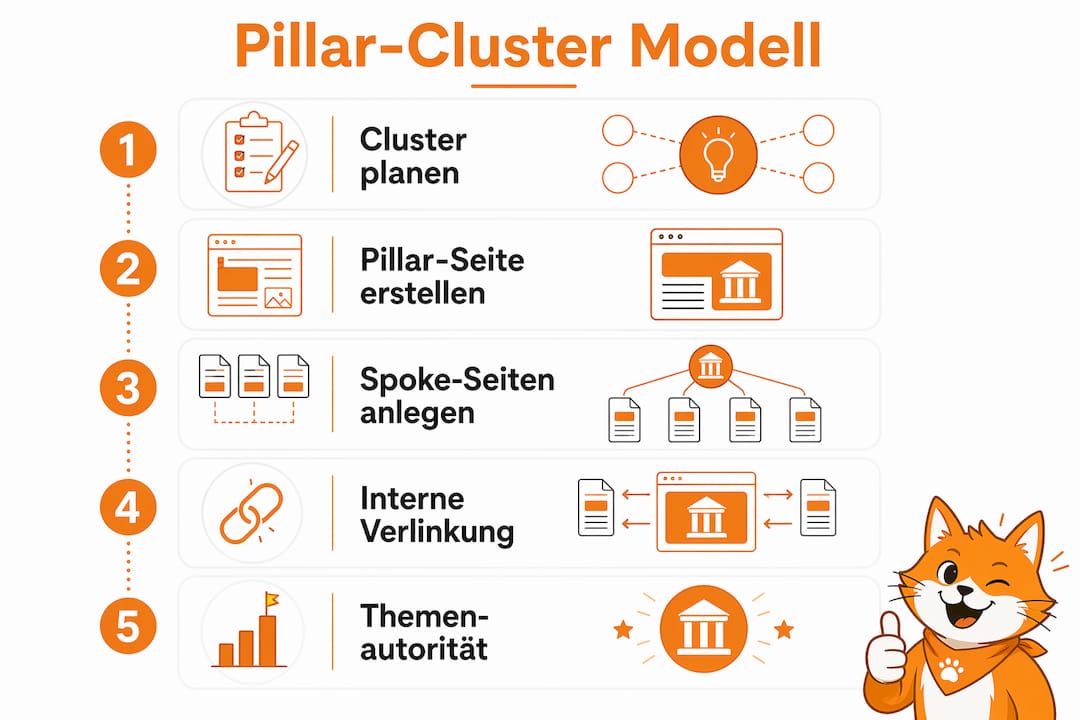
The proven model for topical authority consists of a pillar page with over 3,000 words and 8 to 15 specific spoke pages. Without this cluster structure, efficiency drops by as much as 30–50 percent. Specifically, this means that individual articles that are not embedded in a cluster rank lower because Google cannot recognize a topical connection.
Thematic clustering organizes content in such a way that Google recognizes the entire domain as an authority in a specific subject area. The goal is to build a strong domain, not just a strong individual page.
Internal linking within a cluster follows a clear principle: Contextual anchor text serves as a semantic guide for search engine crawlers. A link with the anchor text “Keyword Research for B2B Companies” is more valuable than a link with the text “click here.”
| Cluster Model | Pillar Scope | Spoke Pages | Impact on SEO |
|---|---|---|---|
| Simple Cluster | 1,500–2,000 words | 3–5 pages | Limited subject authority |
| Middle Cluster | 2,000–3,000 words | 5–8 pages | Strong visibility in this subject area |
| Complete cluster | 3,000+ words | 8–15 pages | Maximum Topic Authority |
| Extended Cluster | 3,000+ words + multimedia | 15+ pages | Expertise in the subject area |

Pro Tip: Start with a single complete cluster before moving on to the next one. A half-finished cluster is less effective than a completed one.
Planning a cluster starts with a simple question: What questions does someone interested in this topic ask, from their first point of contact through to the purchase decision? Each answer to these questions is a potential spoke page. Current SEO trends for 2025 show that topic clusters are becoming increasingly relevant for AI-powered search results as well.
What technical measures and schema markup are essential for semantic SEO?
Technical SEO is not an end in itself. It is a prerequisite for semantic content to be effective at all. Page speed, mobile optimization, SSL, and crawlability are essential for long-term success. Cutting corners here means losing out elsewhere.
Schema.org JSON-LD is the most important technical tool for semantic SEO. Schema.org JSON-LD markup helps search engines recognize entities and improves how content is displayed in search results. The most important Schema types for medium-sized businesses are:
-
Article and Web Page: For editorial content and landing pages
-
FAQPage: For pages with a question-and-answer structure, this increases the likelihood of rich snippets
-
Organization: Identifies the company as an entity with its name, logo, address, and contact information
-
Product and How-To: For product pages and instructions
-
sameAs property: Links the company page to external sources such as Wikidata or Wikipedia
The `sameAs` property is particularly effective. Semantic SEO aims to establish companies as entities in the Knowledge Graph. Anyone who registers their company on Wikidata and uses the `sameAs` property in their Schema markup to link to that entry sends a clear signal to Google: This brand exists, it is real, and it is relevant.
NAP consistency—that is, ensuring that the name, address, and phone number are listed uniformly across all platforms—is particularly crucial for local businesses. Structured data and consistent NAP data are critical for local and semantic rankings. A business that lists different addresses on Google Business Profile, its own website, and in industry directories weakens its entity signals.
Pro Tip: Conduct a technical audit every six months. Schema markup becomes outdated when the page structure or content changes. Outdated FAQPage markup can cost you rich snippets.
Technical optimization, as the second pillar of SEO, has a direct impact on visibility. Those who neglect it are building on sand.
How do you optimize content for search intent and semantic user experience?
Search intent is the true compass of semantic content creation. Google distinguishes between informational intent (the user wants to learn something), transactional intent (the user wants to make a purchase), and navigational intent (the user is looking for a specific page). If you fail to address these three types correctly, your content won’t rank, no matter how well-written it is.
Longer content isn't automatically better. Depth of coverage matters more than word count alone. An 800-word article that answers all relevant user questions is better than a 3,000-word piece that beats around the bush.
In practice, this means:
-
Each page begins with the question: What is the intent behind this search query?
-
Informative pages answer questions completely without referring to another page
-
Transactional pages display products, prices, and clear calls to action
-
FAQ sections on every key page address follow-up questions before the user leaves the site
Clear topic clusters with comprehensive FAQs and "People Also Ask" integration increase user satisfaction and improve search rankings. FAQ sections prevent users from leaving the page because of unanswered questions. This lowers the bounce rate and sends positive user signals to Google.
Semantic keywords are not synonyms that you mechanically sprinkle throughout your text. They are terms that belong to the subject area and help search engines better understand the context. Anyone writing about “photovoltaics” should also mention “feed-in tariff,” “inverter,” and “kilowatt-hour,” because Google recognizes these terms as thematically related. Omitting such terms signals superficiality.
Pro Tip: Use the “People Also Ask” box in Google search results as a free editorial plan. Every question there is a potential FAQ entry or a separate spoke page.
For business owners, it is crucial to consistently provide in-depth answers to all user questions in order to demonstrate subject matter authority. This is not a one-time effort, but an ongoing process.
Key Findings
Semantic SEO has a lasting impact because it builds topic authority rather than chasing individual keywords, and because pillar-cluster structures, Schema markup, and content tailored to search intent collectively strengthen the domain as a whole.
| Topic | details |
|---|---|
| Pillar-Cluster Model | A pillar page with 3,000+ words and 8–15 spoke pages maximizes topical authority. |
| Schema.org JSON-LD | Organization, FAQPage, and the sameAs property establish the company as an entity in the Knowledge Graph. |
| Internal Links | Descriptive anchor text guides crawlers semantically through the site and is often more effective than external links. |
| Search Intent | Every page must serve a clear purpose; otherwise, it won't rank, regardless of the length of the text. |
| Technical Basis | Page speed, SSL, and crawlability are essential before semantic measures can take effect. |
What I've Really Learned After Years of Semantic SEO
Most marketing professionals I know vastly underestimate the importance of internal linking. They spend hours writing new articles and then forget to link those articles to existing pages. It’s like stocking a new product on the shelf but leaving the storefront window empty.
What never ceases to surprise me is that the technical side of semantic SEO is often easier to implement than you’d think. A single JSON-LD block for the Organization schema—correctly filled out and embedded on the homepage—can noticeably improve Google’s entity recognition. It takes 30 minutes. But many companies still haven’t done it, even after years.
The hardest part is staying disciplined when planning topics. Starting a cluster and not finishing it is worse than not having one at all. Google values completeness. Someone with five half-finished clusters is at a disadvantage compared to someone with a single, consistently developed topic area.
AI is changing the rules of the game once again. Language models like the ones behind AI-Overviews prefer to cite sources with high entity density and a clear topic structure. This is no coincidence. It’s proof that semantic SEO isn’t just relevant for traditional search results, but for the entire future of search. Anyone who builds topic authority now is positioning themselves for a search ecosystem that we’ll barely recognize in three years.
My advice for managing directors of small and medium-sized businesses: Start with a topic you truly know better than your competitors. Build a complete content cluster around it. Then move on to the next one. This approach is slower than keyword stuffing, but it’s more sustainable.
Taismo helps small and medium-sized businesses implement semantic SEO
Consistently implementing semantic SEO requires structure, patience, and the right knowledge of entities, clusters, and technical fundamentals. This is exactly where Taismo comes in.
Taismo is a Munich-based search marketing agency that helps medium-sized companies build long-term visibility and measurably improve their keyword rankings. With concrete case studies and a methodology that combines technical SEO, content strategy, and entity optimization, Taismo delivers results instead of promises. If you want to know what empirically tested SEO methods can look like for your own domain, you’ll find a partner with experience in the SME sector at Taismo.
Frequently Asked Questions
What exactly is semantic SEO?
Semantic SEO involves aligning content with topics, entities, and search intent rather than with individual keywords. Search engines evaluate contextual relationships and the Knowledge Graph, not just word matches.
How many pages does a topic cluster need?
A complete cluster consists of one pillar page with over 3,000 words and 8 to 15 spoke pages. Fewer pages are possible, but they provide significantly less thematic authority.
Which schema types are most important for medium-sized businesses?
Organization, Article, FAQPage, and the sameAs property are the most important starting points. They establish the company as an entity and improve its visibility in search results.
How long does it take for semantic SEO to take effect?
Semantic SEO typically begins to show results after three to six months. Full topic authority is established over the course of one to two years, depending on competition and content frequency.
Is semantic SEO also suitable for small budgets?
Yes. It is possible to get started with a single, complete topic cluster and proper schema markup, even on a limited budget. Consistency is key, not volume.