


Local SEO Ranking Factors: Six Levers Behind Google’s Big Three

Dominik Breitbach founded taismo GmbH, an SEO and GEO agency from Munich, and works as its Lead SEO Strategist on search visibility and visibility inside AI answers. He has run SEO and Google Ads programs for local providers, practices and mid-sized companies since 2010.
🔄 Last updated: 27 July 2026
Google ranks local results on three factors: Relevance, distance, and prominence. That is Google’s own documentation, not an industry survey. You cannot change distance, so every local ranking you win comes from relevance and prominence. In practice, six levers move those two factors: A complete Google Business Profile, reviews, a deliberate proximity strategy, consistent name-address-phone data, the website behind the profile, and local links. This guide weights all six levers, names what does not work, and gives you the order to fix them in.
👉 Want these six levers checked against your own profile and website instead of a generic checklist? See what our local SEO service covers
Google names its local ranking factors: Relevance, distance, prominence
Most ranking factor lists are guesswork. Local SEO is the exception: Google publishes its local ranking factors in the Business Profile documentation. The help page “Tips to improve your local ranking on Google” states that local results are mainly based on three factors, and it defines each one:
- Relevance is how well a Business Profile matches what someone is searching for. Complete, detailed business information helps Google match your profile to more searches.
- Distance is how far each business is from the person searching. If the person does not share a location, Google estimates one.
- Prominence is how well known a business is. Google says this factor draws on information from across the web, including how many websites link to your business and how many reviews you have.
The same page contains the sentence every local business owner should memorize: “There’s no way to request or pay for a better local ranking on Google.” Google Ads buys you the ad slot above the map. It buys you nothing inside it.
The three factors interact. A perfectly relevant profile 20 kilometers away loses to a decent profile around the corner. A nearby profile with 3 reviews loses to one with 300. Local SEO means maximizing the two factors you control so that distance decides as rarely as possible. Mapped to the work, the picture looks like this:
| Factor | Google’s definition | Your levers | Time to impact |
|---|---|---|---|
| Relevance | How well the profile matches the search | Complete profile, categories, website content | Weeks |
| Distance | How far you are from the searcher | Location choice, service areas | Fixed, structural |
| Prominence | How well known the business is | Reviews, links, mentions, press | Months, compounds |
One local query, two ranked lists
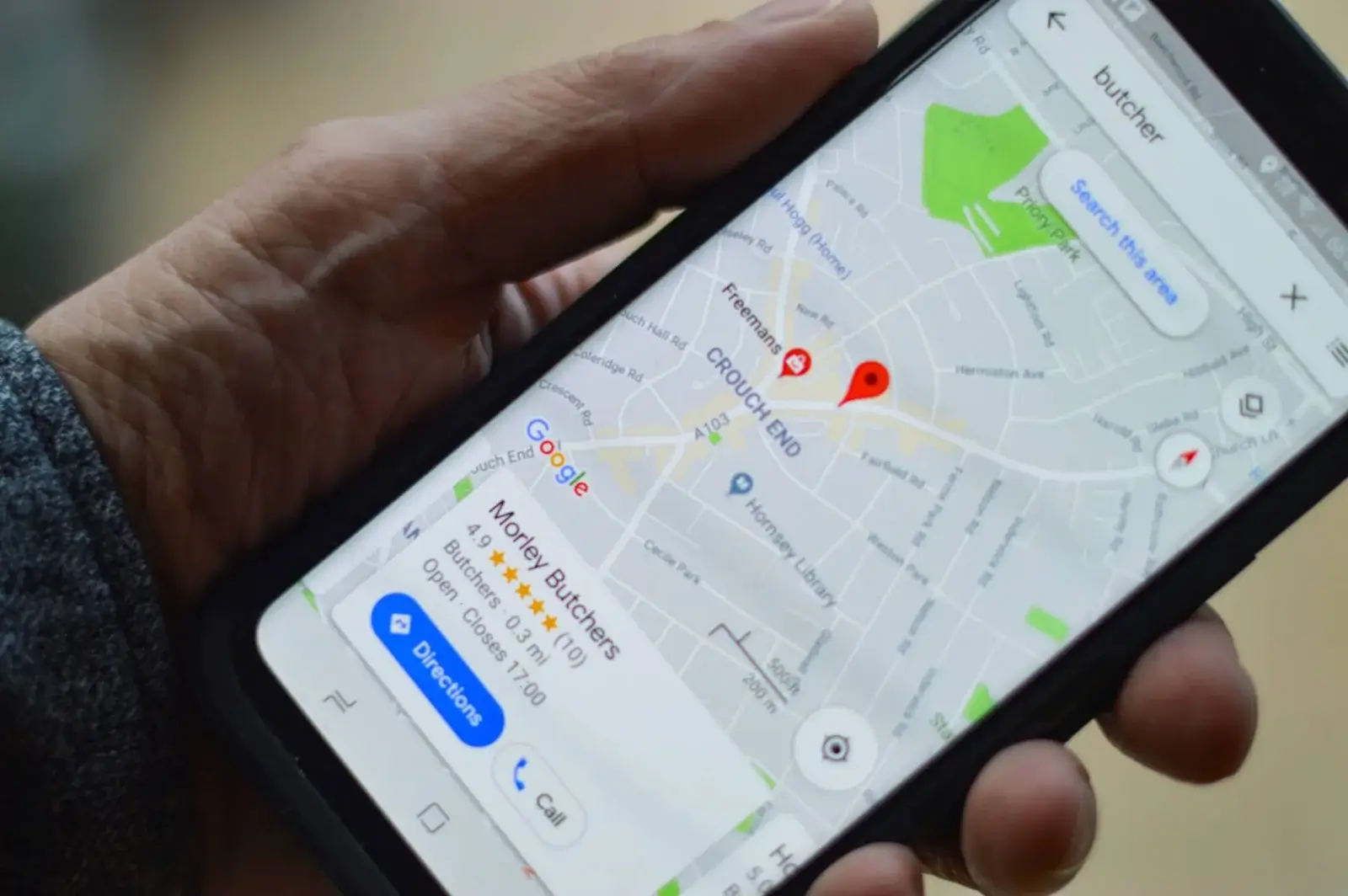
A search like “dentist munich” produces two ranked lists on one page, and they follow different rules. The local pack is the map box with three business listings that Google shows above the classic results for queries with local intent. Below it come the local organic results, the familiar blue links. The same listings power Google Maps, which works as a second search engine of its own.
The distinction matters because the ranked objects differ. The local pack ranks Business Profiles, so profile signals dominate: Categories, reviews, proximity, prominence. The organic list ranks web pages, so page signals dominate: Content, titles, internal links, backlinks. A business can sit in the pack and miss the organic list, or the reverse. The result page itself is worth studying before you optimize; our glossary entry on the SERP breaks down every element.
The six levers below feed both lists, but with different weight. Levers 1 to 3 mainly move the pack. Levers 4 to 6 mainly move local organic results, and they feed prominence, which moves the pack again. That is why the priority order in this article works the profile first and the website second.
Factor 1: A complete Google Business Profile is the entry ticket
Your Business Profile is the object that ranks in the local pack. Google states that businesses with complete and accurate information are more likely to show up in local search results, and that an inaccurate profile might not show up at all. Completeness is a documented ranking input, and it costs hours, not months:
- Verify the profile. Verification tells Google you are authorized to represent the business. Unverified profiles rank poorly or not at all.
- Choose the primary category with care. The primary category is the strongest relevance signal on the profile. “SEO agency” and “marketing agency” produce different result sets. Pick the most specific category that matches the core business, then add secondary categories.
- Fill everything else: Full address, phone number, attributes such as parking or accessibility, photos and videos, in-store products where available.
- Keep opening hours current, including holidays. Google’s tips single hours out, and the reason is visible in the results: For searches made outside your listed hours, closed businesses lose pack visibility to open ones. Wrong hours cost rankings and, worse, send customers to locked doors.
- Reply to reviews and post updates. Google’s own tips list both as ways to stand out.
One rule deserves its own paragraph: The profile name must be your real-world business name. Google’s guidelines for representing your business prohibit adding keywords, taglines or locations that are not part of the actual name. “Miller Plumbing” may not call itself “Miller Plumbing | Emergency Plumber Chicago 24/7”. Stuffed names can be corrected by anyone through “Suggest an edit” and repeat violations risk profile suspension. If a competitor outranks you with a stuffed name, report it instead of copying it.
From our own setup work: When we opened our second location in Tuttlingen, the profile went live with a real street address, the specific primary category and exactly the same name, address and phone data as the website. The matching city page reached the top 3 for its local terms. No trick was involved, just a complete, consistent profile in a market where completeness is rare.
Profile optimization has enough depth for an article of its own, from category strategy to photo cadence. This one stays at the factor level; the dedicated profile guide goes through every field in order.
Factor 2: Reviews are the prominence lever you control directly
Reviews are the only prominence input Google names twice. The ranking documentation says plainly: More reviews and positive ratings can help your business’s local ranking. Four dimensions of your review profile do the work:
- Count. A business with 300 reviews signals more verified demand than one with 9. The gap to close is the local market’s median, not an absolute number.
- Rating. The average score is a ranking input and a click filter at the same time; many searchers filter the map to 4 stars and above.
- Recency and cadence. A steady flow of reviews signals a business that is alive. Fifty reviews from 2022 and silence since read as decline.
- Content and replies. Review text feeds relevance: When a review mentions “root canal”, the profile gains a connection to that query. Google highlights matching review words in the local pack. Replies are listed in Google’s own improvement tips, so answer every review, the critical ones first.
The rules are as clear as the benefit. Google’s review tips state that offering incentives, free or discounted goods or services in exchange for reviews, is “considered fake & misleading content and is strictly prohibited”. The same page notes that a mix of positive and negative feedback often feels more trustworthy, which is Google telling you not to fear the occasional 3-star review. The sanctioned route: Ask every customer at the moment of completed service, with the direct review link or a QR code, and never filter who you ask.
Review text has a second, visible payoff: Justifications. Those are the extra snippet lines Google adds to pack listings, such as a quoted review sentence or a note that your website mentions the searched term. Justifications are assembled from your reviews, your website and your profile posts, and a listing that carries one gets a larger, more clickable result without ranking a single position higher. You cannot request a justification. You can only feed the sources it quotes from, which is one more reason to want customers describing specific services in their reviews rather than leaving bare star ratings.
How review signals work in detail, from the rating algorithm to removal requests, is covered in our glossary entry on Google reviews.
Factor 3: Proximity sets your radius, structure widens it
Distance is the factor you cannot optimize, and pretending otherwise wastes budget. What you can do is structure your presence so distance hurts less:
- A real address in the target city beats remote optimization. If a market matters strategically, a staffed location there outranks any amount of content written from elsewhere.
- Service-area businesses declare their area. Plumbers, cleaners and caterers without a storefront set service areas on the profile instead of a visitor address.
- Multi-location businesses need one profile and one location page per site. One profile for three cities cannot win three local packs.
How far your ranking radius reaches is not a fixed distance; it depends on competitor density. For a locksmith in a city center, the pack changes every few blocks because dozens of profiles compete within walking distance. For a specialized clinic in a rural region, one strong profile can own the pack across half a county. The practical test: Search your main term from your location, then from the far edge of the area you want to serve. Where your listing drops out of the pack, prominence has to do the work distance no longer does, and that is exactly what levers 2 and 6 are for.
Our own rankings show how hard proximity and prominence cap what content can do. Our Munich city page carries more than 2,300 words of genuinely local content, more than several pages that outrank it. It still trails in the metro market, where the top spots hold an exact-match domain and agencies with far larger link profiles. The identical playbook took our Tuttlingen and Starnberg pages to the top 3, because there the proximity and prominence math worked in our favor. The lesson: Pick target cities where the three factors give you a real chance, and let content decide the close races instead of expecting it to beat geography.
Factor 4: Consistent NAP data keeps your business unambiguous
NAP stands for name, address, phone. Google cross-references these three fields everywhere they appear: Your profile, your website, directories, social profiles, industry portals. Consistent data confirms that all mentions describe one business, which strengthens it as an entity Google can trust. Conflicting data splits that trust: If the profile says “Weissenfelder Str. 6” and a directory says a different street, Google has two candidate truths and less confidence in both.
Citations, mentions of your business data on other sites, once carried local SEO on volume alone. Today they work as a verification layer, and quality beats count. Cover the platforms that matter and stop: The major directories of your country, your industry portals, your chamber of commerce, your city’s business listings. Mass submissions to 300 portals produce no measurable gain and create 300 places where your data can rot.
A wrong listing is worse than a missing one. In our own offpage audit we found a directory profile carrying a completely different street, city and postal code for our business, every field wrong. A listing like that is not neutral; it actively feeds the index a second, false version of your address. Auditing existing citations for errors comes before building new ones.
An audit answers that with data instead of a feeling: Profile completeness, review profile, NAP conflicts, page signals and structured data, checked in one pass.
Factor 5: The website behind the profile feeds both lists
Your Business Profile links to a page, and that page competes in the local organic results while its strength feeds back into the profile’s relevance. Four page-level signals carry the local weight:
- One dedicated page per location and service area. The page states city and service in the title, the H1 and the first paragraph, in the words customers search with. Which words those are is keyword research, not guesswork.
- Genuinely local substance. Directions, team, local references, area-specific problems. We measured our own five city pages and found two sharing almost 80 percent of their text; near-identical city pages are doorway pages in Google’s terms and get filtered rather than ranked. Every page earned an individual rewrite.
- LocalBusiness structured data. Google documents a LocalBusiness markup type that makes name, address, geo-coordinates, opening hours and reviews machine-readable, and recommends matching Search Console verification so Google can confirm the data comes from the owner. How markup works in general is covered in our entry on structured data.
- Mobile performance. Local searches happen on phones, on the street, on mobile networks. A location page that loads slowly loses the searcher before the address renders; the Core Web Vitals tell you whether yours does.
None of this replaces the profile work. It multiplies it: A strong page under a complete profile lifts both ranked lists at once.
Factor 6: Local links are prominence Google can verify
Google’s prominence definition explicitly counts how many websites link to your business. For local rankings, the sources matter more than the raw number, because a link is also a local mention that confirms you exist in this market. Five sources produce links that general link building rarely reaches:
- Local press. A story in the city newspaper about an opening, an anniversary or a local data point earns the strongest local link there is.
- Chambers, guilds and business associations. Membership pages link routinely, and the domains carry regional authority.
- Sponsorships. The youth sports club, the neighborhood festival, the school event; sponsor pages link their supporters.
- Suppliers and partners. “Our retail partners” pages are links you can request with one email.
- Local institutions. Universities, nonprofits and municipal pages that list local providers.
One link from the local newspaper outweighs 50 directory entries, because it is editorial, topical and geographically unambiguous. What makes a link count in the first place is covered in our entry on backlinks. Budget this lever in months, not days; it is the slowest of the six and the hardest for competitors to copy.
What does not move local rankings
Knowing the real factors means you can name the fake ones. Five things local businesses pay for that do not move the local pack:
- Paying Google. The documentation says it directly: There is no way to request or pay for a better local ranking. Google Ads places ads above the pack; it never changes the pack.
- Social media activity. No Google documentation lists posting frequency or follower counts as a local ranking factor. Social channels can bring customers and occasionally earn a link or a review; the activity itself ranks nothing. Older factor lists, including the 2025 version of this article’s German original, claimed otherwise.
- Keyword-stuffed profile names. They can move rankings short-term, which is exactly why Google’s naming guidelines prohibit them; the edit is reversible by anyone and the penalty is suspension of the profile.
- Bought or incentivized reviews. Strictly prohibited as fake and misleading content, with profile restrictions as the documented consequence, and detection has become noticeably better since Google moved review moderation to machine learning models.
- Mass directory submissions. Past the relevant 20 to 30 platforms, additional citations add maintenance risk instead of rank.
- Ritual gestures on the website. Embedding a Google Map on the contact page, hiding city names in footers, or repeating the town in every heading: None of these appears in any Google documentation as a ranking input. A map embed is fine for visitors; expecting rank from it confuses decoration with data.
The pattern behind all five: Anything that simulates prominence instead of building it either does nothing or gets punished. The three factors reward being a well-documented, well-reviewed, genuinely local business; shortcuts to looking like one keep getting shorter-lived.
The priority order: What to fix first
Effort and payoff differ wildly across the six levers, so the order of work matters more than the list itself. Work the six levers in this order:
- Verify and complete the Business Profile. Hours of work, and the single biggest jump available, because completeness is a documented ranking input and most local competitors leave fields empty.
- Install a review routine. Ask at service completion via link or QR code, reply to everything, keep the cadence. Starts paying within weeks and compounds forever.
- Fix NAP data everywhere it exists. Days of work: Audit current listings, correct the wrong ones, cover the relevant platforms, stop.
- Strengthen the location page. Local title and H1, genuinely local content, one page per location. Weeks of work, lifts pack relevance and organic rankings together.
- Add LocalBusiness structured data. Days of work for a developer, makes every fact on the page machine-readable.
- Earn local links. The months-long lever; start it last but start it, because it is the one competitors cannot clone.
Steps 1 to 3 are a one-time cleanup a focused week can finish. Steps 4 to 6 are the ongoing program; this is where a monthly SEO engagement earns its fee, because reviews, content and links compound while one-off fixes decay.
The same factors now decide AI answers
Ask ChatGPT or Gemini for “a good physiotherapist in Augsburg” and you get named recommendations, not ten links. Those names come from the same substrate the local pack ranks: Business Profile data, review counts and ratings, and what the open web says about each business. Gemini draws on Google Maps data directly; ChatGPT’s search mode cites web sources, where your profile pages, review platforms and local mentions are the evidence available about you.
Google’s documentation on AI features in Search says there are no extra requirements for appearing in AI Overviews beyond standard technical and content best practices. For local businesses that has a concrete consequence: The six levers in this article are also your AI visibility program. Complete profile data becomes quotable fact, reviews become citable social proof, consistent NAP data keeps AI systems from confusing you with someone else. The businesses that treated the three factors seriously are the ones AI assistants can safely recommend; how to build on that systematically is what GEO, generative engine optimization, covers.
Measure before and after, from more than one point
Local rankings are position-dependent: One keyword has a different ranking on every street, because distance is a live input. Checking your ranking from the office chair measures exactly one point on the map, usually the most flattering one. Meaningful measurement tracks positions from several points across the target area, watches local pack presence separately from organic positions, and reads the profile’s own performance data, calls, direction requests and website clicks, as the outcome layer. That measurement loop runs as a standing part of our local SEO service, because it is the only way to prove which lever moved a ranking. Measuring local visibility properly is a discipline of its own, and it gets its own article in this magazine.
We check your profile, reviews, data and pages against the six levers and tell you which one moves your market. Plain answers, no sales script.
Frequently asked questions
What are the most important local SEO ranking factors?
Google names three: Relevance, distance, and prominence. Relevance is how well your Business Profile matches the search, distance is how far you are from the searcher, prominence is how well known your business is through reviews, links and mentions. Since distance is fixed, profile completeness and reviews are the two most important inputs you control.
How do I rank higher on Google Maps?
Google Maps and the local pack rank the same Business Profiles with the same three factors. The fastest path: Verify and fully complete your profile with the most specific primary category, collect reviews steadily and reply to all of them, and make sure your website names your city and services clearly. Paying Google does not improve a Maps ranking.
How long does local SEO take to work?
Profile changes such as categories and completed fields can show an effect within weeks. Review effects build over 2 to 3 months of steady collection, and local links need several months. In markets without overwhelming competition, visible movement within 3 months is a realistic expectation.
How much does local SEO cost?
The one-time cleanup, profile, data corrections and structured data, is a project of days and often costs a few hundred to a few thousand euros or dollars. Competitive city markets need the ongoing levers, reviews, content and local links, which is why local SEO is typically priced as a monthly retainer rather than a one-off fix.
Does social media activity improve local rankings?
No documented Google local ranking factor includes social media activity. Posting frequency and follower counts do not move the local pack. Social channels help indirectly at most, by prompting reviews, mentions or links, and those are the signals that actually count.
Sources
- Google Business Profile Help: “Tips to improve your local ranking on Google”, support.google.com, accessed 27 July 2026.
- Google Business Profile Help: “Guidelines for representing your business on Google”, support.google.com, accessed 27 July 2026.
- Google Business Profile Help: “Tips to get more reviews”, support.google.com, accessed 27 July 2026.
- Google Search Central: “Local business (LocalBusiness) structured data”, developers.google.com, accessed 27 July 2026.
- Google Search Central: “AI features and your website”, developers.google.com, accessed 27 July 2026.