



What is anchor text?
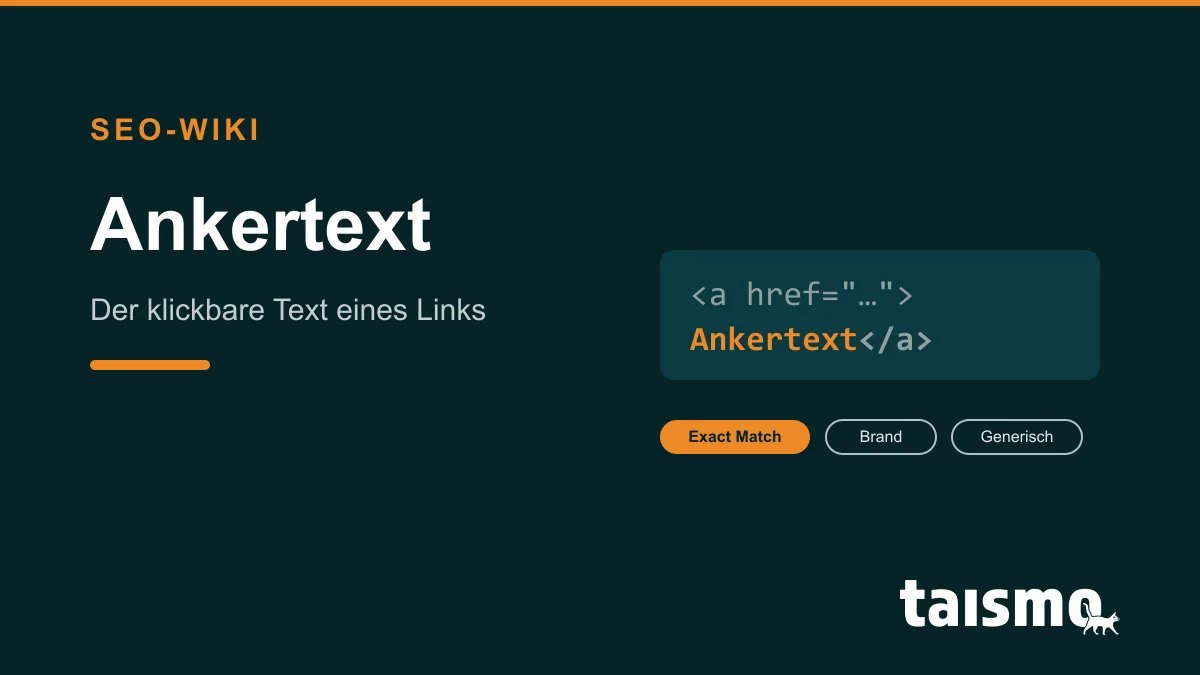
Anchor text is the visible, clickable text of a link; in HTML code it sits between the opening <a href="/%E2%80%A6"> and the closing </a>. Search engines read anchor text as a context signal: it describes what topic the linked target page covers. Precise anchor text helps users and Google alike understand where a link leads.
What types of anchor text are there?
SEO practice distinguishes 6 anchor text types:
| Type | Example | Signal effect |
|---|---|---|
| Exact match | “SEO services” | Exact focus keyword of the target page, strongest topical signal |
| Partial match | “monthly SEO services for B2B” | Keyword embedded in additional words |
| Brand | “taismo” | Brand name, the most natural signal for backlinks |
| Generic | “click here”, “learn more” | No topical signal |
| Naked URL | “taismo.de” | Neutral, common in source citations |
| Image anchor | Linked image | The image’s alt attribute takes over the role of the anchor text |
A natural link profile mixes all 6 types. Experience shows that brand anchors and naked URLs make up the largest share, while hard exact match anchors remain the exception.
Why is anchor text important for SEO?
Anchor text tells Google what the target page is relevant for before the crawler even visits it. Together with the surrounding sentence, it forms the context in which the linked page is topically classified; the link also passes link juice to the target.
With backlinks, a warning applies at the same time: Google treats an unnaturally high share of hard exact match anchor text from external domains as an attempt at manipulation. The Penguin update has targeted exactly this pattern since 2012 and has been working in real time within the core algorithm since 2016. A natural backlink profile therefore mixes brand anchors, URLs, and descriptive phrasing.
How do you use anchor text correctly in internal links?
Internally, different rules apply than externally: you can consistently connect your own pages with precise, keyword-bearing anchor text without risking a penalty. 3 rules lead to the goal:
- Anchor text emerges from the sentence context. The link blends into the reading flow instead of interrupting it as a “click here” foreign object.
- Anchor text describes the target page. Anyone who clicks “internal linking” lands on the page about internal links, not on the homepage.
- One anchor text per target page stays consistent. Changing link texts pointing to the same target dilute the topical signal.
A well-planned anchor text strategy across all internal links is one of the strongest on-page levers; that is why our ongoing SEO services review it with every new piece of content.
Frequently asked questions about anchor text
What is an example of good anchor text?
Good anchor text names the link target specifically: “guide to internal linking” instead of “click here”. Readers know before the click which page to expect, and Google receives a clear topical signal.
Is “click here” bad anchor text?
For SEO, yes: generic anchor text such as “here” or “learn more” carries no topical signal to the target page. Used occasionally it is harmless; as a standard it wastes relevance.
How long should anchor text be?
There is no technical limit. 2 to 6 words have proven effective: long enough for a clear topical signal, short enough to stay readable within the sentence. Whole sentences as anchor text dilute the signal.
Welt der SEO lernen?