



What Is a Ranking?
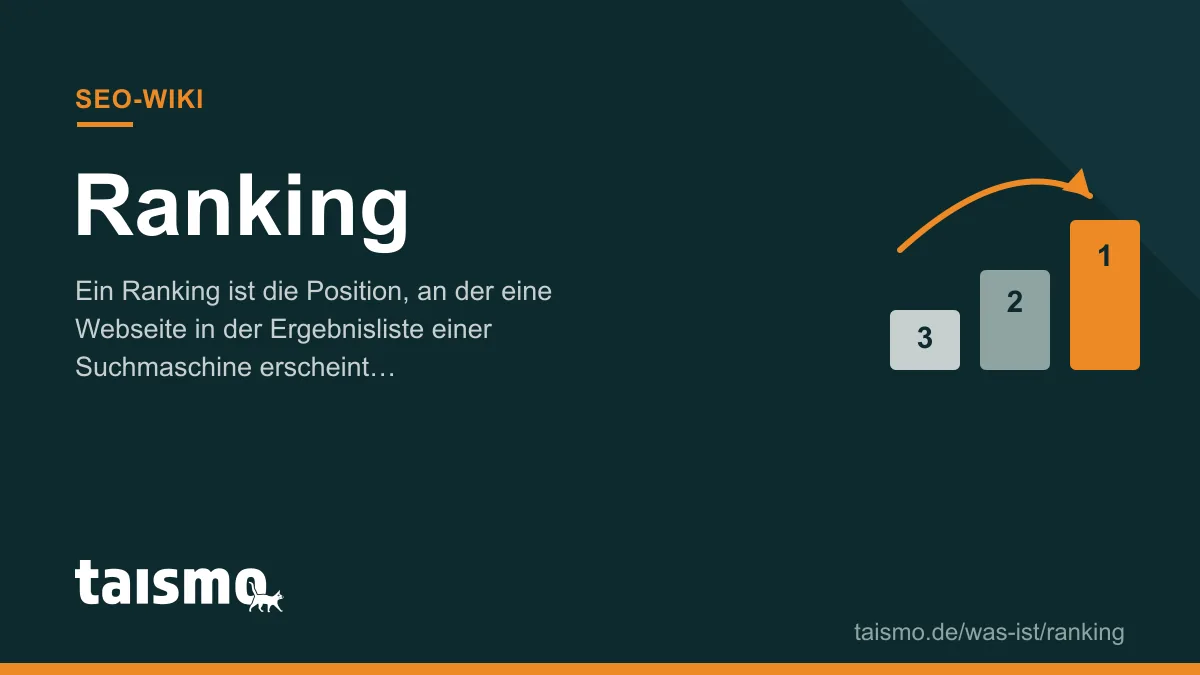
A ranking is the position at which a web page appears in a search engine’s list of results. Position 1 sits at the very top of the organic results, followed by the remaining hits in descending order. A ranking always applies to the combination of one page and one specific search query: The same page can rank at position 3 for one keyword and not rank at all for another. Search engine optimization is the work of improving these positions for relevant search queries.
Term profile
| Attribute | Details |
|---|---|
| Part of speech | Noun: the ranking, the rankings; from “to rank” |
| Also known as | Placement, position in the search results |
| Field | SEO, search engines, web analytics |
| Related terms | SERP, SEO, Search intent |
How does a ranking on Google come about?
A ranking comes about in 3 steps: crawling, indexing, sorting. First the Google crawler reads a page, then Google adds it to the index, and for every search query the ranking algorithm sorts all matching pages from the index into an order. This sorting happens in real time and turns out differently for each query.
A ranking is therefore not a fixed property of a page but a snapshot. Location, device, language, and the user’s previous searches change the order. If you check your ranking in your own browser, you see a personalized result, not the neutral position.
Only the organic list counts here: Ads, map listings, and other SERP features sit outside the organic count. Position 1 can therefore visually start in the lower third of the screen when ads or a featured snippet sit above it.
Which factors influence a ranking?
Google evaluates a large number of signals for every ranking. The 4 most important groups are:
- Relevance: How well does the content answer the search intent behind the query? This is the strongest signal.
- Quality and trust: Well-sourced content, author expertise, and backlinks from other websites speak for a page.
- Usability: Load time, mobile friendliness, and a clean site structure.
- Context: The searcher’s location and language, and for local queries the proximity to the business.
No single factor guarantees a position. Rankings improve when a page serves the search intent more completely than the competition on the search results page.
How do you measure a ranking?
You measure rankings with two kinds of tools: Google Search Console shows the average position of your own pages for real search queries, while rank tracking tools check defined keywords daily, neutrally, and by location. What matters is the trend view: A single measurement says little because of the constant fluctuations; only the trend over weeks shows whether a page is gaining or losing.
Economically, the front positions are what count: The click-through rate drops sharply with every position, and beyond the first results page hardly any clicks happen at all. A ranking at position 40 is therefore practically invisible, even though the page formally ranks. This ongoing monitoring and improvement of positions is the core of continuous SEO services.
Welt der SEO lernen?