



What is Retrieval Augmented Generation (RAG)?
Retrieval Augmented Generation (RAG) is an AI architecture that combines a large language model with a retrieval step placed in front of it. Before the answer is generated, relevant information is pulled from an external knowledge source and handed to the model as context. That way RAG reduces hallucinations and delivers current answers you can trace back to sources. RAG is the basis of many AI search systems such as Perplexity and Google’s AI Overviews.
A plain language model answers only from what it learned during training. Its knowledge is frozen at a cut off date and cannot be checked. RAG breaks through that limit: at runtime the model reaches into a current knowledge base, for example a document collection, a database or the open web, and bases its answer on those findings. The result is an answer with a source behind it instead of one from memory.
The term at a glance
| Attribute | Detail |
|---|---|
| Term | Retrieval Augmented Generation (RAG) |
| Category | AI architecture, a method of machine learning |
| Also written | retrieval-augmented generation (with a hyphen) |
| Pronunciation | “ri-TREE-vuhl awg-MEN-tid jen-uh-RAY-shuhn” |
| Components | retrieval, augmentation, generation |
| Related terms | LLM, embedding, vector database, grounding, GEO |
| First described | 2020 (research paper by Lewis et al., Facebook AI Research) |
How does RAG work (retrieval, augmentation, generation)?
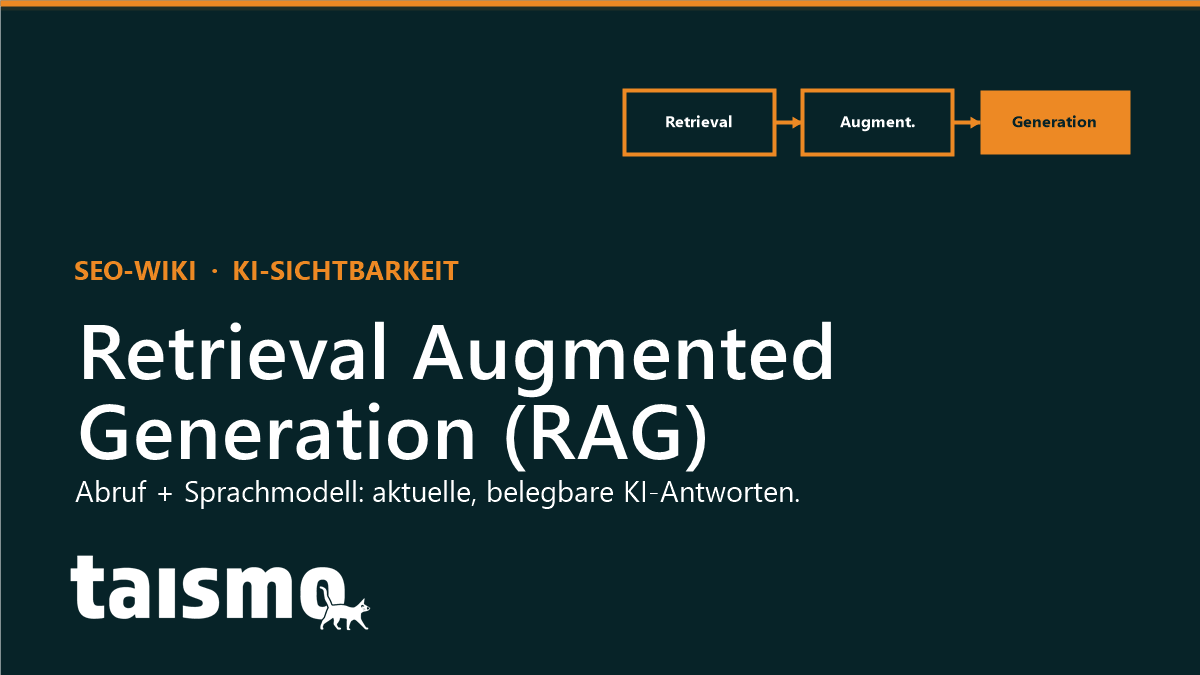
RAG runs in three consecutive steps, and those steps give the method its name: first the retrieval, then the augmentation, finally the generation. The decisive difference from a plain language model sits in the first two steps, which happen before any text is written out.
- Retrieval: the user question is turned into a vector (an embedding) and matched against a knowledge base. A vector database finds the passages that are closest in meaning, not through an exact word match but through semantic proximity.
- Augmentation: the passages found are attached to the original prompt as context. The model no longer receives the question on its own, it receives it together with the relevant evidence.
- Generation: the language model formulates the answer on the basis of this enriched prompt. Because the facts came with the prompt, it can quote them instead of guessing them.
The retrieval works through entities and semantic similarity, not through keywords in the classic sense. That is exactly why structured, unambiguous information plays such a big role for being found in the retrieval step.
Why is RAG used against hallucinations?
RAG solves the two biggest weaknesses of plain language models: invented facts and outdated knowledge. A language model produces text by statistical probability and can turn out statements that sound very convincing but are wrong, which is what people call a hallucination. Because RAG ties the answer to concrete findings, that risk drops considerably.
The most important advantages at a glance:
- Currency: the knowledge base can be updated at any time without retraining the model. New facts are available immediately.
- Traceability: answers can point to their sources. That is precisely what AI searches make visible when they show footnotes or links.
- Domain knowledge: companies bring in their own documents, from manuals to product data to internal wikis, without handing that sensitive material to the model training.
- Cost: the retrieval is cheaper than another training run every time the knowledge changes.
Anchoring an answer to verifiable facts like this is also called grounding. RAG is the most common technical method for putting grounding into practice.
What does RAG mean for SEO and GEO?
For search engine optimization, RAG means a change of perspective: content no longer only has to rank, it has to be retrievable and quotable as evidence in the retrieval step. Systems such as AI Overviews, ChatGPT or Perplexity fetch content at runtime and build their answer from it. Whoever wants to be retrieved and named as a source has to optimize for the retrieval step.
This is exactly where Generative Engine Optimization (GEO) comes in, the discipline of preparing content to be cited in AI answers. Closely related is LLMO, the optimization of visibility inside large language models. Both aim at the same thing: that a RAG system finds your content, understands it and adopts it as a sourced statement.
Three levers help in particular:
- Clear definitions: short statements that stand on their own and can be quoted, exactly like the definition at the top of this article, are easy to retrieve as a passage.
- Structured data: schema.org and a clean structured data setup make entities and relations machine readable and raise the chance of being retrieved correctly.
- Topical depth: questions answered in full deliver the passages that a RAG system prefers as context.
This interlocking of technical cleanliness and quotable content is the core of modern SEO services, which think about classic rankings and AI visibility together.
RAG vs. a plain LLM and fine-tuning
RAG, a plain LLM and fine-tuning solve the knowledge problem in different ways, and they do not rule each other out. A plain LLM answers from its training knowledge alone. Fine-tuning retrains a model with additional examples in order to shape its style or its behavior in a subject area. RAG, by contrast, leaves the model untouched and passes the knowledge in at runtime.
| Aspect | Plain LLM | Fine-tuning | RAG |
|---|---|---|---|
| State of knowledge | frozen | frozen (until the next training run) | current at any time |
| Sources traceable | no | no | yes |
| Effort for new knowledge | retraining | another fine-tuning run | update the knowledge base |
| Strength | fluent language | tone & behavior | facts & freshness |
In practice, RAG and fine-tuning are often combined: fine-tuning shapes how the model answers, RAG contributes what it answers with. For current, verifiable facts, RAG is the approach of choice.
Frequently asked questions about Retrieval Augmented Generation
What does the abbreviation RAG stand for?
RAG stands for Retrieval Augmented Generation. The name describes the three steps of the method: retrieval, augmentation and generation.
Does RAG need a vector database?
In most cases yes. A vector database stores content as embeddings and finds the passages that fit semantically in the retrieval step. There are also RAG variants with a classic full text search, but semantic search over vectors is the standard.
Does RAG prevent hallucinations completely?
No. RAG lowers the risk considerably because the answer is tied to retrieved facts. Context that is retrieved wrongly or incompletely can still lead to errors. The quality and the currency of the knowledge base remain decisive.
What does RAG have to do with SEO?
AI search systems use RAG to build answers from retrieved web content. Whoever wants to be cited as a source optimizes their content so that it gets found and picked up in the retrieval step, and that is the goal of GEO and LLMO.
Welt der SEO lernen?