



What is NAP?
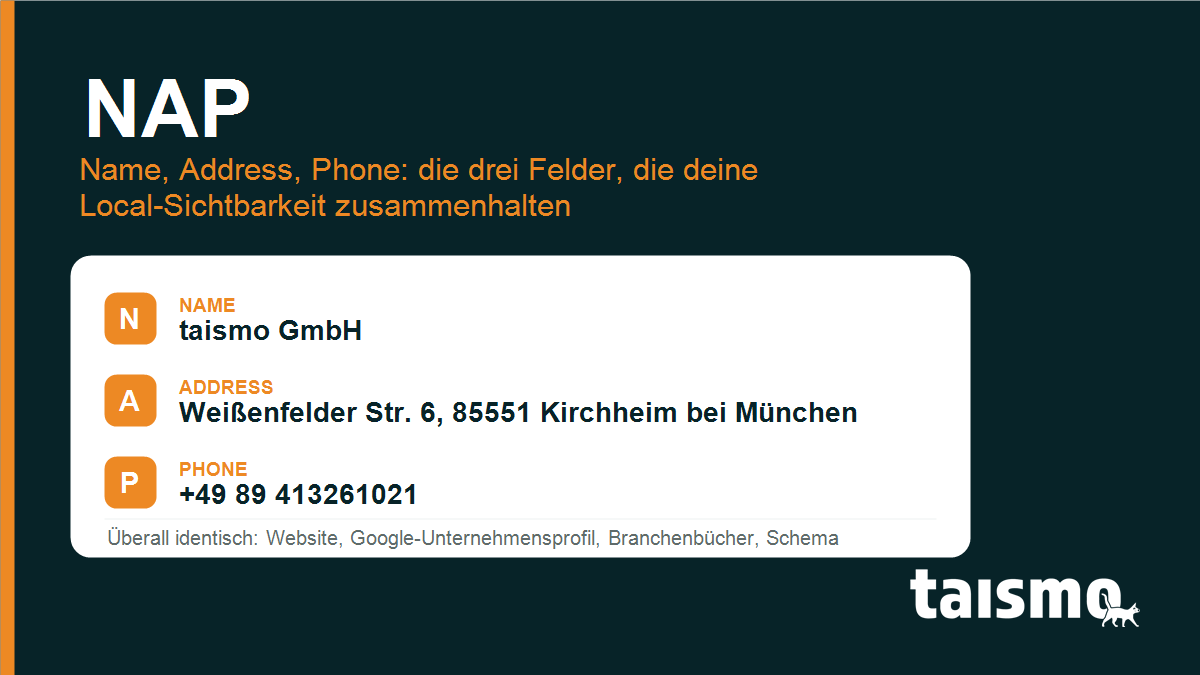
NAP stands for name, address, phone and refers to the three core details of a business: the company name, the street address and the phone number. In local SEO, NAP stands for the principle that these three details appear word for word identically on every channel, so on your own website, in your Google Business Profile, in directories and in structured markup. That is how search engines recognize that all mentions belong to the same business. Because AI systems also take contact details from such sources instead of verifying them live, one uniform data set additionally affects whether language models return the right location and the right phone number.
The term at a glance
| Property | Detail |
|---|---|
| Word type | abbreviation, used as a noun: the NAP |
| Pronunciation | usually spelled out as N, A, P, in English also spoken as one word |
| Long form | Name, Address, Phone |
| Also called | NAP data or location data |
| Field | local SEO, entity building, offpage work |
| Related terms | citation (a business mention), Google Business Profile, entity, knowledge graph |
What do name, address and phone stand for?
NAP consists of exactly three fields, and each one has a rule of its own:
- Name: the company name as it is really used, including the legal form if that form is part of the name. Additions such as a city or a service do not belong in it. “Musterbau GmbH” is the name, “Musterbau GmbH roofer Munich cheap” is keyword stuffing and breaks the guidelines for the Google Business Profile.
- Address: the complete street address in one fixed spelling. What matters is not whether you write “St.” or “Street”, but that you use the same variant everywhere.
- Phone: one phone number in a single format. A number with a local area code proves the tie to the location better than a toll free number does.
These three fields are not phrased anew for each channel, they are copied from one source. That is exactly what makes NAP an organizational task and not a writing task.
Why does NAP consistency matter for local SEO?
NAP consistency matters because search engines have to assemble a picture of a business out of many separate mentions across the web. Every mention in a directory, on a review platform or in a press article is one data point. If the data points agree, a clearly outlined entity emerges from them, and that entity can be anchored in the knowledge graph.
If the details differ, Google has to decide which variant is correct. That uncertainty works in three directions: the match to the location gets weaker, trust in the data drops, and in the worst case duplicates appear, meaning several profiles for one and the same business. For local search that gets expensive, because only a few results compete for visibility in the map area.
Consistent data is not a ranking factor you can turn up on its own. It is the precondition for every other local signal, such as Google reviews or local landing pages, to pay into the same account at all.
Why does NAP data matter for AI systems?
NAP data matters for AI systems because language models such as ChatGPT, Perplexity or Google AI Overviews do not verify contact details live. The answer comes out of training data and out of sources the system fetches for the query. A model does not call the business to check, it repeats what its sources give it.
The consequence: the clearer and more uniform the facts are across the web, the more likely a system returns the correct address and phone number. If the sources contradict each other, the chance rises that an outdated or wrong detail shows up. How strongly individual AI systems weigh this cannot be measured from the outside and differs by provider. Only the direction is certain: consistent data helps, contradictory data hurts.
Two building blocks work especially well here, because they are machine readable and need no interpretation. The LocalBusiness markup of the website makes the name, address and phone number directly readable, and an llms.txt can serve the same location data as a curated briefing for AI crawlers. Neither replaces the work on your directory entries, both reinforce it. How AI systems pick and cite sources is covered by the term Generative Engine Optimization, the role of solid fact pages by the term Grounding Page. NAP consistency is the foundation of any optimization for AI visibility.
How do NAP inconsistencies happen?
NAP inconsistencies almost never happen on purpose, they build up over time. These are the six most common causes:
- A move or a change of company name: your own website gets updated, old directory entries stay as they are.
- Data aggregators: many portals buy in data sets and thereby multiply one outdated state.
- Automatically generated entries: some directories create profiles without the business doing anything.
- Keyword additions in the name: anyone who pads the company name with services ends up with a different spelling per channel.
- Phone variants: switchboard, direct dial, mobile and service numbers land in different profiles without coordination.
- Several people: when marketing, sales and external providers all maintain entries independently, the data drifts apart.
NAP, NAP+W or NAPU: which variants exist?
Besides NAP, two extended spellings are common that stretch the same basic idea to a fourth field:
- NAP+W or NAPW adds the website. That makes sense, because the linked URL also decides which web presence a directory entry gets assigned to.
- NAPU means the same thing, but uses URL instead of website as the fourth letter.
A binding standard exists only for the three core fields. Everything beyond that, such as opening hours, categories or description texts, gets abbreviated differently from agency to agency. For practical work the abbreviation is secondary: what counts is that every field that goes out has one fixed version. Anyone who maintains the URL as well should make sure it matches the canonical address exactly, so the same protocol and the same spelling with or without a trailing slash.
How do you check your NAP consistency?
The check follows five steps that work without any special tool:
- Fix the reference: define the three fields once as binding and keep them in a file that everybody copies from.
- Match the business profile: the Google Business Profile is the single most important entry. It has to match the reference and the imprint.
- Search for the number: search for the phone number and the street in quotation marks. That is how you find mentions you never created yourself.
- Work through the directories: go through the relevant portals once completely and correct the entries that differ instead of creating new ones.
- Cross check the markup: finally, compare the structured markup of the website with the reference.
How big this alignment turns out depends on the age of the business. Companies that have moved once or changed their legal form regularly find double digit numbers of differing entries. If you would rather not run that alignment yourself, it belongs to ongoing local SEO management.
How do NAP, the business profile and schema fit together?
NAP data works twice over: once visibly for people and once machine readable for search engines and AI systems. The machine readable part runs through structured data in the JSON-LD format. There, a LocalBusiness object holds the fields name, address and telephone, plus geo coordinates, opening hours and, with sameAs, a pointer to the Google Business Profile.
That closes the circle: the markup confirms what the imprint says, the business profile confirms both, and the directory entries back up the same statement from the outside. If the markup contradicts the visible details, it is not an advantage but one more piece of noise.
How does NAP work with multiple locations?
With several locations, NAP applies per location, not per company. Every location needs its own data set with its own address, its own Google Business Profile and ideally its own location page on the website. In the markup, every location becomes its own LocalBusiness object that points to the parent company through parentOrganization.
Two things go wrong here often. First, reviews of the main location get carried over to the branches, although reviews belong to the entity that earned them. Second, cities without a real location get an address of their own, purely to rank locally. Both are risky: the first breaks the guidelines for review markup, the second breaks the requirement that a profile has to represent a real location you can actually visit. If you have no location in a city, you work with a service area there, not with an address.
Frequently asked questions about NAP
Is “St.” instead of “Street” a problem?
No, as long as you settle on one variant and use it everywhere. Search engines normalize common abbreviations. It only becomes risky when the house number, an addition or the postal code differ as well.
Does the phone number need a local area code?
It is not mandatory, but it is worth doing. A number with a local area code supports the tie to the location, while central service numbers are identical for every location and therefore say nothing about the place.
What is a citation?
A citation is a mention of your business with its NAP data on a third party website, for example in a directory. A citation does not need a link to have an effect: the matching mention alone is evidence.
Do AI systems pass on wrong contact details?
That can happen. Language models do not verify addresses and phone numbers live, they repeat what their sources give them. If an outdated number sits in many directories, it can turn up in AI answers even though your own website was corrected long ago. That is why maintaining directories also pays into AI visibility.
What happens after a move?
After a move the address and often the phone number change, so two of the three fields. The order matters: first switch the imprint, the website and the markup, then the business profile, then the directories. A temporary drop in rankings is normal, it only becomes permanent if old entries stay in place.