
How Does Local SEO Rank Tracking Work? Your Guide
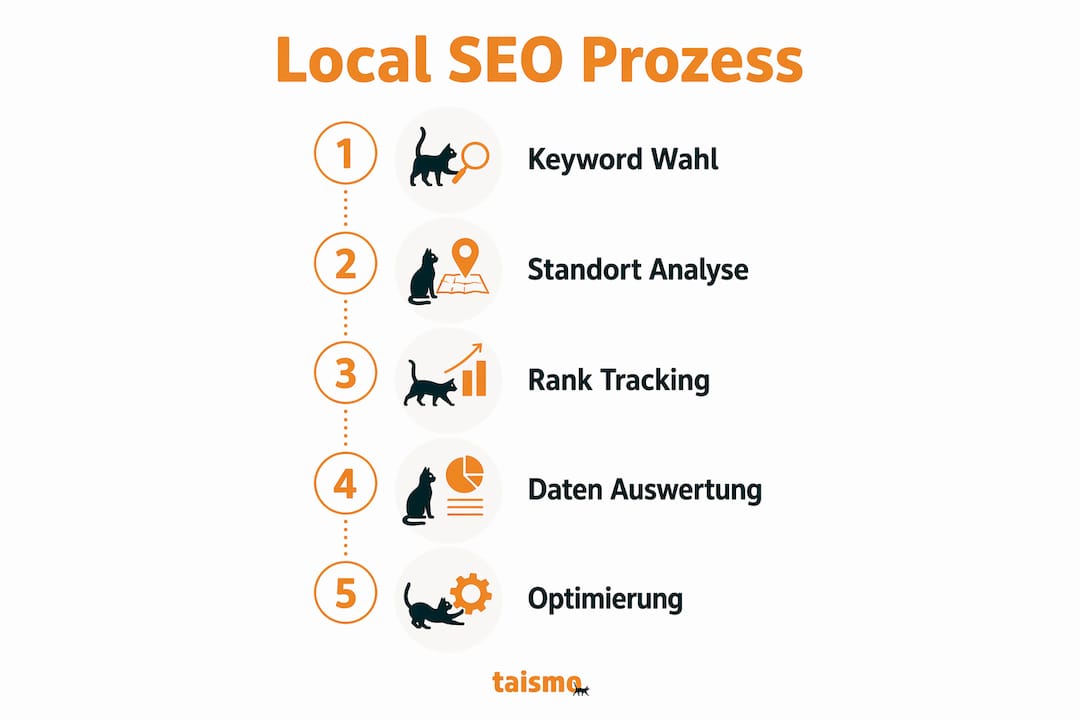
Local SEO rank tracking is the process of systematically monitoring your business’s position in local search results. If you want to be visible in Google Search for “bakery Munich” or “dentist Cologne,” you need to know where you currently rank and why. The top three spots in the Google Local Pack account for about 93% of all clicks on local search queries. This means that if you rank 4th or lower, you’re simply invisible to most potential customers. Local rank tracking makes this difference measurable and shows you where you need to take action.
How does local SEO rank tracking work from a technical standpoint?
Local SEO rank tracking measures where your business appears in the search results for a specific search query in a specific location. That sounds simple. But it isn't, because Google returns completely different results depending on location, device, and search context.

Location and equipment determine the result
Someone searching for “physical therapist” in Munich will see different results than someone making the same search in Schwabing, even though both are in Munich. Google uses the user’s exact location to prioritize local results. Rank tracking for local search engines must account for this effect. To do so, specialized tools simulate search queries from defined geographic coordinates, not just from the city center.
Mobile devices play a unique role. Changes in local rankings must be tracked by location, device, and keyword to identify genuine trends. A business might rank second on desktop and fifth on a smartphone. If you track only one metric, you’re only seeing half the picture.
Geo-Grid Tracking: Visibility on the Map
Geo-grid tracking is the most advanced method in local rank tracking. Specialized local SEO tracking tools enable geo-grid tracking, which maps local visibility down to the street level. The tool overlays a grid of measurement points across your service area, measures your position at each point, and displays the results as a heat map. You can see at a glance where you’re strong and where you’re losing customers.
Here’s an example: A plumber in Hamburg-Altona tracks his ranking for “plumber Hamburg” at 25 geographic coordinates around his location. The heat map shows that he ranks first within a 1-km radius, but drops to seventh place at 3 km. This provides a concrete basis for action.
Why Averages Can Be Misleading
Many business owners look at a single average score and believe that’s their ranking. That’s a fallacy. An average based on 20 data points might show you in 3rd place, even though you don’t even appear in the top 10 in half of your service area. Local SEO ranking analyses only become meaningful when you break down the data by location, device, and keyword group.
Pro Tip: Track at least three different keyword variations per service, such as “dentist in Munich,” “dentist in Schwabing,” and “dentist near me.” This will help you identify which phrasing your target audience actually uses.
An overview of the most important measurement dimensions:
- Location: Where exactly are the measurements taken? Downtown, the outskirts, neighboring towns?
- Device: Desktop or mobile? The two values can differ significantly.
- Keyword: Which search terms are tracked? Generic or location-specific?
- Time frame: Weekly or monthly measurements for trend comparisons?
What tools and data sources are relevant for local SEO tracking?
Two data sources form the foundation of any solid local SEO analysis: Google Search Console and specialized Geo-Grid tracking tools. Both have clear strengths. Combining them provides the most comprehensive overview.
Google Search Console: Free and Honest
Google Search Console provides real user data. You can see which keywords your site appears for, how many impressions it has received, and how often users have actually clicked on it. Google Search Console is sufficient for self-employed individuals because it offers real user data for free. This isn't marketing. Search Console shows you what's actually happening, not what a tool simulates.
The downside: Search Console aggregates data. You don't see location-specific rankings or a geo-grid view. For a sole proprietor with a single location, this is often sufficient. For a company with multiple branches or a larger catchment area, however, it quickly reaches its limits.
Specialized Geo-Grid Trackers: Depth at the Expense of the Budget
Paid Geo-Grid tracking tools go a step further. They simulate search queries based on defined coordinates, display locations on a map, and allow for comparisons over time. The price is higher, but the value of the information gained is significant once local visibility becomes a key source of revenue.
| Characteristic | Google Search Console | Geo-Grid Tracking Tool |
|---|---|---|
| Costs | Free | Subject to a fee |
| Data Source | Real user queries | Simulated Location Queries |
| Location Accuracy | Limited | Street-level |
| Device Classification | Yes | Depending on the tool |
| Heat Map Visualization | No | Yes |
| Barrier to entry | Low | Moderate to high |
The gold standard: combining both sources
The combination of Google Search Console and Geo-Grid tracking is the gold standard for local SEO analysis. Search Console shows you what users are actually searching for and how they respond. The Geo-Grid tool shows you where your geographic weaknesses lie. Together, they provide a picture that neither tool can deliver on its own.
Pro Tip: Export a screenshot of your Geo-Grid heat map every month and save it with the date. After three months, you’ll be able to see at a glance whether your efforts are having an impact. This serves as your campaign documentation.
When it comes to local SEO strategies, don't track more keywords than you're actively working on. Ten well-monitored keywords are more valuable than 100 neglected ones.
How do you interpret the tracking results correctly?
Numbers alone don't mean anything. A #4 ranking can be fantastic if you were in 15th place just three months ago. It can be disappointing if you know that the top three spots get the lion's share of clicks. Context is everything.
Fluctuations vs. Real Growth
Google rankings fluctuate daily. This is normal and no cause for panic. If you track them daily and react to every fluctuation, you’ll waste time and fray your nerves. You can only identify real growth by looking at the weekly average over several weeks. Ranking fluctuations are like gusts of wind. The trend is the direction of the wind, not the individual gust.
Google Business Profile as a Ranking Factor
The Google Business Profile is the most important local ranking factor, accounting for about 32% of the influence on Local Pack rankings. Completeness, reviews, selected categories, and regular posts directly influence where you appear in the Local Pack. If you neglect your profile, you’ll lose rankings, no matter how good your website is.
Reviews aren't just a nice bonus. They're a ranking signal. A business with a 4.8-star rating and 200 reviews will generally outrank a business with a 4.9-star rating and 12 reviews, because Google evaluates relevance and trust together.
Other key figures in addition to the position
Ranking alone isn't enough. In addition to rankings, local SEO success is measured by impressions, clicks, calls, and route plans from Google Business Insights. These metrics show whether your ranking is actually leading to customer interactions.
The most important supplementary financial metrics:
- Insights: How often does your listing appear in search results?
- Website clicks: How many users want to learn more?
- Calls: How many people call directly from the search results?
- Route Planning: How many people plan their route to your place?
If your ranking goes up but the number of calls goes down, something isn't right. Maybe your profile doesn't match the search query. Maybe your business hours are out of date. Tracking helps identify these issues.
Using Geo-Grid Data for Regional Decision-Making
A heat map doesn't just show you your weaknesses. It shows you where you should focus your efforts. If you're ranked 8th in a neighborhood but 30% of your target audience lives there, that's a clear call to action: more local content for that neighborhood, more reviews from customers there, and perhaps a dedicated subpage focused on that neighborhood.
Common Mistakes in Local SEO Rank Tracking and How to Avoid Them
Rank tracking isn't a sure thing. Most mistakes stem not from a lack of knowledge, but from unrealistic expectations or a lack of structure.
-
Track only one location. If you run a café in Berlin-Mitte but also want to attract customers from Prenzlauer Berg, you need to track both areas. A single tracking point isn't enough.
-
Relying on averages. An average calculated from multiple locations and devices can give the false impression that you're doing well, even though you're weak in key areas.
-
Tracking too few keywords. If you only monitor one term, you’re only seeing a small part of the picture. Local searches are diverse: “Hair salon Berlin,” “Hair salon Mitte,” and “Hair salon near me” are three different signals.
-
Don't separate desktop and mobile. Mobile devices account for the majority of local search queries. If you only track desktop rankings, you're measuring the wrong device.
-
Don't keep records. If you don't keep track of when you implemented which measures, you can't assess whether they were effective. Tracking without documentation is like cooking without a recipe.
Pro Tip: For small businesses, checking rankings once a week for a few relevant keywords is often sufficient. It’s only worth putting in more effort once local visibility has become a key source of revenue.
Unrealistic expectations are also a problem. If you start tracking today, you won’t be number one tomorrow. Local SEO strategies take time. Three to six months is a realistic timeframe for seeing the first measurable results. If you know this, you’ll stay calm and keep working consistently.
Key Findings
Local SEO rank tracking only provides real value if you track location, device, and keyword group separately and regularly compare the results with your actions.
| Topic | details |
|---|---|
| Click Distribution in the Local Pack | The top 3 positions account for about 93% of all clicks; results ranked 4th and lower are barely visible. |
| Geo-Grid Tracking | Measures your location based on multiple geographic coordinates and displays geographic weaknesses as a heat map. |
| Google Company Profile | It has an impact of about 32% on Local Pack rankings and must be fully maintained. |
| Combining Data Sources | Google Search Console and Geo-Grid tools together provide the most comprehensive picture of your local visibility. |
| Tracking Frequency | For small businesses, checking less relevant keywords once a week is a good place to start. |
What I've Really Learned After Years in Local SEO
I've worked with many small business owners who thought rank tracking was a luxury reserved for large corporations. The opposite is true. Especially if you're working with a small budget, you can't afford to invest blindly. Tracking shows you whether your money is making a difference.
What never ceases to surprise me is that most business owners don’t know their Google ranking. They just have a hunch. And relying on a hunch is costly. I’ve seen cases where a company spent months investing in content for keywords for which it had long held the No. 1 spot. That budget would have been better spent elsewhere.
My honest advice for getting started: Start with Google Search Console. It’s free, shows real data, and won’t overwhelm you. Once you understand which keywords are driving clicks, you can add a Geo-Grid tool to target specific areas. This step is especially worthwhile if your service area is larger than 5 km or if you want to serve multiple neighborhoods.
Another thing I’ve learned: Consistency beats intensity. Someone who consistently analyzes and documents their changes once a month will get further than someone who does a major review once a quarter and then forgets about it. Local SEO isn’t a sprint. It’s more like watching the weather: If you check it every day, you’ll recognize patterns. If you only check it occasionally, all you’ll see is chaos.
And here's something else that's rarely mentioned: Your competitors are tracking, too. If you stop measuring, you don't just lose your position—you lose it to someone who kept at it.
— Dominik Breitbach
taismo helps you with local SEO tracking
Setting up rank tracking is one thing. Interpreting the data correctly and deriving concrete actions from it is another. That's exactly where taismo comes in.
taismo is an SEO agency based in Munich that helps small business owners and marketing professionals build and maintain their local visibility. The team sets up tracking, analyzes the data, and shows you which adjustments really make a difference. No technical jargon without explanation, no reports you won’t understand. If you want to learn more about the basics, taismo’s SEO glossary offers concise explanations of all relevant terms. Reach out to us if you want to know exactly where you stand in your region right now.
Frequently Asked Questions
What is Local SEO Rank Tracking?
Local SEO rank tracking is the systematic monitoring of a business's ranking in local search results, broken down by location, device, and keyword.
How often should I check my local rankings?
For small businesses, checking less relevant keywords once a week is sufficient. It’s only worth putting in more effort once local visibility becomes a key source of revenue.
Why do my rankings vary depending on my location?
Google provides location-based results because it takes the user's exact location into account. Even within a single city, locations can vary significantly.
Do I need a paid tool for local SEO tracking?
No. Google Search Console provides real user data on impressions, clicks, and average position for free. Paid Geo-Grid tools are useful once you want to analyze your specific target area.
What has the greatest impact on my ranking in the Google Local Pack?
The Google Business Profile has the greatest influence on Local Pack rankings, at about 32%. Completeness, the number of reviews, and the selected categories are the most important factors.